
A behind-the-scenes account of the shocking discovery of the skeleton of “Ardi,” a human ancestor far older than Lucy—a find that shook the world of paleoanthropology and radically altered our understanding of human evolution. FOSSIL MEN is popular science at its best, and a must read for fans of Jared Diamond, Richard Dawkins, and Edward O. Wilson.
FOSSIL MEN:
The Quest for the Oldest Skeleton and the Origins of Humankind
by Kermit Pattison
William Morrow/HarperCollins, June 2020
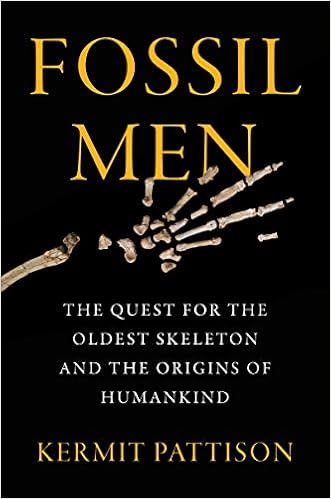 In 1994, a team led by fossil-hunting legend Tim White—”the Steve Jobs of paleoanthropology”—uncovered the bones of a human ancestor in Ethiopia’s Afar region. Radiometric dating of nearby rocks indicated the skeleton, classified as Ardipithecus ramidus, was 4.4 million years old, more than a million years older than “Lucy,” then the oldest known human ancestor. The findings challenged many assumptions about human evolution—how we started walking upright, how we evolved our nimble hands, and, most significantly, whether we were descended from an ancestor that resembled today’s chimpanzee—and repudiated a half-century of paleoanthropological orthodoxy. FOSSIL MEN is the first full-length exploration of Ardi, the fossil men who found her, and her impact on what we know about the origins of the human species. It is a scientific detective story played out in anatomy and the natural history of the human body. Kermit Pattison brings into focus a cast of eccentric, obsessive scientists, including one of the world’s greatest fossil hunters, Tim White—an exacting and unforgiving fossil hunter whose virtuoso skills in the field were matched only by his propensity for making enemies; Gen Suwa, a Japanese savant who sometimes didn’t bother going home at night to devote more hours to science; Owen Lovejoy, a onetime creationist-turned-paleoanthropologist; Berhane Asfaw, who survived imprisonment and torture to become Ethiopia’s most senior paleoanthropologist and who fought for African scientists to gain equal footing in the study of human origins; and the Leakeys, for decades the most famous family in paleoanthropology.
“An entertaining update on a process as ‘red in tooth and claw’ as nature itself… Pattison delivers a gripping and reasonably balanced account… Big personalities, simmering turmoil, and fascinating popular science.” —Kirkus, starred review
Kermit Pattison is a journalist whose work has appeared in the New York Times, GQ, Fast Company, and Inc., among many other publications. He spent more a decade doing research for FOSSIL MEN, a large portion of which was spent in the field in Ethiopia with the team that discovered Ardi. This is his first book. He lives in St. Paul, Minnesota.
 In 1932, Roy Chapman Andrews, president of the men-only Explorers Club, boldly stated to hundreds of female students at Barnard College that “women are not adapted to exploration,” and that women and exploration do not mix. He obviously didn’t know a thing about either… THE GIRL EXPLORERS is the inspirational and untold story of the founding of the Society of Women Geographers—an organization of adventurous female world explorers—and how key members served as early advocates for human rights and paved the way for today’s women scientists by scaling mountains, exploring the high seas, flying across the Atlantic, and recording the world through film, sculpture, and literature. Follow in the footsteps of these rebellious women as they travel the globe in search of new species, widen the understanding of hidden cultures, and break records in spades. For these women dared to go where no woman—or man—had gone before, achieving the unthinkable and breaking through barriers to allow future generations to carry on their important and inspiring work. THE GIRL EXPLORERS is an inspiring examination of forgotten women from history, perfect for fans of bestselling narrative history books like The Radium Girls, The Woman Who Smashed Codes, and Rise of the Rocket Girls.
 In 2017 acclaimed journalist Alexander Wolff moved to Berlin to ta explore the lives of his exile grandfather Kurt Wolff and émigré father Niko Wolff—two part-Jewish, German-born men who became American citizens. Kurt Wolff broke into the book business in 1909 as partner of Ernst Rowohlt in Leipzig; four years later, at age 26, he went out on his own, publishing Franz Kafka, Heinrich Mann, Franz Werfel, Joseph Roth, and other writers whose books would be burned by the Nazis. Just after the Reichstag fire in 1933, he and his wife Helen fled to France and Italy, and eight years later in New York they founded Pantheon Books, which went on to publish
 In illness, Bauer provides a surprising new lens through which to consider all of human history—she argues that bodily sickness and our conception of it has shaped our culture, our philosophies, and our religions, and has directly and indirectly affected how we view others, how we view ourselves, and how we fashion our world. She argues that sickness is the great mirror that reflects back our most urgent and eternal questions: Why does calamity descend without warning? How can we explain it? And how do we fight back? Told in a propulsive narrative style that brings sweeping history to life through intimate individual stories—the feverish Mesopotamian sufferer; the plague victim who dies alone, the last in his village; the seventeenth-century teenager racked by smallpox; the Congolese grandmother watching her family die of Ebola—Bauer takes readers on a journey from humans’ earliest days when sickness was an unsolvable mystery, evidence that humans were powerless to the unseen forces of gods, to more modern times and the birth of germ theory, when secularism grew alongside our fear of contamination. A multidisciplinary human history like no other, BONES, BLOOD, BREATH is a big think book that tells a large-scale, vivid, chronological story, stretching around the world from ancient times until the present—it will change the way we understand who we are.