
How we become who we are
WIE WERDEN WER WIR SIND
by Joachim Bauer
Blessing, publication Mai 2019
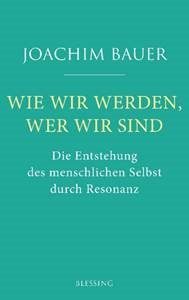 Why there is no me without you – the new major book by bestselling author Joachim Bauer.
Recent neuroscientific research indicates that human beings are born without a self. But how do we develop this « self », this « me » that can later define itself as distinct from others? How do we manage to think and feel in terms of me, you or we? What makes a human being into an individual? These are the central questions Joachim Bauer examines in his new major work, in which he demonstrates that our « true self » does not slumber within us like some natural resource waiting to be found and polished. It is rather the product of our encounters and relationships with others – experiences, joys and fears we share. Joachim Bauer makes us realise that this « me », in contrast to what had long been thought, is not engraved in stone but instead is a process of perpetual self-construction and life-long transition and can grow and change.
In an age of rampant egocentricity and social currents forcing us to assert ourselves by erecting a border between our own self and others, Bauer has drawn a new image of how we become who we are and explains why we can only find this path if we tread it together.
Also by Joachim Bauer, Selbsteuerung, the re-discovery of free will. blessing, May 2015
Self-control is an ability that in the world we live in is a prerequisite for professional success, happy relationships, and psychological and physical health. Those of us with selfcontrol– in other words, people who are in a position to postpone the short-term satisfaction of personal needs in favour of long-term advantages – don’t fall victim to unhealthy eating habits and lack of exercise; they don’t spend too much time in front of the television or computer screens and are not at risk of addiction. This book makes it clear how self-control works, why it is so important for a successful life and what we can do to relearn what we have forgotten. Joachim Bauer emphasises that abstinence, putting off wants and consciously tackling problems are by no means unnatural forms of self-castigation. In fact, the contrary is true: the ability to learn self-control is inherent in human beings. If it is to develop, we have to practice it from an early age – an observation that radically runs counter to the idea of children not having to make an effort, of perpetually being « enthusiastic ».
Joachim Bauer is a university teacher and professor at the University of Freiburg. He is a doctor of internal medicine, psychosomatic medicine, psychiatry and psychotherapy. For his research work, he was awarded the renowned Organon Prize of the German Society for Biological Psychiatry.Spiegel bestselling author: More than 700,000 copies of his books sold.
 In THE VOYAGE OF SORCERER II, Venter and science writer David Ewing Duncan tell the remarkable story of these expeditions and of the momentous discoveries that ensued―of plant-like bacteria that get their energy from the sun, proteins that metabolize vast amounts of hydrogen, and microbes whose genes shield them from ultraviolet light. The result was a massive library of millions of unknown genes, thousands of unseen protein families, and new lineages of bacteria that revealed the unimaginable complexity of life on earth. Yet despite this exquisite diversity, Venter encountered sobering reminders of how human activity is disturbing the delicate microbial ecosystem that nurtures life on earth. In the face of unprecedented climate change, Venter and Duncan show how we can harness the microbial genome to develop alternative sources of energy, food, and medicine that might ultimately avert our destruction.
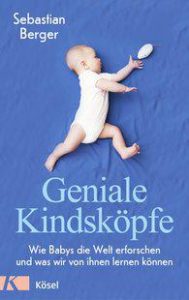 Babies truly are miracles in learning: Sebastian Berger introduces us to the fascinating world of early infant learning, describes the development in the brain areas that enable learning, and gives insights into the respective cognitive research. He shows that babies not only learn much faster than adults, but