
From an award-winning writer whose work Roxane Gay calls “utterly unique and remarkable” comes a surreal novel about a woman in Silicon Valley who must decide how much she’s willing to give up for success—for fans of My Year of Rest and Relaxation and Her Body and Other Parties.
RIPE
by Sarah Rose Etter
Scribner, July 2023
(via Neon Literary)
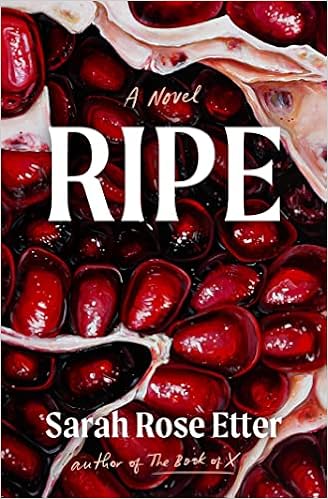 A year into her dream job at a cutthroat Silicon Valley start-up, Cassie finds herself trapped in a corporate nightmare. Between the long hours, toxic bosses, and unethical projects, she also struggles to reconcile the glittering promise of a city where obscene wealth lives alongside abject poverty and suffering. Ivy League grads complain about the snack selection from a conference room with a view of houseless people bathing in the bay. Start-up burnouts leap into the paths of commuter trains, and men literally set themselves on fire in the streets.
Though isolated, Cassie is never alone. From her earliest memory, a miniature black hole has been her constant companion. It feeds on her depression and anxiety, growing or shrinking in relation to her distress. The black hole watches, but it also waits. Its relentless pull draws Cassie ever closer as the world around her unravels.
When her CEO’s demands cross an illegal threshold and she ends up unexpectedly pregnant, Cassie must decide whether the tempting fruits of Silicon Valley are really worth it. Sharp but vulnerable, funny yet unsettling, RIPE portrays one millennial woman’s journey through our late-capitalist hellscape and offers a brilliantly incisive look at the absurdities of modern life.
« Sarah Rose Etter is a wonder, and this novel is a knife to the heart. » —Carmen Maria Machado, author of Her Body and Other Parties
« RIPE is exactly the kind of book I want to read: astoundingly bold, terrifically haunting, and deeply human. Etter refuses to pull any punches here, asking us to look directly at the nightmares we sometimes agree to live with in exchange for comfort and security. Reading this book felt like pressing repeatedly on a bruise; the most pleasurable kind of pain. Ripe is a dazzlingly gorgeous novel and Sarah Rose Etter is truly one hell of a writer. » —Kristen Arnett, New York Times bestselling author of Mostly Dead Things
Sarah Rose Etter is the author of the chapbook Tongue Party and The Book of X, winner of a Shirley Jackson Award for best novel. Her work has appeared in Time, Guernica, BOMB, the Bennington Review, The Cut, VICE, and elsewhere. She has been awarded residences at the Jack Kerouac House, the Disquiet International program in Portugal, and the Gullkistan in Iceland. She earned her BA in English from Pennsylvania State University and her MFA in fiction from Rosemont College. She lives in Los Angeles.
 YONNONDIO follows the heartbreaking path of the Holbrook family in the late 1920s and the Great Depression as they move from the coal mines of Wyoming to a tenant farm in western Nebraska, ending up finally on the kill floors of the slaughterhouses and in the wretched neighborhoods of the poor in Omaha, Nebraska.
 DEMON COPPERHEAD is the story of a boy born to a teenaged single mother in a single-wide trailer, with no assets beyond his dead father’s good looks and copper-colored hair, a caustic wit, and a fierce talent for survival. In a plot that never pauses for breath, relayed in his own unsparing voice, he braves the perils of foster care, child labor, derelict schools, athletic success, addiction, disastrous loves, and crushing losses. A modern retelling of Dickens’s David Copperfield, which transposes that epic novel, chapter by chapter, to a modern place and time: the American south.
 In stories that beckon and haunt, FRUITING BODIES ranges confidently from the fantastical to the gothic to the uncanny as it follows characters—mostly queer, mostly women—on the precipice of change. Echoes of timeless myth and folklore reverberate through urgent narratives of discovery, appetite, and coming-of-age in a time of crisis.
 A young woman puts on a white coat for her first day as a student doctor. So begins this powerful debut, which follows our unnamed narrator through cadaver dissection, surgical rotation, difficult births, sudden deaths, and a budding relationship with a seminarian. In the troubled world of the hospital, where the language of blood tests and organ systems so often hides the heart of the matter, she works her way from one bed to another, from a man dying of substance use and tuberculosis, to a child in pain crisis, to a young woman, fading from confusion to aphasia to death. The long hours and heartrending work begin to blur the lines between her new life as a physician and the lifelong traumas she has fled.