
A behind-the-scenes account of the shocking discovery of the skeleton of “Ardi,” a human ancestor far older than Lucy—a find that shook the world of paleoanthropology and radically altered our understanding of human evolution. FOSSIL MEN is popular science at its best, and a must read for fans of Jared Diamond, Richard Dawkins, and Edward O. Wilson.
FOSSIL MEN:
The Quest for the Oldest Skeleton and the Origins of Humankind
by Kermit Pattison
William Morrow/HarperCollins, June 2020
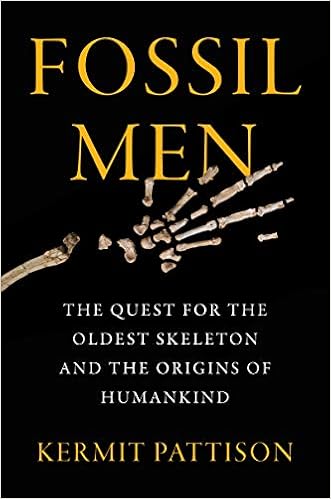 In 1994, a team led by fossil-hunting legend Tim White—”the Steve Jobs of paleoanthropology”—uncovered the bones of a human ancestor in Ethiopia’s Afar region. Radiometric dating of nearby rocks indicated the skeleton, classified as Ardipithecus ramidus, was 4.4 million years old, more than a million years older than “Lucy,” then the oldest known human ancestor. The findings challenged many assumptions about human evolution—how we started walking upright, how we evolved our nimble hands, and, most significantly, whether we were descended from an ancestor that resembled today’s chimpanzee—and repudiated a half-century of paleoanthropological orthodoxy. FOSSIL MEN is the first full-length exploration of Ardi, the fossil men who found her, and her impact on what we know about the origins of the human species. It is a scientific detective story played out in anatomy and the natural history of the human body. Kermit Pattison brings into focus a cast of eccentric, obsessive scientists, including one of the world’s greatest fossil hunters, Tim White—an exacting and unforgiving fossil hunter whose virtuoso skills in the field were matched only by his propensity for making enemies; Gen Suwa, a Japanese savant who sometimes didn’t bother going home at night to devote more hours to science; Owen Lovejoy, a onetime creationist-turned-paleoanthropologist; Berhane Asfaw, who survived imprisonment and torture to become Ethiopia’s most senior paleoanthropologist and who fought for African scientists to gain equal footing in the study of human origins; and the Leakeys, for decades the most famous family in paleoanthropology.
“An entertaining update on a process as ‘red in tooth and claw’ as nature itself… Pattison delivers a gripping and reasonably balanced account… Big personalities, simmering turmoil, and fascinating popular science.” —Kirkus, starred review
Kermit Pattison is a journalist whose work has appeared in the New York Times, GQ, Fast Company, and Inc., among many other publications. He spent more a decade doing research for FOSSIL MEN, a large portion of which was spent in the field in Ethiopia with the team that discovered Ardi. This is his first book. He lives in St. Paul, Minnesota.
 What if Elizabeth Macarthur—wife of the notorious John Macarthur, wool baron in the earliest days of Sydney—had written a shockingly frank secret memoir? And what if novelist Kate Grenville had miraculously found and published it? That’s the starting point for A Room Made of Leaves, a playful dance of possibilities between the real and the invented.
 THE RED ARROW follows an unnamed narrator, a failed novelist deeply in debt to his publisher, on a high-speed train from Rome to Modena, where he is desperate to find the famous Italian physicist whose memoir he’s been ghostwriting, and an whose disappearance in the middle of the project has threatened the narrator and his newly formed family with financial ruin. Moving swiftly and seamlessly through his past—including a chemical spill in West Virginia, a failed New York art career, psychedelic therapy in California, and a luxury beach resort in Sicily—THE RED ARROW contains multitudes: it is at once one of the most authentic descriptions of the experience of depression I’ve ever read, and a joyously earnest celebration of freedom from the toxic power of the ego; a spiraling meditation on time, memory, and the nature of the self; and a novel with the ineffable mystery of a poem, one whose originality lies in admitting that it’s not original at all. For we are each just a cloud of quotations with no fixed center—or, as the Physicist might put it, we are nothing more than interactions, like subatomic particles—and when we’re finally able to let go of the fiction of our discrete selves, all that is left is love.
 Anna Obata is a biracial teenager living in economically depressed Southern Japan just before the millennium. Left to fend for herself (and to look after her increasingly senile Grandfather) Anna copes with her devastating loneliness by calling upon her strongest inner resource: imagination. This is the story of girl who falls in love with a satellite, yes—but it is also the story of how the human mind attempts to repair itself, no matter the cost, no matter the odds. Told in alternating perspectives by Anna, the satellite, and several others, SATELLITE LOVE is exquisitely strange and refreshingly unconventional.