
From one of the brightest and most acclaimed new lights in YA fiction, a fantastic new novel about a bi Black boy finding first love… and facing the return of the mother who abandoned his preacher family when he was nine.
THINGS WE COULDN’T SAY
by Jay Coles
Scholastic, September 2021
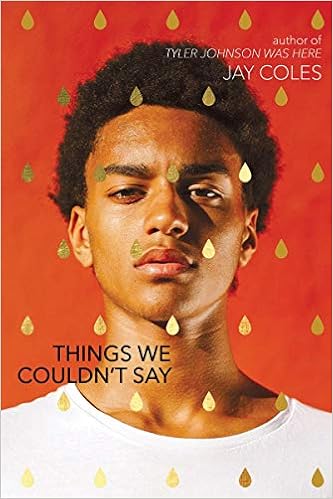 There’s always been a hole in Gio’s life. Not because he’s into both guys and girls. Not because his father has some drinking issues. Not because his friends are always bringing him their drama. No, the hole in Gio’s life takes the shape of his birth mom, who left Gio, his brother, and his father when Gio was nine years old. For eight years, he never heard a word from her . . . and now, just as he’s started to get his life together, she’s back. It’s hard for Gio to know what to do. Can he forgive her like she wants to be forgiven? Or should he tell her she lost her chance to be in his life? Complicating things further, Gio’s started to hang out with David, a new guy on the basketball team. Are they friends? More than friends? At first, Gio’s not sure . . . especially because he’s not sure what he wants from anyone right now. There are no easy answers to love— whether it’s family love or friend love or romantic love. In THINGS WE COULDN’T SAY, Jay Coles, acclaimed author of Tyler Johnson Was Here, shows us a guy trying to navigate love in all its ambiguity—hoping at the other end he’ll be able to figure out who is and who he should be.
Jay Coles is a graduate of Vincennes University and Ball State University. When he’s not writing diverse books, he’s advocating for them, teaching middle school students, and composing for various music publishers. His debut novel Tyler Johnson Was Here is based on true events in his life and inspired by police brutality in America. He resides in Indianapolis, Indiana.
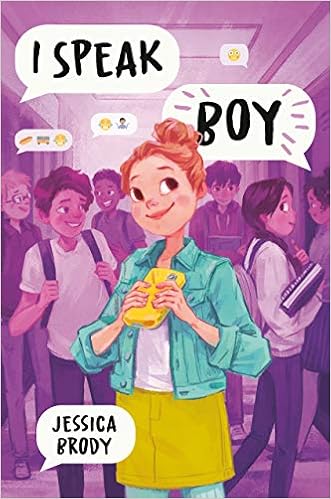 After a matchmaking attempt for her best friend, Harper, goes horribly, embarrassingly wrong, Emmy is fed up. Why are boys so hard to figure out? But then something amazing happens . . . she wakes up with a new app on her phone: iSpeak Boy! Suddenly Emmy has access to the super-secret knowledge of how boys think—and who they like! Now Emmy is using her magical app to make matches left and right. But can she use it to help Harper, the only person who doesn’t seem to buy into Emmy’s “gift”? And when her secret gets out and the app ends up in the wrong hands, can Emmy undo all the damage she’s caused? From the author of
  The smartphone. How could a small device have become so life-defining so quickly? Can we change this situation without having to do without too many things? Christoph Koch says, yes, we can. For many years he has been dealing with the topics of internet abstinence and online addiction. With scientifically supported findings, he explains what is behind all this. Why are apps so addicting? What is happening in the brain? Why is almost no one resistant to it? Which business models are based on this? And what do experts say? Koch’s 30-day challenge shows why it is worth reducing online consumption and how one can benefit both physically and mentally through a more aware interaction with digital media. Motivating, entertaining, easy to implement – a guide for creating a digital balance.
 The nose sits in the middle of the face, yet most people know surprisingly little about it. Yet our ENT department manages a large part of our perception – apart from breathing. Next to the eyes, the nose, ears and throat form our most important connection to the outside world. Dr. Christine Löber explains in best pop science manner how smelling works, where the voice comes from and why cotton swabs have no place in the ear. She makes us impressively aware of the influence the ENT area has on our psyche. And she gives tips on how to keep the throat, nose and ears healthy. The great knowledge book about the throat, nose and ears.
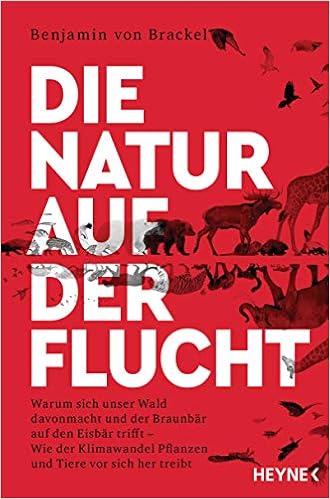 There is something afoot in the world of animals and plants, something which has so far caught too little attention. Wherever they can, animals and plants are moving towards the earth’s poles to flee from rising temperatures and drought in their natural habitats. Tropical zones lose their inhabitants, beavers are settling in Alaska, gigantic shoals of fish disappear just to reappear in front of foreign coastlines. Sea creatures move an average of 72 kilometres a year, land creatures an average of 17 kilometres. In this exciting and vivid book, Benjamin von Brackel describes a phenomenon which demonstrates nature’s impressive adaptability as well as the dramatic consequences of climate change – not the least for humankind, for the migration of species won’t leave us unaffected.