
Told as an unfolding detective story, WATER ALWAYS WINS by award-winning science journalist Erica Gies follows experts who are obsessed with water as they use close observation, historical research, ancient animal and human expertise and cutting-edge science to understand how water really works, why efforts to control it are failing and how to create more resilient water systems in the urgent race to mitigate the catastrophic effects of climate change.
WATER ALWAYS WINS:
Collaborating with Nature for a More Resilient Future
by Erica Gies
University of Chicago Press, 2022
 WATER ALWAYS WINS makes clear that we need to fundamentally rethink our relationship with water. We must embrace the reality that we are an integral part of nature and need learn to live in harmony with these forces that we cannot conquer. This requires humility, not arrogance; collaboration, not aggressive control and setting a goal, which is to determine what water wants and figure out a how to make way for it, while protecting and securing our lives. The overarching theme is that such a mindset is essential in all our dealings with every aspect of nature, if we want our planet to survive. As Erica Gies so beautifully states, water is life, it “flexes with the rhythms of the earth, expanding and retreating in an eternal dance upon the land.”
WATER ALWAYS WINS follows the scientists and engineers who are recovering this lost knowledge and also new understanding of water and then finding ways to let water be water, a kind of un-engineering that reclaims space for water to stall on the land for cleaning, capture, and storage – a “slow water” ethic with many of the same attributes as the slow food movement. WATER ALWAYS WINS takes us along on this great journey, from Peru, where scientists are restoring a 1,500-year-old aqueduct system created by a pre-Incan civilization to Chennai, India, where the technology of ancient Dravidian temple tanks is being introduced to control flooding to San Francisco, where urban planners are mapping the original “ghost” waterways under the city to find improved methods of water management. Animal researchers are studying the ways creatures from beavers (who built a continuous dam twice as long as the Hoover dam) to elephants naturally “engineer” water systems that renew and replenish the land.
This is a riveting and eye-opening “big idea” book that will do for water what The Hidden Life of Trees did for forests or what The Sixth Extinction did for animal genocide.
Erica Gies is the perfect person to write this book. She is an independent journalist who writes about water, climate policy, urban planning, plants and animals for Scientific American, Nature, The New York Times, The Guardian, National Geographic, The Economist, with a proven track record of bringing science alive for the general public. Erica has appeared on NPR’s Science Friday and they are eager to have her on when the book comes out. She holds a master’s degree in literature with a focus in eco-criticism, which brings a wide-angle, narrative lens to her science reporting.
 This was the grim reality that Ann Burgess, then a doctoral graduate with a degree in psychiatric nursing, found when she decided to get involved in the study of rape and sexual assault, choosing a topic that few others saw as worth the trouble. But what she called the complete “absence of understanding” surrounding this urgent issue left her no choice. Fortunately, she connected with a medical sociologist, Lynda Lytle Holmstrom, with whom Ann created the first ever formalized study of rape from the victim’s perspective, and through countless interviews with rape survivors ultimately proved that rape is more about dominance and control than sex. The impact of this early work was groundbreaking. It led to the development of the first rape crisis centers, created new police standards, and resulted in an increase in rape trials with outcomes that favored the victim. It also captured the attention of the FBI Academy, leading Burgess to become one of the first female consultants hired by the agency.
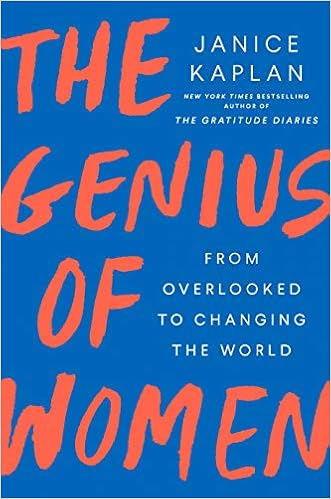 Even in this time of rethinking women’s roles, we define genius almost exclusively through male achievement. When asked to name a genius, people mention Albert Einstein, Leonardo da Vinci, and Steve Jobs. As for great women? In one survey, the only female genius anyone listed was Marie Curie. Janice Kaplan, the New York Times bestselling author of The Gratitude Diaries, set out to determine why the extraordinary work of so many women has been brushed aside. Using her unique mix of memoir, narrative, and inspiration, she makes surprising discoveries about women geniuses now and throughout history, in fields from music to robotics. Through interviews with neuroscientists, psychologists, and dozens of women geniuses at work in the world today—including Nobel Prize winner Frances Arnold and AI expert Fei-Fei Li—she proves that genius isn’t just about talent. It’s about having that talent recognized, nurtured, and celebrated. Across the generations, even when they face less-than-perfect circumstances, women geniuses have created brilliant and original work. In THE GENIUS OF WOMEN, you’ll learn how they ignored obstacles and broke down seemingly unshakable barriers. The geniuses in this moving, powerful, and very entertaining book provide more than inspiration—they offer a clear blueprint to everyone who wants to find her own path and move forward with passion.
  Most of us do not give much thought to the centerpiece of our bathrooms, but the toilet is an unexpected paradox. On the one hand, it is a modern miracle: a ubiquitous fixture in a vast sanitation system that has helped add decades to human lifespan by reducing disease. On the other hand, the toilet is also a tragic failure: less than half of the world’s population can access a toilet that safely manages bodily waste, including many right here in the United States. And it is inefficient, squandering clean water as well as the nutrients and energy contained in the waste we flush away. While we see radical technological change in almost every other aspect of our lives, we remain stuck in a sanitation status quo—in part because the topic of toilets is taboo. Fortunately, there’s hope—and PIPE DREAMS daringly profiles the growing army of scientists, engineers, philanthropists, entrepreneurs, and activists worldwide who are overcoming their aversions and focusing their formidable skills on making toilets accessible and healthier for all. This potential revolution in sanitation has many benefits, including reducing inequalities, mitigating climate change and water scarcity, improving agriculture, and optimizing health. Author Chelsea Wald takes us on a wild world tour from a compost toilet project in Haiti, to a plant in the Netherlands that harvests used toilet paper from sewage, and shows us a bot that hangs out in manholes to estimate opioid use in a city, among many other fascinating developments. Much more than a glorified trash can, the toilet, Wald maintains, holds the power to help solve many of the world’s problems, if only we can harness it.
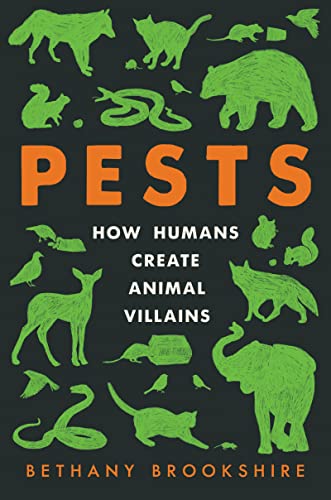 A squirrel in the garden. A rat in the wall. A pigeon on the street. Humans have spent so much of our history drawing a hard line between human spaces and wild places. When animals pop up where we don’t expect or want them, we respond with fear, rage, or simple annoyance. It’s no longer an animal. It’s a pest.