
Why are some people more susceptible to bad ideas and others are more capable of repelling them?
MENTAL IMMUNITY:
Infectious Ideas, Mind Parasites, and the Search for a Better Way to Think
by Andy Norman
HarperWave, May 2021
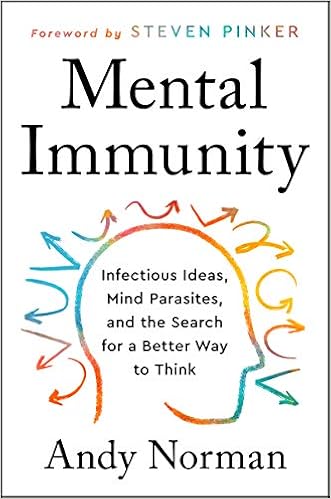 Andy Norman has spent years studying the destructive forces that can flip the minds of sensible people to understand how they take hold. He calls them mind-parasites, ideas that can poison our thinking and leave us more susceptible to wild conspiracies, lead us to reject scientific evidence, and convince us to double down on unfounded beliefs. Just as the body can be weakened by foreign organisms that make us sick, the mind too is vulnerable to infection. But just as antibiotics can be used to attack the biological organisms causing physical illness, we can treat the mind parasites that invade our heads. He shows us how to engage in productive discussion, analyzes the psychological evidence about how to change minds, and reveals how we can safeguard ourselves and protect those around us from mind-parasites like conspiracies and fake news. In MENTAL IMMUNITY Andy Norman calls for the study of cognitive immunology, a way of thinking where individuals and society learn to differentiate facts and reasons from disinformation and false memes. By strengthening our mental immunity, we become open to other ideas and learn how better to communicate about beliefs and policy without dissolving into partisan finger-pointing. Norman offers suggestions to create a value- and respect-based system of dialogue that can help us bolster cultural cognitive immunity as we protect our own minds from succumbing to bad ideas.
Steven Pinker will write the foreword and has already said that this is “a splendid idea for a book: original, controversial, and timely.”
Andy Norman teaches philosophy and directs the Humanism Initiative at Carnegie Mellon University. His work has appeared in Free Inquiry, Essays in the Philosophy of Humanism, and dozens of other journals.
 Netflix vient d’acquérir les droits audiovisuels des trois romans de Jenna Evans Welch publiés chez Simon Pulse aux États-Unis : LOVE & GELATO, LOVE & LUCK et LOVE & OLIVES, tous les trois des New York Times Bestsellers. C’est le scénariste et producteur Brandon Camp (Coup de foudre à Seattle, 2009 ; Benji, 2018) qui écrira, réalisera et produira les trois adaptations. Aucune date n’a été annoncée pour l’instant.
 Magnolia Moon is nine years old, likes Greek mythology, her best friend Imogen May (who understands the importance of questions like, “If you could be one fruit, any fruit, what would you be?”), wishing trees, and speaking crows. She knows instinctively that buffadillos are armadillos crossed with buffalos and believes there are walramingos living in her garden. She’s also the kind of person who can be entrusted with a great many secrets.
 In the near future, after the internet grinds to a halt amid a wave of cyber-attacks, a company named Zodiac steps in to replace it with an evolved, augmented-reality version called The Grid. Harrigan, a hard-drinking private detective living as off-Grid as possible, is about to be evicted from his apartment when a stranger shows up asking for his help in finding Anna, an escort who he claims he’s desperately in love with. Turns out that through Harrigan’s new client, Anna has come into possession of a program/entity called Mirror, Mirror, which has the capacity to merge The Grid and reality, bending both to the whims of the program’s user. Soon Harrigan finds himself up against the last surviving organized crime gangs in Los Angeles, Zodiac’s mercenaries, and a mysterious group called The First Church Multiverse, all of whom are hot on the trail of Mirror, Mirror – if the comet rapidly approaching Earth doesn’t kill them all first.