
The Druid Peak Pack was the most famous wolf pack in Yellowstone National Park, and maybe even in the world. This is the dramatic true story of its remarkable leader, Wolf 21.
THE REIGN OF WOLF 21
by Rick McIntyre
Greystone, September 2020 (voir catalogue)
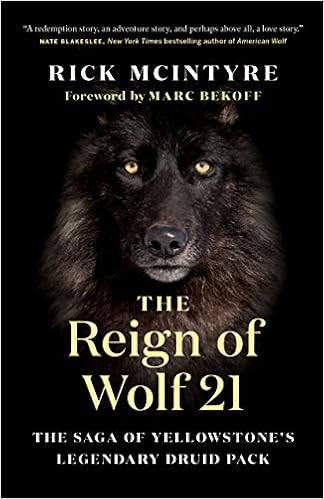 In this compelling follow-up to the national bestseller The Rise of Wolf 8, Rick McIntyre profiles one of Yellowstone’s most revered alpha males, Wolf 21. Leader of the Druid Peak Pack, Wolf 21 was known for his unwavering bravery, his unusual benevolence (unlike other alphas, he never killed defeated rival males), and his fierce commitment to his mate, the formidable Wolf 42. Wolf 21 and Wolf 42 were attracted to each other the moment they met—but Wolf 42’s jealous sister interfered viciously in their relationship. After an explosive insurrection within the pack, the two wolves came together at last as leaders of the Druid Peak Pack, which dominated the park for more than 10 years. McIntyre recounts the pack’s fascinating saga with compassion and a keen eye for detail, drawing on his many years of experience observing Yellowstone wolves in the wild. His outstanding work of science writing offers unparalleled insight into wolf behavior and Yellowstone’s famed wolf reintroduction project. It also offers a love story for the ages.
“Like Thomas McNamee, David Mech, Barry Lopez, and other literary naturalists with an interest in wolf behavior, McIntyre writes with both elegance and flair, making complex biology and ethology a pleasure to read. Fans of wild wolves will eat this one up.” —Kirkus starred review
Rick McIntyre has spent more than fifty years watching wolves in America’s national parks, twenty-five of those years in Yellowstone, where he has accumulated over 100,000 wolf sightings and educated the public about the park’s most famous wolves. He has spoken about the Yellowstone wolves with 60 Minutes, NPR, and CBC, and he is profiled extensively in Nate Blakeslee’s American Wolf and in international publications. He lives in Silver Gate, Montana.
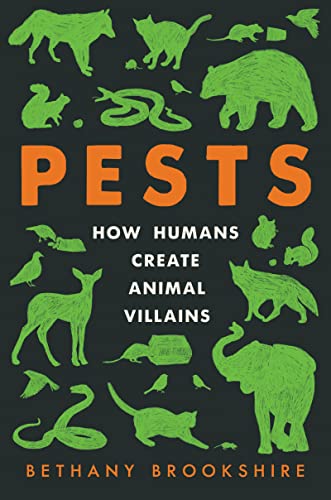 A squirrel in the garden. A rat in the wall. A pigeon on the street. Humans have spent so much of our history drawing a hard line between human spaces and wild places. When animals pop up where we don’t expect or want them, we respond with fear, rage, or simple annoyance. It’s no longer an animal. It’s a pest.
 A return trip to the South Pole is an impossible dream for many of us – but the medic Carmen Possnig did just that. On behalf of the European Space Agency, she spent a year in the heart of the Antarctica to find out what it’s like to live in extreme weather conditions, with a distinct lower level of oxygen and in complete isolation from the rest of the world. With twelve other scientists, she spent the winter at the Concordia research station in the eternal ice. There, she not only encountered the breathtaking beauty of the most extreme continent on Earth, but also her own limits: Sharing a tight space with other people for twelve months, in a world that remains dark for months on end and where the temperature drops to -80°C, requires a huge physical and mental effort. Carmen Possnig’s personal and witty travel report, and its wealth of photographs, opens up a window onto an alien world – making us marvel at our planet’s diversity, and at how adaptable human nature can be.
 Six days after giving birth, a polar bear named Aurora got up and left her den at the Columbus Zoo, leaving her tiny, squealing cub to fend for herself. Hours later, Aurora still hadn’t returned. The cub was furless and blind, and with her temperature dropping dangerously, the zookeepers entrusted with her care felt they had no choice: They would have to raise one of the most dangerous predators in the world themselves, by hand. Over the next few weeks, a group of veterinarians and zookeepers would work around the clock to save the cub, whom they called Nora. Humans rarely get as close to a polar bear as Nora’s keepers got with their fuzzy charge. But the two species have long been intertwined. Three decades before Nora’s birth, her father, Nanuq, was orphaned when an Inupiat hunter killed his mother, leaving Nanuq to be sent to a zoo. That hunter, Gene Agnaboogok, now faces some of the same threats as the wild bears near his Alaskan village of Wales, on the westernmost tip of the North American continent. As sea ice diminishes and temperatures creep up year-after-year, Gene and the polar bears—and everyone and everything else living in the far north—are being forced to adapt. Not all of them will succeed. Sweeping and tender, THE LONELIEST POLAR BEAR explores the fraught relationship humans have with the natural world, the exploitative and sinister causes of the environmental mess we find ourselves in, and how the fate of polar bears is not theirs alone.
 Working through a year in the garden of a large country estate, a gardener explores the path that led him there. His days are spent with the magnolias and roses, moths and beetles and the distant lady who has employed him for the past thirty years. A broken biographical telling of the journey, mythology and poetry of an outcast boy who just wanted to be somebody’s flower, to an old man who has and is everything that he wants. Intimate, moving and full of beauty, Marc’s meditative prose fills the heart with an appreciation for the life we live, making SEED TO DUST the perfect companion for his critically-acclaimed first book, HOW TO CATCH A MOLE.