
What happens to us when our home becomes a financial bargaining chip?
UNSER GLÜCK
(Our Good Fortune)
by Natalie Buchholz
Penguin Germany/PRH Verlagsgruppe, February 2022
 When the young parents Franziska and Coordt find a lovely – and affordable – flat in one of Munich’s best neighbourhoods, it’s the opportunity of a lifetime. But there’s a condition attached: it won’t be just them and their small boy living there. Tempted by the chance of owning their own home, and one they wouldn’t otherwise be able to afford, they agree to a deal that will put their love to the test. Like a catalyst, the new flat accelerates and deepens existing cracks in their relationship, and their son, too, is aware of the increasing friction between them. A once-in-a-lifetime opportunity has turned out to be a trap. Will they find a way out?
Natalie Buchholz has created an irresistible story, written in clear, rhythmic prose. A novel set up like an experiment, showing the freedom that improved living conditions can bring – and the destructive power of financial pressure.
Natalie Buchholz, born in France in 1977, studied Cultural Studies and Aesthetic Practice at the University of Hildesheim and at the Université Aix-Marseille. In 2018, her debut novel The Red Swimming Pool was published. In 2020 she was awarded the Spiegelungen Prize for minimal prose.
 A stinging, elegiac snapshot of contemporary Los Angeles, told, you guessed it, from the perspective of a queer, dangerously hungry mountain lion, isolated and struggling to survive in a drought-devastated Griffith Park. As it protects the precarious welfare of a nearby homeless encampment from its thicket, it confronts a carousel of temptations and threats, taking us on a tour that spans the city’s cruel inequalities to the toll of climate grief, all while grappling with the complexities of its own gender identity and memories of a vicious, absent father.
 All the world is a puzzle, and 28-year-old Mike Brink—a celebrated and ingenious puzzle constructor—understands its patterns like no one else. Once a promising football star, he was transformed by a traumatic brain injury that caused a rare (but real) medical condition: Sudden Acquired Savant Syndrome. The injury left him with a mental superpower—he can solve puzzles, calculate equations, and see patterns in ways the rest of us can’t. But his condition has also left him damaged: he feels deeply isolated because of his talent, and unable to fully connect with other people. Puzzle-solving has become Mike Brink’s only way to manage his gift and maintain emotional well-being.
 On a river deep in the Mexican jungle stands the colossal villa Xanadu, a retreat center that’s home to The Mandala, an ardent spiritual group devoted to self-help guru Paul Bentzen and his enigmatic wife Kali. But when, mysteriously, Paul suddenly dies, his entire estate—including Xanadu—is left to his estranged niece Sveta, a former model living in New York City.
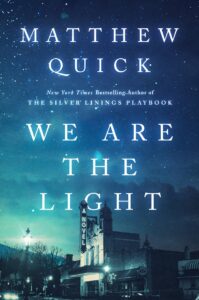 Lucas Goodgame lives in a small town in Pennsylvania, a community that has been torn apart by a recent tragedy at the local movie house. Everyone in town sees Lucas as a hero—everyone, that is, except Lucas himself. Lucas spends his time writing letters to his former Jungian analyst Karl, and he insists that his deceased wife Darcy visits him every night in the form of an angel. It is only when 18-year-old Eli, a young man who the community has ostracized, begins camping out in Lucas’s backyard that an unlikely alliance forms and the two begin a journey to heal their neighbors and, most importantly, themselves.