
World War I is raging overseas while the home front battles the Spanish Flu. Schools are converted into hospitals, churches and funeral homes are closed, and the dead are left on the streets to be picked up nightly by horse drawn wagons collecting corpses. But are they all truly victims of the flu?
LITTLE SOULS
by Sandra Dallas
St. Martin’s Press, Winter 2022
 Sisters Helen and Lutie moved to Denver from Iowa after their parents died. Helen, the oldest and a nurse, and Lutie, a carefree advertising designer, share a small, neat house and make a modest income from a rental apartment in the basement. But when their tenant dies from the flu, Helen and Lutie are thrust into much more than a sad family drama. There is no safe place for a wayward child in the midst of the epidemic, so the sisters are forced to take in the woman’s small daughter. Dorothy is a shy girl who tries to hide the bruises on her body and who shuts down at any mention of her absent father. They shower her with kindness and love and the three soon feel like a new family, albeit a temporary one. But then everything shatters. Lutie comes home from work and discovers a dead man on their kitchen floor and Helen standing above the body with an icepick in hand. Lutie has no doubt Helen killed the man—Dorothy’s father—defending herself or the little girl, but she knows that will be hard to prove. So when Helen’s doctor boyfriend arrives, a pact is made to protect the nurse at all costs. And this will not be the only secret they have to keep as the war and the flu knock relentlessly on their door.
Set against the backdrop of an epidemic that feels so familiar now, LITTLE SOULS is a powerful tale of sisterhood and of the sacrifices people make to protect those they love most.
Sandra Dallas is New York Times best-selling author of sixteen adult novels, four children’s novels, and two non-fiction books. Sandra’s novels with their themes of loyalty, friendship, and human dignity have been translated into a dozen foreign languages and have been optioned for films.
 Berlin—September, 1945. Two manuscripts are found in the rubble, each one narrating conflicting versions of the life of an Irish spy during the war in this slow-burn historical thriller with a dark comic edge with echoes of Thomas Mann and Flann O’Brien. One manuscript is the journal of German spy handler Adrian de Groot, written from a cellar during the Berlin air raids of 1943, following the death of his agent, friend, and former lover Frank Pike. In de Groot’s narrative, Pike is a charismatic Irish socialist and IRA fighter recruited by German intelligence to assist with the planned Irish-German invasion of Britain, but who never gets the chance to consummate his deal with the devil and spends his final years languishing in Berlin. While the journal chronicles de Groot’s complicated relationship with Pike and his attempts to keep him in his thrall, it also reveals de Groot’s own psychological struggle—as a bookish homosexual, erstwhile literary translator, and anti-Nazi conservative— to accommodate himself to the murderous regime he works for.
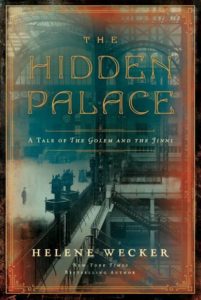 Chava is a golem, a woman made of clay, able to hear the thoughts and longings of the humans around her, and compelled to help them. Ahmad is a jinni, a being of fire now imprisoned in the shape of a man, perpetually restless and free-spirited. Having met as two unlikely immigrants in 1899 Manhattan, their lives have become deeply intertwined, but they must decide what, exactly, they mean to each other—all while living disguised as humans, constantly fearing they’ll be exposed as monsters. Meanwhile, Park Avenue heiress Sophia Winston, whose brief encounter with Ahmad has left her with a strange illness that makes her shiver with cold, travels to the Middle East to seek a cure. There she meets a tempestuous female jinni who’s been banished from her tribe for her own untreatable condition. And in a tenement on the Lower East Side, a little girl named Kreindel helps her rabbi father build a golem that she names Yossele. When she is sent to an uptown orphanage, the hulking golem will become her only friend and companion. Spanning the tumultuous years from the turn of the 20th century to the beginning of World War I, THE HIDDEN PALACE follows these lives and others as they collide and interleave. Can Chava and Ahmad find their places in the human world while remaining true to each other? Or will their own natures and desires conspire to tear them apart—especially once they encounter, thrillingly, other creatures of their own kinds?
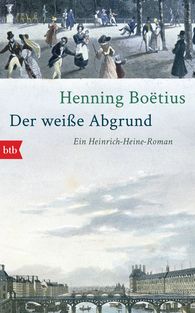 Paris, ca. 1850. Bed-ridden and terminally ill, Heinrich Heine wants to prise one final work from the jaws of death: His memoirs are to be his magnum opus. It’s been a long time since he last attended an illustrious bohemian dinner – instead, he receives occasional visits from German exiles and French artist friends. One day, Elise Krinitz seeks him out. The young woman admires Heine, and hopes to find in him a mentor for her own literary ambitions. He tenderly and ironically calls her ‘Mouche’, and they soon embark on a platonic, but nonetheless passionate affair. Yet when Heine dies on the 17th February 1856, his memoirs are lost forever. Steeped in the fascinating panorama of 1850s Paris, Boëtius’s novel is a unique portrait of the final years of the great German poet Heinrich Heine.
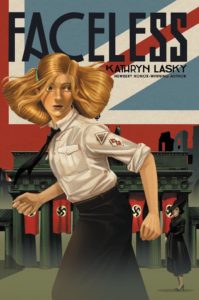 Over the centuries, unbeknownst to all, a small clan of spies has worked ceaselessly to fight oppression. They are called the Tabula Rasa. They can pass unseen through enemy lines, eavesdrop on conversations, and « become » other people without being recognized. They are, essentially, faceless. Alice and Louise Winfield are sisters and spies in the Tabula Rasa. They’re growing up in war-time England, where the threat of Nazi occupation is ever near. But Louise wants to live an ordinary life, and she tires of spy missions. When she leaves the agency, Alice must face her most dangerous assignment yet, without her sister at her side. As Alice prepares for her new mission, she must head into Hitler’s inner sanctum in Germany to report on the Nazis. She fears the threat of discovery, but, worst of all, she fears losing her own sister. This novel is a mix of espionage and historical adventure. Lasky masterfully spins a tale filled with mystery, suspense and intrigue.