
In a sweeping intellectual narrative, award-winning neuroscientist and author Erik Hoel argues there are two fundamental perspectives on reality: the intrinsic and the extrinsic. The intrinsic perspective is that of consciousness and experience, the feelings and sensations that make up your waking world. The extrinsic perspective is that of science, which views the universe as a set of mechanisms and relations.
THE WORLD BEHIND THE WORLD:
Consciousness, Free Will, and the Limits of Science
by Erik Hoel
Avid Reader, Fall 2023
(via Writers House)
 The two perspectives have had an uneasy, sometimes troubled relationship. Throughout history some cultures have emphasized one perspective more than the other, which has radically changed how humans think about and conceptualize our own selves. Technologies and media often implicitly enforce one perspective: for instance, television and movies take the extrinsic perspective, exploring the world of relations and images, while literature and novels take the intrinsic perspective, exploring the world of consciousness.
Hoel offers a whirlwind tour of the two perspectives across the ages, like how the intrinsic perspective is absent from Homeric epics and earlier eras, its historical development and ultimate culmination in the invention of the novel, the separation of the two perspectives by Galileo Galilei when he recommended science remove the observer to focus solely on the extrinsic, and the reintroduction of the intrinsic perspective to science by Francis Crick, the discoverer of DNA, who proposed a search for the neural correlates of consciousness that continues to this day.
Hoel shows how our picture of reality is incomplete following Galileo’s separation and emphasis on the extrinsic. The ignored intrinsic perspective sheds light on fundamental scientific questions like causation, emergence, how the brain functions, the biological purpose of dreaming, artificial intelligence, and even why humans create art. He reveals how our own culture is becoming more based in the extrinsic perspective over time, neglecting the intrinsic and forgetting the importance of human consciousness, all to its cultural, scientific, and artistic detriment.
Ultimately, the two perspectives have stood apart for too long and must be reunited. To this end Hoel proposes a way to merge the intrinsic and the extrinsic in a radical new theory of consciousness.
Erik Hoel received his PhD in neuroscience from the University of Madison-Wisconsin. He is a research assistant professor at Tufts University and was previously a postdoctoral researcher at Columbia University in the NeuroTechnology Lab, and a visiting scholar at the Institute for Advanced Study in Princeton. Hoel is a 2018 Forbes “30 under 30” for his neuroscientific research on consciousness. His first novel, The Revelations, was published in April 2021 by The Overlook Press. He lives in Massachusetts.
 This is what I think I know: my father met my mother while he was dating her sister. Their love was figured on betrayal, both hostile and libidinous. She was in her late teens. He was twenty and travelled everywhere barefoot. Neither had finished high school and both were decorated with amateur tattoos. Things may have been good for a while, but it didn’t last: they argued fiercely and he left. Weeks later, she tracked him down and said she was pregnant. So he moved back in, and they prepared themselves for parenthood.
 THE ELEMENTS focuses on fire, earth, air, and water, which each exist in everyone’s birth charts in unique concentrations that influence your personality, how you work, how you love, and how you understand other people. Knowing your elemental balance is almost like knowing your love language. Dr. Freed will show you how to use a few key pieces of information to understand how your elements influence you in 12 different areas of life (which correspond to the 12 houses of Astrology). She’ll teach someone with a fire/air concentration how to commit to daily routines that keep them happy and grounded. She’ll teach you how to support your watery partner in the way he needs. And she’ll teach you how to tap into the secret strengths of your unique elemental makeup.
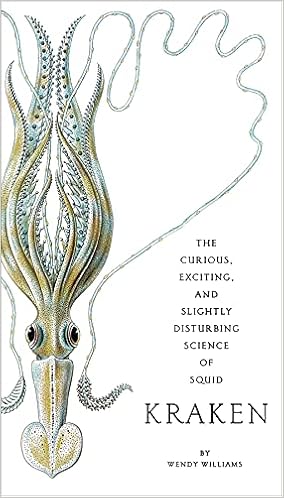 The ocean is the last remaining source of profound mystery and discovery on Earth with eighty percent of it still largely unexplored; thus, it is of perennial fascination. In KRAKEN, journalist Wendy Williams introduces one of the ocean’s most charismatic, monstrous, enigmatic, and curious inhabitants: the squid. More than just calamari, squid species are fascinatingly odd creatures, with much to teach us about our own species, not to mention the obsessive interest so many of us can’t help but have for the enormous beast that is the giant squid, which is quick to attack sperm whales, and even submarines and boats. Williams also examines other equally enthralling cephalopods, including the octopus and the cuttlefish, and explores their otherworldly abilities, such as camouflage and bioluminescence. Kraken takes the reader on a wild ride through the world of squid science and adventure, along the way answering some riddles about how the human brain works, what intelligence really is, and what monsters lie in the deep. Wendy Williams weaves a rich narrative tapestry around her subject, drawing powerfully on the passions and discoveries of scientists, fisherman, and squid enthusiasts around the world.
 For years,