
Beloved guru Ram Dass tells the story of his spiritual awakening and gives you the tools to take control of your life in this “counterculture bible” (The New York Times) featuring powerful guidance on yoga, meditation, and finding your true self. October 12, 2021 will mark the 50th Anniversary of Ram Dass’ publication, a classic on mind, body, and spirit.
BE HERE NOW
by Ram Dass
Harmony, October 1971
 When BE HERE NOW was first published in 1971, it filled a deep spiritual emptiness, launched the ongoing mindfulness revolution, and established Ram Dass as perhaps the preeminent seeker of the twentieth century. Just ten years earlier, he was known as Professor Richard Alpert. He held appointments in four departments at Harvard University. He published books, drove a Mercedes and regularly vacationed in the Caribbean. By most societal standards, he had achieved great success. . . . And yet he couldn’t escape the feeling that something was missing. Psilocybin and LSD changed that. During a period of experimentation, Alpert peeled away each layer of his identity, disassociating from himself as a professor, a social cosmopolite, and lastly, as a physical being. Fear turned into exaltation upon the realization that at his truest, he was just his inner-self: a luminous being that he could trust indefinitely and love infinitely. And thus, a spiritual journey commenced. Alpert headed to India where his guru renamed him Baba Ram Dass—“servant of God.” He was introduced to mindful breathing exercises, hatha yoga, and Eastern philosophy. If he found himself reminiscing or planning, he was reminded to “Be Here Now.” He started upon the path of enlightenment, and has been journeying along it ever since.
BE HERE NOW is a vehicle for sharing the true message, and a guide to self-determination.
Ram Dass served on the faculty at Stanford and Harvard Universities. In the 1960s, he traveled to India, where he met his guru, and over the course of his life pursued a variety of spiritual practices, including guru kripa, devotional yoga, karma yoga, many forms of meditation, and Sufi and Jewish studies. Many of his books, including BE HERE NOW, are international bestsellers and classics of their kind. He died in December 2019.
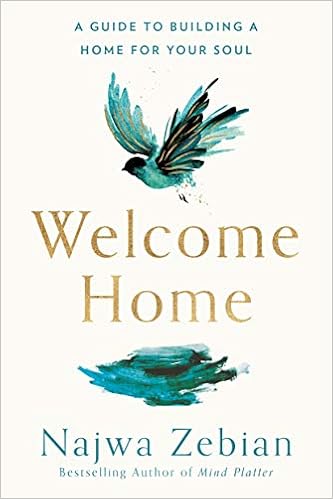 In her debut book of inspiration, Najwa Zebian shares her revolutionary concept of home—the place of safety where you can embrace your vulnerability and discover your self-worth. It’s the place where your soul feels like it belongs, where you are loved for who you are. Too many of us build our homes in other people in the hope that they will deem us worthy of being welcomed inside, and then we feel abandoned and empty when those people leave. Building your home inside yourself—and never experiencing inner homelessness again—begins here. In WELCOME HOME, Zebian shares her personal story for the first time, powerfully weaving memoir, poetry, and deeply resonant teachings into her storytelling, from leaving Lebanon at sixteen, to coming of age as a young Muslim woman in Canada, to building a new identity for herself as she learned to speak her truth. After the profound alienations she experienced, she learned to build a stable foundation inside herself, an identity independent of cultural expectations and the influence of others. The powerful metaphor of home provides a structure for personal transformation as she shows you how to construct the following rooms: Self-Love, Forgiveness, Compassion, Clarity, Surrender, and The Dream Garden. With practical tools and prompts for self-understanding, she shows you how to build each room in your house, which form a firm basis for your self-worth, sense of belonging, and happiness. Written with her trademark power, candor, and warmth, WELCOME HOME is an answer to the pain we all experience when we don’t feel at peace with ourselves. Every human deserves their own home. WELCOME HOME provides the life-changing tools for building that inner space of healing and solace.
 For some, the idea of fasting by eating only one or two meals a day still sounds like an extreme and overly restrictive dieting tactic. But many of us already feel like victims to our daily eating schedule: three meals a day, plus snacks. Eat every few hours, we are told by the experts. This fixed eating schedule has become the norm. But the truth is this is an artificially constructed schedule that does not reflect our bodies’ natural and most optimal eating schedule. In fact, eating three meals a day causes metabolic inflexibility, which can easily lead to inflammation, weight gain, and disease. For millions of years, our bodies have actually functioned best by fasting. With his four-week fasting flexibility plan, Dr. Cole will help you reset your body, recharge your metabolism, renew your cells, and rebalance your hormones. He’ll illustrate the most effective ways to fast and eat to amplify the health benefits of intermittent fasting, balancing rest and repair with clean, nutrient dense, delicious foods. Along with 60-70 recipes, he also includes a maintenance plan, so you can adapt fasting and feeding windows to work with your lifestyle.
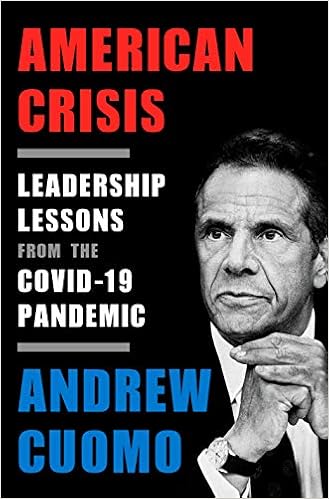 When COVID-19 besieged the United States, New York State emerged as the global “ground zero” for a deadly contagion that threatened the lives and livelihoods of millions. Quickly, Governor Andrew Cuomo provided the leadership to address the threat, becoming the standard-bearer of the organized response the country desperately needed. With infection rates spiking and more people dying every day, the systems and functions necessary to combat the pandemic in New York—and America—did not exist. So Cuomo undertook the impossible. He unified people to rise to the challenge and was relentless in his pursuit of scientific facts and data. He quelled fear while implementing an extraordinary plan for flattening the curve of infection. He and his team worked day and night to protect the people of New York, despite roadblocks presented by a president incapable of leadership and addicted to transactional politics. In his own voice, Andrew Cuomo chronicles the ingenuity and sacrifice required of so many to fight the pandemic, sharing the decision-making that shaped his policy as well as his frank accounting and assessment of his interactions with the federal government, the White House, and other state and local political and health officials. Real leadership, he shows, requires clear communication, compassion for others, and a commitment to truth-telling—no matter how frightening the facts may be. A remarkable portrait of selfless leadership and a gritty story of difficult choices that points the way to a safer future for all of us.
 Six days after giving birth, a polar bear named Aurora got up and left her den at the Columbus Zoo, leaving her tiny, squealing cub to fend for herself. Hours later, Aurora still hadn’t returned. The cub was furless and blind, and with her temperature dropping dangerously, the zookeepers entrusted with her care felt they had no choice: They would have to raise one of the most dangerous predators in the world themselves, by hand. Over the next few weeks, a group of veterinarians and zookeepers would work around the clock to save the cub, whom they called Nora. Humans rarely get as close to a polar bear as Nora’s keepers got with their fuzzy charge. But the two species have long been intertwined. Three decades before Nora’s birth, her father, Nanuq, was orphaned when an Inupiat hunter killed his mother, leaving Nanuq to be sent to a zoo. That hunter, Gene Agnaboogok, now faces some of the same threats as the wild bears near his Alaskan village of Wales, on the westernmost tip of the North American continent. As sea ice diminishes and temperatures creep up year-after-year, Gene and the polar bears—and everyone and everything else living in the far north—are being forced to adapt. Not all of them will succeed. Sweeping and tender, THE LONELIEST POLAR BEAR explores the fraught relationship humans have with the natural world, the exploitative and sinister causes of the environmental mess we find ourselves in, and how the fate of polar bears is not theirs alone.