
Eight young people, lost in the Canadian wilderness – if they want to get out alive, they must stick together.
ACHT WÖLFE
(Eight Wolves)
by Ulla Scheler
Heyne/PRH Germany, September 2023
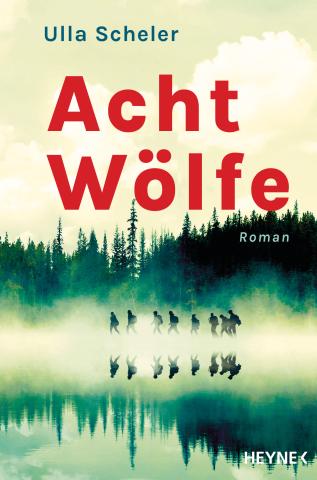 Eight young people join a guided hike through Canada’s biggest national park. For the next three weeks, they will experience the wilderness and see the Northern Lights. But even in the wilderness, you can end up in the wrong place at the wrong time. When they witness a crime, the eight have no choice but to run. Lost in the middle of nowhere, they have no equipment and nothing to help them find their way home. They also can’t stand each other. But their only chance of getting out of this alive is to work together.
A survival thriller for fans of « Rust Creek ».
Ulla Scheler, born in 1994, studied psychology and IT in Munich and Karlsruhe. Her debut novel « Es ist gefährlich, bei Sturm zu schwimmen » (« Swimming during a storm is dangerous ») was a big popular and critical success, and shortlisted for the German YA Prize. « Eight Wolves » is her first non-YA novel.

 Many people think that protecting our climate and democracy are mutually exclusive. For some, the fight against climate change is moving too slowly, while others are already feeling threatened by the prospect of an « eco-dictatorship ». In DEMOKRATIE IM FEUER, journalist Schaible shows that protecting the climate and democracy are actually prerequisites for each other. Without one, the other will become impossible. He exposes false contradictions, and argues that what we need is « climate democracy » – for the climate crisis is already starting to limit our freedoms, and we’ll only be able to save the planet by democratic means. DEMOKRATIE IM FEUER takes a new look at the relationship between democracy and climate change, and sketches an optimistic vision of a future where the two reinforce each other.
 Our relationship with other people, closeness and intimacy has fundamentally changed. This is due not only to the « safe distances » and lockdowns of the past couple of years or so, but to a social trend that has merely been intensified by the pandemic – as evidenced by rising divorce rates, an increase in polyamorous relationships, the rising number of single households and political discussions around « responsible communities ».
 The catastrophe happens over coffee and cake: on a visit to his mother’s childhood friend in March 1943, Karlrobert Kreiten, a consummate 26-year-old pianist with a promising future ahead of him, claims that Germany has lost the war, and the Führer his mind. Six months after making these unguarded comments, he dies on the gallows.