
Why we want to do the right thing, but do the wrong thing instead – and how to become a better person.
WARUM ES SO SCHWER IST, EIN GUTER MENSCH ZU SEIN
(Why It Is So Hard to Be Good)
by Armin Falk
Siedler Verlag, May 2022
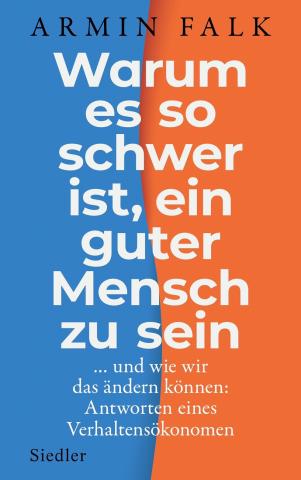 Would you save a life for 100 euros? The answer has to be yes – doesn’t everyone want to do the right thing? But Armin Falk, Germany’s leading behavioural economist, shows that we often do bad things despite wanting to be good, and are far from being as good as we like to think.
Why is it that we don’t do the right thing day in and day out: help others, give to those in need, protect our climate or care for the well-being of animals? Using many concrete examples and the insights he has gained from years of research, the Leibniz Prize-winner reveals under what circumstances people are likely to act morally – or immorally – and the role that personality, gender, education and culture play. Once we have understood this, we’ll find it easier to change – not only ourselves, but the very fabric of our economy and society.
Armin Falk, born in 1968, is the director of the Institute for Behavioural Economics and Inequality (BRIQ) and of the Laboratory for Experimental Economic Research, as well as Professor of economics at the University of Bonn. He is one of the world’s most highly regarded economic scientists. His work has won him the 2009 Leibniz Prize (the ‘German Nobel’) and a 2013 Advanced Grant from the European Research Council, the world’s highest prize for economists.
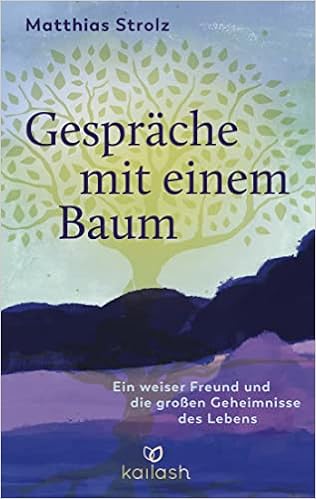 When he realises he is able to converse with his favourite tree, Matthias Strolz sets out on a journey of discovery that takes him through the essential questions of life that affect us deeply and make us human, eventually leading him to his personal « inner place ». His intensive, entertaining, and profound conversations with the magical tree revolve around birth and death, time and space, God and religion, politics and the state, money and power, job and success, pain and joy, and happiness and love. Knowledge and inner truths will come to fruition through the universal connectedness of everything in existence.
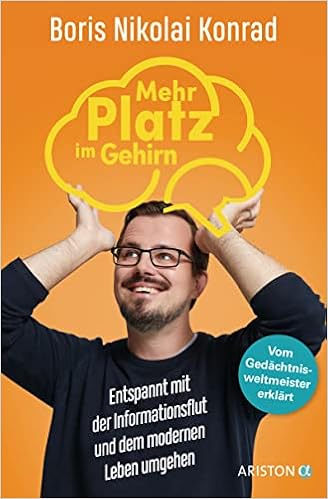 The human brain is quite remarkable and is most often compared very favorably with high-performance computers. How is it then that we still have the feeling constantly forgetting things, being late to appointments, and having a hopelessly crowded head? Boris Nikolai Konrad helps us regain control of our cerebral processes. This neuroscientist first illustrates the amazing ways the brain functions. He then explains how we can improve how we use our brains. With his techniques we can learn to experience full relaxation without yoga, to remember every name with ease – and to finally eliminate the chaos in our head.
 Can the personality of a deceased person be recreated and eventually transferred to a digital revenant? Will we be able to talk to the dead in the future? What sounds like a science fiction plot is already being worked on: Start-ups are working on a digital form of immortality, raising great hopes among people who have lost their partners, family members and friends.
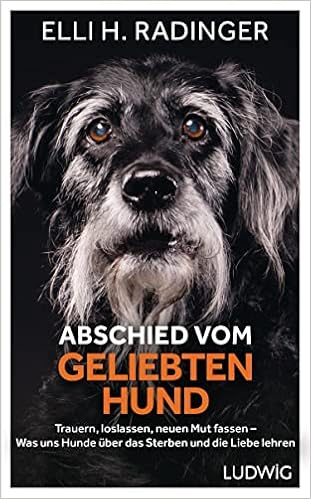 When her Labrador Shira died and Elli Radinger spoke publicly about her grief, thousands got in touch with the well-known wolf and dog expert to tell her about their own old, sick or deceased pets, as well as their deep sadness, desperation, loneliness and helplessness – because those around us often don’t understand our pain. Radinger wants to help those who are affected by this, and give them the strength they need during this difficult time, whether they are caring for a dying dog, or grieving for one that has already passed away. Saying goodbye to your faithful friend doesn’t have to be just the end of something – it can also be a gift, and even bring forth something new.