
The birth of modernity: a journey through a trailblazing literary year in a turbulent world.
1922: WunderJahr der Worte
(1922: An Annus Mirabilis for Words)
by Norbert Hummelt
Luchterhand Literaturverlag/PRH Verlagsgruppe, February 2022
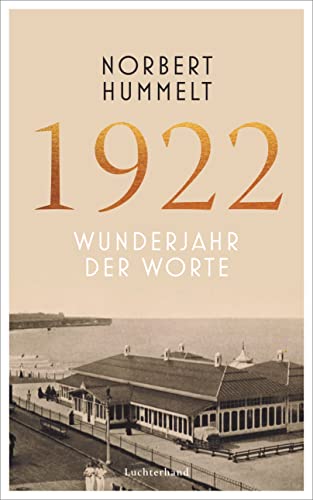 It’s an eventful year: a new Pope is elected in Rome, Howard Carter discovers the tomb of Tutankhamun, Albert Einstein receives the Nobel Prize, and the assassination of Germany’s foreign secretary Walther Rathenau foreshadows the rise of Adolf Hitler.
At the same time, 1922 is a year of unprecedented creative energy – Kandinsky is appointed to the Bauhaus in Dessau, Louis Armstrong makes jazz history in Chicago, and literary works by James Joyce, Virginia Woolf, Rainer Marie Rilke, Katherine Mansfield and T.S. Eliot that will change the course of world literature usher in the birth of modernity. In Paris, London, Trieste, Valais and Margate, Norbert Hummelt accompanies these authors through a groundbreaking literary year, capturing Europe’s highly charged atmosphere along the way.
Norbert Hummelt, born in 1962, works as a freelancing author in Berlin. In 2021, he received the Rainer Malkowski Prize for his life’s oeuvre. Further awards for his poems include the Rolf Dieter Brinkmann Prize, the Mondsee Lyric Prize, the Hermann Lenz Scholarship and Lower Rhine Literature Prize. He has been teaching at the German Literature Institute in Leipzig since 2002.
 Viktoryia Andrukovič, the Belarusian human rights advocate and political activist, was born in 1994, the year that Lukashenko came to power. She knows her homeland only as a country under the yoke of an increasingly autocratic regime, and she spent her deprived and precarious adolescence there hoping for a better, freer future for her country. An opposition activist both before and after the 2020 presidential elections, she now works with Belarusian NGOs in exile.
 Travelling is simply wonderful – that joyful sensation of heading out into the big wide world to experience the wholly new, that feeling of freedom and openness to accidental encounters… and it’s not least the ideal chance to experience time, the world and yourself differently. Whether it’s the beauty of old pilgrims’ ways in Scandinavia or dark alleyways in Cairo, the effortlessness of the flip-flop-wearing guides to Guatemala’s Atitlán volcano, the dogs dozing idly in the Portuguese sun, nights in Blackpool or Tokyo …
 It’s a given that, as far as work is concerned, nothing these days is a given. The Second Machine Age of self-teaching computers and robots will revolutionise not only the job market, but also redefine what ‘work’ is in the first place, and why we still do it. What happens when machines do so much of the work that economies no longer need to rely on human productivity? Without the old wage labour society of the First Machine Age, our conception of work as defined by the nineteenth century will become a mere appendix – useless and outdated. The big prize we aim for will no longer be full-time work, but self-realisation, and the raffle tickets will change accordingly: society will cease to think of employment as the be-all and end-all, and place greater value on high-quality jobs and workplace conditions.
 Schleswig, 1872. Emma’s mother is furious when she turns down a proposal from an eligible bachelor. Rather than marry a man she doesn’t love, though, Emma boards the steamship Borussia and emigrates to California. In San Francisco, she accepts a position as companion to a wealthy widow, and soon falls in love with the likeable timber merchant Lars. They get married and plan to start a family, and Emma goes to live with him on Humbolt Bay. Yet their marriage remains childless, Lars is often away on business, and Emma is lonely. When Hans – owner of a shipyard, Lars’s closest friend and best man at their wedding – offers her a position in his office, the two of them develop deep feelings for each other. But there is a love that cannot be.