
A refreshing, positive guide for taking care of your people and forming deep connections in the digital age.
FRIENDSHIP IN THE AGE OF LONELINESS:
An Optimist’s Guide To Connection
by Adam “Smiley” Poswolsky
Running Press, May 2021
(chez Levine Greenberg Rostan – voir catalogue)
 We are lonelier than ever. The average American hasn’t made a new friend in the last five years. Research has shown that people with close friends are happier, healthier, and live longer than people who lack strong social bonds. But why— when we are seemingly more connected than ever before—can it feel so difficult to keep those bonds alive and well? Why do we spend only four percent of our time with friends? In this warm, inspiring guide, Adam « Smiley » Poswolsky proposes a new solution for the mounting pressures of modern life: focus on your friendships. Smiley offers practical habits and playful reminders on how to create meaningful connections, make new friends, and deepen relationships. He’ll help you develop a healthier relationship with technology, but he’ll also encourage you to prioritize real-world experiences, send snail mail, and engage in self-reflective exercises.
Written in short, digestible, action-oriented sections, this book reminds us that nurturing old and new friendships is a ritual, a necessity, and one of the most worthwhile things we can do in life.
Adam Smiley Poswolsky is a millennial workplace expert, motivational speaker, and author of The Quarter-Life Breakthrough and The Breakthrough Speaker. Smiley helps companies attract, retain, and empower millennial talent, and he has inspired thousands of professionals to be more engaged at work. His TEDx talk on « the quarter-life crisis » has been viewed more than 1.5 million times, and he has spoken in 15 countries about millennials, multigenerational engagement, and fostering connection and belonging in the workplace. Smiley’s work has been featured in The New Yorker, the Washington Post, USA Today, Fast Company, Forbes, Cosmopolitan, CNN, and the World Economic Forum, among many other outlets.
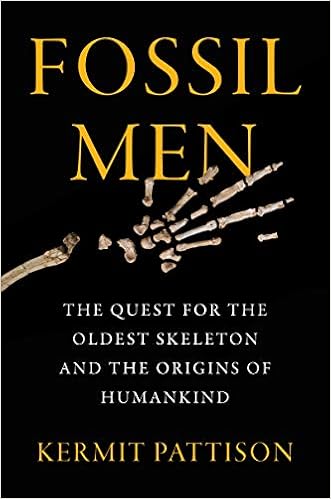 In 1994, a team led by fossil-hunting legend Tim White—”the Steve Jobs of paleoanthropology”—uncovered the bones of a human ancestor in Ethiopia’s Afar region. Radiometric dating of nearby rocks indicated the skeleton, classified as Ardipithecus ramidus, was 4.4 million years old, more than a million years older than “Lucy,” then the oldest known human ancestor. The findings challenged many assumptions about human evolution—how we started walking upright, how we evolved our nimble hands, and, most significantly, whether we were descended from an ancestor that resembled today’s chimpanzee—and repudiated a half-century of paleoanthropological orthodoxy. FOSSIL MEN is the first full-length exploration of Ardi, the fossil men who found her, and her impact on what we know about the origins of the human species. It is a scientific detective story played out in anatomy and the natural history of the human body. Kermit Pattison brings into focus a cast of eccentric, obsessive scientists, including one of the world’s greatest fossil hunters, Tim White—an exacting and unforgiving fossil hunter whose virtuoso skills in the field were matched only by his propensity for making enemies; Gen Suwa, a Japanese savant who sometimes didn’t bother going home at night to devote more hours to science
 In illness, Bauer provides a surprising new lens through which to consider all of human history—she argues that bodily sickness and our conception of it has shaped our culture, our philosophies, and our religions, and has directly and indirectly affected how we view others, how we view ourselves, and how we fashion our world. She argues that sickness is the great mirror that reflects back our most urgent and eternal questions: Why does calamity descend without warning? How can we explain it? And how do we fight back? Told in a propulsive narrative style that brings sweeping history to life through intimate individual stories—the feverish Mesopotamian sufferer; the plague victim who dies alone, the last in his village; the seventeenth-century teenager racked by smallpox; the Congolese grandmother watching her family die of Ebola—Bauer takes readers on a journey from humans’ earliest days when sickness was an unsolvable mystery, evidence that humans were powerless to the unseen forces of gods, to more modern times and the birth of germ theory, when secularism grew alongside our fear of contamination. A multidisciplinary human history like no other, BONES, BLOOD, BREATH is a big think book that tells a large-scale, vivid, chronological story, stretching around the world from ancient times until the present—it will change the way we understand who we are.
  A criminalistic search for clues of the origins of humanity