
The renowned social scientist, professor, and bestselling author of Predictably Irrational delivers his most urgent and compelling book—an eye-opening exploration of the human side of the misinformation crisis—examining what drives otherwise rational people to adopt deeply irrational beliefs.
MISBELIEF:
What Makes Rational People Believe Irrational Things
by Dan Ariely
HarperCollins, September 2023
(via Levine Greenberg Rostan)
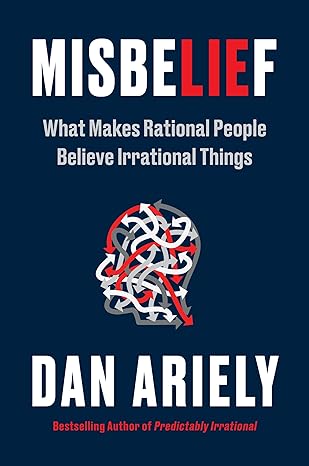 Misinformation affects all of us on a daily basis—from social media to larger political challenges, from casual conversations in supermarkets, to even our closest relationships. While we recognize the dangers that misinformation poses, the problem is complex—far beyond what policing social media alone can achieve—and too often our limited solutions are shaped by partisan politics and individual interpretations of truth.
In MISBELIEF, preeminent social scientist Dan Ariely argues that to understand the irrational appeal of misinformation, we must first understand the behavior of “misbelief”—the psychological and social journey that leads people to mistrust accepted truths, entertain alternative facts, and even embrace full-blown conspiracy theories. Misinformation, it turns out, appeals to something innate in all of us—on the right and the left—and it is only by understanding this psychology that we can blunt its effects. Grounded in years of study as well as Ariely’s own experience as a target of disinformation, MISBELIEF is an eye-opening and comprehensive analysis of the psychological drivers that cause otherwise rational people to adopt deeply irrational beliefs. Utilizing the latest research, Ariely reveals the key elements—emotional, cognitive, personality, and social—that drive people down the funnel of false information and mistrust, showing how under the right circumstances, anyone can become a misbeliever.
Yet Ariely also offers hope. Even as advanced artificial intelligence has become capable of generating convincing fake news stories at an unprecedented scale, he shows that awareness of these forces fueling misbelief make us, as individuals and as a society, more resilient to its allure. Combating misbelief requires a strategy rooted not in conflict, but in empathy. The sooner we recognize that misbelief is above all else a human problem, the sooner we can become the solution ourselves.
Dan Ariely is the James B. Duke Professor of psychology and behavioral economics at Duke University. He is a founding member of the Center for Advanced Hindsight; co-creator of the film documentary (Dis)Honesty: The Truth About Lies; and a three-time New York Times bestselling author. His books include Predictably Irrational, The Upside of Irrationality, The Honest Truth About Dishonesty, Irrationally Yours, Payoff, Dollars and Sense, and Amazing Decisions. His TED talks have been viewed more than 27 million times. Dan has what appears to be bad luck in terms of the troubles he gets into, but also the good fortune to learn and develop from these challenges.
 Our relationship with other people, closeness and intimacy has fundamentally changed. This is due not only to the « safe distances » and lockdowns of the past couple of years or so, but to a social trend that has merely been intensified by the pandemic – as evidenced by rising divorce rates, an increase in polyamorous relationships, the rising number of single households and political discussions around « responsible communities ».
 Pacemakers, running blades, stem cell research, life-prolonging medicine: these achievements might sound normal, but they are all part of what is called transhumanism. Transhumanism stipulates that humanity’s next evolutionary step will come about through the use of modern science and technology, but many people see it as a dangerous endeavour. They fear that it will dehumanise us, that we’ll become « cyborgised » and open ourselves up to ethically questionable genetic experiments and state-sponsored eugenics.
 Foregoing motherhood has traditionally marked a woman as “other.” With no official place setting for her in our society, she has hovered on the sidelines: the quirky girl, the neurotic career obsessive, the “eccentric” aunt. Instead of continuing to paint women without kids as sad, self-obsessed, or somehow dysfunctional, what if we saw them as boldly forging a first-in-a-civilization vision for a fully autonomous womankind? Or as journalist and thought leader Ruby Warrington asks, What if being a woman without kids were in fact its own kind of legacy?
 For the past four years before Covid hit, Eliot Stein has been traveling all around the planet profiling remarkable people who are producing or preserving a distinct cultural wonder that exists nowhere else for a column he created for BBC Travel called Custom Made. In Italy, Eliot learned the secrets of the world’s rarest pasta from one of only three women alive who knows how to make it. In Taiwan, he shadowed the island’s last film poster painter, a man who’s now partially blind but still hangs his giant brushstroke canvases on the theater marquee. In Sardinia, Eliot meets a 24th generation diver who is the only person left on Earth who still knows how to harvest and embroider an incredibly rare fiber known as sea silk, into elaborate patterns that glisten like gold.