
From Wall Street Ponzi schemes to Nigerian email scams, from chess cheaters with hidden computers to Bridge cheaters with covert signals, from psychic mediums preying on credulous audiences to scientific fraudsters making up results their colleagues want to hear, from art forgers to deceptive marketers, our world is filled with people who want to fool us..
FOOLED:
How Cheating Works and What You Can Do About It
by Christopher F. Chabris and Daniel J. Simmons
Basic Books, June 2023
(via Levine Greenberg Rostan)
 FOOLED is a book about why we fall for the schemes of liars, deceivers, marketers, con artists, and anyone else who tries to trick us into believing or doing something in their interest rather than our own. It identifies ten specific reasons why we are easily deceived, drawing upon classic and current research in cognitive psychology and the social sciences to explain exactly how deception works, why all of us are fooled at least some of the time, and how we can avoid being scammed—or even scam the scammers in return. FOOLED is not a book about why people cheat, but about how they manage to get away with it.
Chris and Dan’s first book, The Invisible Gorilla, was about how the brain’s limited capacities for attention, memory, and understanding make us miss so much in everyday life. It was a New York Times Editor’s Choice and bestseller published in over twenty languages.
Daniel Simons is a Professor in the Department of Psychology and the University of Illinois. Previously he was an Assistant and then Associate Professor of Psychology at Harvard University. He received his B.A. from Carleton College and a Ph.D. in Experimental Psychology from Cornell University. He is one of the leading researchers in the world studying visual cognition and visual awareness, and he has made pioneering discoveries about the limitations of human perception, memory, and awareness.
Christopher Chabris is a Professor at Geisinger, an integrated healthcare system in Pennsylvania, where he is also co-director of the Behavioral and Decision Sciences Program and faculty co-director of the Behavioral Insights Team. Chris received his A.B. in computer science and his Ph.D. in psychology from Harvard University, where he was also a Lecturer and Research Associate for many years. His research, published in leading journals, focuses on several areas: attention, intelligence, behavior genetics, and decision-making.
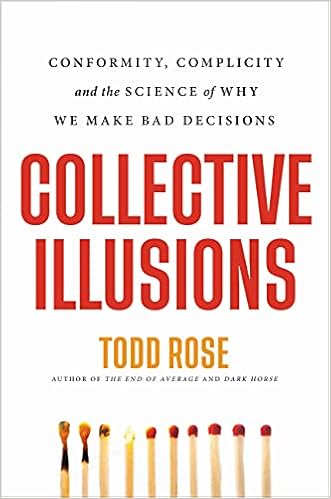 The desire to fit in is one of the most powerful, least understood forces in a society. Todd Rose believes that as human beings we continually act against our own best interests out of our brains’ misunderstanding of what we think
 Even after a decades-long opioid overdose crisis, intense controversy still rages over the fundamental nature of addiction and the best way to treat it. With uncommon empathy and erudition, Carl Erik Fisher draws on his own experience as a clinician, researcher, and alcoholic in recovery as he traces the history of a phenomenon that, centuries on, we hardly appear closer to understanding—let alone addressing effectively.
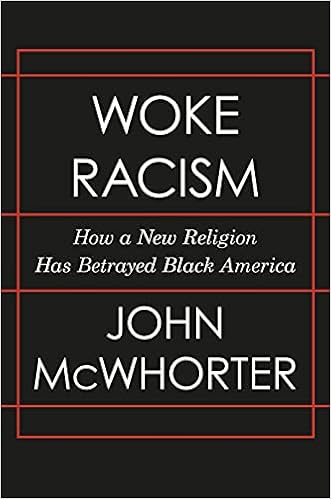 Americans of good will on both the left and the right are secretly asking themselves the same question: how has the conversation on race in America gone so crazy? We’re told to read books and listen to music by people of color but that wearing certain clothes is “appropriation.” We hear that being white automatically gives you privilege and that being Black makes you a victim. We want to speak up but fear we’ll be seen as unwoke, or worse, labeled a racist. According to John McWhorter, the problem is that a well-meaning but pernicious form of antiracism has become, not a progressive ideology, but a religion—and one that’s illogical, unreachable, and unintentionally neoracist.