
The harrowing, highly entertaining inside chronicle of how FTX founder Sam Bankman-Fried and a cast of fellow nerds and hustlers convinced the world to send trillions of dollars of real money to buy useless virtual coins—from a Bloomberg Businessweek writer.
NUMBER GO UP:
Inside Crypto’s Wild Rise and Staggering Fall
by Zeke Faux
Currency/PRH, September 2023
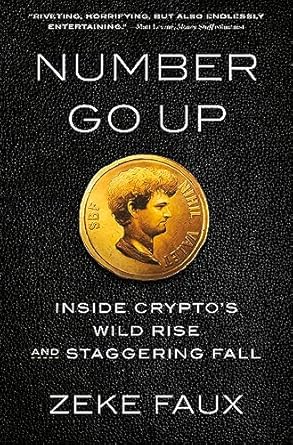 After years on the financial world’s margins, crypto went mainstream in 2021. Giant investment funds were buying it, celebrities like Tom Brady and Justin Bieber endorsed it, and Washington bigwigs debated new regulations. It seemed like everyone knew someone who was bragging about their returns from Bitcoin, Ethereum, Dogecoin and other bizarrely named “digital assets.” FOMO spread: Was crypto the new path to financial freedom? Unspoken was that hardly anyone knew how it worked. To borrow a phrase from crypto parlance, the only thing that mattered was “number go up.”
Observing this mania, Zeke Faux decided to embark on a quest to pull back the curtain on the wizards behind this new financial machinery. He first sets his sights on Tether, a digital currency dreamed up by a former child actor from the 1992 Disney film The Mighty Ducks. Tether had become crypto’s de facto bank, with $69 billion pouring into it. Each Tether was supposedly backed by one dollar. But where was the money?
As he chases this mystery around the globe, Faux is driven by a nagging question: Is it all just a global confidence game of epic proportions? In the Bahamas, he meets Tether’s biggest customer: Sam Bankman-Fried, a schlubby 29-year-old who Fortune once suggested was “the next Warren Buffett.” In El Salvador, he discovers what happens when a country decides to gamble its treasury on Bitcoin. A spam text message leads him to a crypto-fueled human-trafficking ring in Cambodia. And in Lugano, Switzerland, he finally tracks down the mysterious former plastic surgeon who runs Tether.
Then, in 2022, the crypto bubble burst, and Tether’s biggest customers started collapsing one by one. It culminated in November, when Bankman-Fried’s FTX failed in spectacular fashion. Faux returns to the Bahamas and takes readers inside the glittering sadness, lies and delusion of SBF’s luxury loft in the days after FTX’s implosion, revealing the emptiness at the center of the crypto industry. Fueled by the absurd details and authoritative reporting that earned Faux the title “our great poet of crime” (Matt Levine), NUMBER GO UP is a riveting account of the biggest financial mania the world has ever seen.
Zeke Faux is an investigative reporter for Bloomberg Businessweek and Bloomberg News in New York. He’s a winner of the Gerald Loeb award for explanatory business journalism and the American Bar Association’s Silver Gavel award, and a finalist for a National Magazine Award. Faux lives in Brooklyn, New York, with his wife and their three children.
 The practical advice gleaned from thirty years of mentorship and mentoring, a lifetime of studying how people make money, how they lose it, and what it takes to come out ahead. THE ALGEBRA OF WEALTH
 Political upheaval and social turmoil have peeled back the glitzy layers of capitalism to reveal an uncomfortable truth: historically, businesses have sourced materials from remote corners of the globe and moved millions of people and tons of cargo around the clock—all in the name of profit. Yet many of today’s startups are rewriting the rules of business: how it’s done, by whom, and, most importantly, for what purpose. Journalist Esha Chhabra draws on her decades of reporting to explore not only the “feel good, do good” factors of these restorative enterprises but also the nuanced realities and promise of regenerative business operations.
 As the speed of change in our increasingly complex world accelerates daily, leaders are tasked with performing outside of their familiar zones both in their personal and professional lives. This requires us to adapt. Yet, the same conditions that make adapting so important can also trigger fear, leading us to resist change and default to reactive behavior. The authors call this the “adaptability paradox”: when we most need to learn and change, we stick with what we know, often in ways that stifle learning and innovation. To avoid this trap, leaders must become proactive so they can lead ahead of the curve.
 According to the Pew Research Center, in the US alone, the share of Americans who say having conversations with those they disagree with politically is “stressful and frustrating” has increased dramatically in recent years. As individuals, we are finding it increasingly hard to engage in civil discourse to negotiate our struggles and conflicts. We are stuck in difficult, intractable challenges and conflicts – with the characteristic fear and anger, entrenched positions, and destructive fighting – in all aspects of our lives.