
A bold manifesto arguing that the most complex challenges we face today—as individuals, businesses, and a society—require us to ask deeper questions, not seek easier answers.
RADICAL CURIOSITY:
Questioning Commonly Held Beliefs to Imagine Flourishing Futures
by Seth Goldenberg
Crown, August 2022
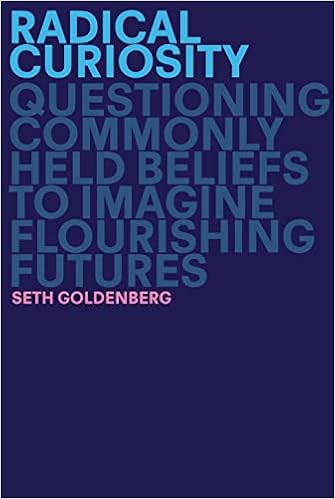 In a world with an endless hunger for innovation, why is it so hard to create audacious change? According to thought leader Seth Goldenberg, the answer to this question stems from how we, as a society, view questions themselves.
In RADICAL CURIOSITY, Goldenberg argues that because we value knowing above learning and prioritize doing over thinking, curiosity has become an endangered species. Only by rediscovering the power of questions can we hope to rewrite the commonly held “legacy” narratives that no longer serve us and to remake our organizations, our politics, and our lives.
With this empowering book, Goldenberg introduces the practice of Radical Curiosity through the lens of seven narratives that are going through significant transformation: Learning, Cohesion, Time, Youth, Aliveness, Nature, and Value. Along the way, he unpacks principles intended to spark our own questioning, including:
• Education is too big to fail, but maybe it should.
• Time travel isn’t reserved for DeLoreans.
• Let us now praise rural communities.
• Survival economics have made imagination a luxury good.
Blending philosophy, business strategy, cultural criticism, and fascinating case studies, RADICAL CURIOSITY is a new way of solving our most complex problems—one focused not on technology or science but on the power of human inquiry. By asking us to relearn how we learn, reengage in dialogue, revive our youthful sense of wonder, and rethink what we value, it reignites the curiosity needed to imagine and build a better world.
Seth Goldenberg is a designer, curator, and entrepreneur who harnesses the power of questioning to catalyze innovation and cultural change. He is the founder and CEO of Curiosity & Co., a one-of-a-kind bookstore, experience laboratory, and design-ventures studio, and the creator of the Ideas Salons, invitational thought-leader retreats that tackle the essential questions of our time. Goldenberg has led high-profile projects with clients such as Apple, American Express, the Oprah Winfrey Network, and the governor of Rhode Island. He also founded Dialog:City, the civic arts festival for the 2008 Democratic National Convention. His work has been featured in The New York Times, Wired, and Fast Company. He lives on the island of Jamestown, Rhode Island.
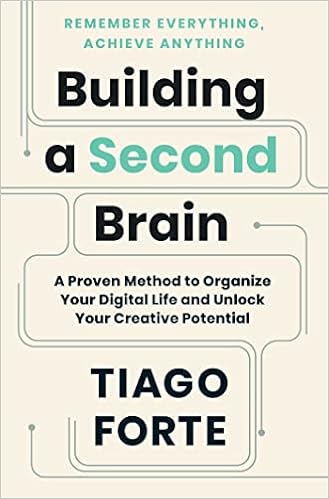 For the first time in history, we have instantaneous access to the world’s knowledge. There has never been a better time to learn, to contribute, and to improve ourselves. Yet, rather than feeling empowered, we are often left feeling overwhelmed by this constant influx of information. The very knowledge that was supposed to set us free has instead led to the paralyzing stress of believing we’ll never know or remember enough.
 A global pandemic, economic volatility, natural disasters, civil and political unrest. From New York to Barcelona to Hong Kong, it can feel as if the world as we know it is coming apart. Through it all, our human spirit is being tested. Now more than ever, it’s imperative for leaders to demonstrate compassion. But in hard times like these, leaders need to make hard decisions—deliver negative feedback, make difficult choices that disappoint people, and in some cases lay people off. How do you do the hard things that come with the responsibility of leadership while remaining a good human being and bringing out the best in others? Most people think we have to make a binary choice between being a good human being and being a tough, effective leader. But this is a false dichotomy. Being human and doing what needs to be done are not mutually exclusive. In truth, doing hard things and making difficult decisions is often the most compassionate thing to do.
 RISING TOGETHER will offer practical advice to help men and women move past impediments and establish relationships built on authenticity and trust. Finding a way to do this has become urgent in the wake of the pandemic. Working virtually has made questions of visibility, perception and assessment both more vital and more complex, while also undermining time-honored ways of building networks and alliances. These challenges will not disappear when we emerge from this period because the trend toward virtual work was already underway; the disruptions of 2020 simply accelerated it. Rising Together addresses the human questions on how we move forward.
 Gabriella Rosen Kellerman
 Martin Seligman