
The deeply researched and definitive account of the invisible emotional work and mental load so often shouldered by women, and the economics of how it is devalued monetarily and socially, as it relates to the workplace, relationships, sex, family life, and much more – providing a new framework and language for a 21st-century feminism, and ideas for how to better share the load.
EMOTIONAL LABOR
by Rose Hackman
Flatiron/St. Martin’s Press, March 2023
 “Emotional labor.” The term might sound familiar, but what does it mean exactly? Originally used to describe the unacknowledged labor flight attendants did to make guests feel welcomed and safe—on top of their actual job description—the phrase has burst through to the national lexicon in recent years. The examples, whispered among friends and posted online, are endless—a woman is tasked with organizing family functions, even without volunteering; a stranger insists you “smile more,” even as you navigate a high stress environment or grating commute. Emotional labor is essential to our society and economy, but many are asked to perform this exhausting, draining work at no extra cost. In this ground-breaking, journalistic deep-dive, Rose Hackman traces the history of the term and exposes common manifestations of the phenomenon. She describes the many ways women and girls are forced to edit the expressions of their emotions to accommodate and elevate the emotions of others. But Hackman doesn’t simply diagnose a problem—she empowers us to combat patriarchy and forge pathways for radical evolution, justice and change. This is a must-have for any feminist reader.
Rose Hackman is a British journalist based in Detroit. Her work on gender, race, labor, policing, housing and the environment – published in the Guardian – has brought international attention to overlooked American policy issues, historically entrenched injustices, and complicated social mores.
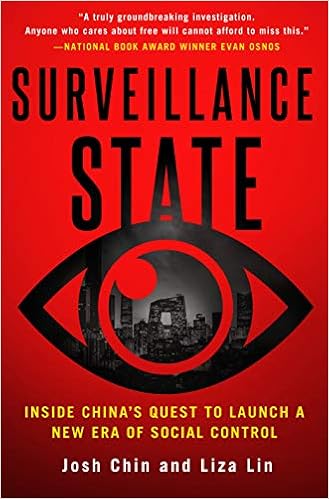 People living in democracies have for decades drawn comfort from the notion that their form of government, for all its flaws, is the best history has managed to produce. SURVEILLANCE STATE documents with startling detail how even as China’s Communist Party pays lip service to democracy as a core value of “socialism with Chinese characteristics,” it is striving for something new: a political model that shapes the will of the people not through the ballot box but through the sophisticated―and often brutal―harnessing of data.
 In 2015, increasing numbers of refugees and migrants, most of them fleeing war-torn homelands, arrived by boat on the shores of Greece, setting off the greatest human displacement since WWII. As journalists reported horrific mass drownings, an ill-prepared and seemingly indifferent world looked on. Those who reached Europe needed food, clothing, medicine, and shelter, but the international aid system broke down completely.
 Deportation is a system that pervades every aspect of American life, yet remains largely invisible. In popular discourse, it is treated as a discrete event affecting one person at a single time; in fact, the devastating ripple effect of deportation has a closer analogue in the destabilization felt by millions of Black American households when their sons and fathers are swept into our mass incarceration system. The households of deported immigrants, as well as those who live with the daily fear of expulsion, have been grappling with a similar reality on a massive and underrecognized scale.
 “
“