
The heartbreaking and ultimately hopeful story of an abandoned polar bear cub named Nora and the humans working tirelessly to save her and her species, whose uncertain future in the accelerating climate crisis is closely tied to our own.
THE LONELIEST POLAR BEAR:
A True Story of Survival and Peril on the Edge of a Warming World
by Kale Williams
Crown, March 2021
 Six days after giving birth, a polar bear named Aurora got up and left her den at the Columbus Zoo, leaving her tiny, squealing cub to fend for herself. Hours later, Aurora still hadn’t returned. The cub was furless and blind, and with her temperature dropping dangerously, the zookeepers entrusted with her care felt they had no choice: They would have to raise one of the most dangerous predators in the world themselves, by hand. Over the next few weeks, a group of veterinarians and zookeepers would work around the clock to save the cub, whom they called Nora. Humans rarely get as close to a polar bear as Nora’s keepers got with their fuzzy charge. But the two species have long been intertwined. Three decades before Nora’s birth, her father, Nanuq, was orphaned when an Inupiat hunter killed his mother, leaving Nanuq to be sent to a zoo. That hunter, Gene Agnaboogok, now faces some of the same threats as the wild bears near his Alaskan village of Wales, on the westernmost tip of the North American continent. As sea ice diminishes and temperatures creep up year-after-year, Gene and the polar bears—and everyone and everything else living in the far north—are being forced to adapt. Not all of them will succeed. Sweeping and tender, THE LONELIEST POLAR BEAR explores the fraught relationship humans have with the natural world, the exploitative and sinister causes of the environmental mess we find ourselves in, and how the fate of polar bears is not theirs alone.
Kale Williams is a reporter at The Oregonian/OregonLive, where he covers science and the environment. A native of the Bay Area, he previously reported for the San Francisco Chronicle. He shares a home with his wife, Rebecca; his two dogs, Goose and Beans; his cat, Torta; and his step-cat, Lucas.
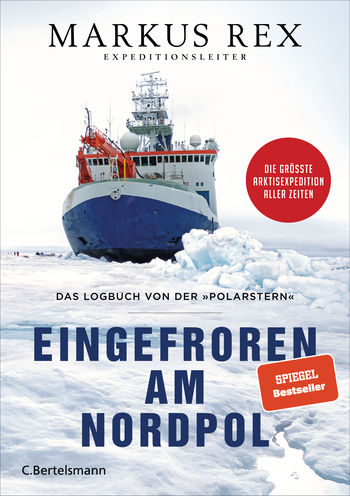 On the 20th September 2019 began the largest polar expedition of all time: The research vessel RV Polarstern set off from the port of Tromsø, Norway, to be frozen to the ice of the North Pole. Scientists from 20 countries have boarded to research the consequences of climate change for one whole year. Markus Rex, the head of this research expedition called MOSAiC, recounts in his book the story of this unique endeavour. He tells of everyday life in the extreme environment of the Arctic, of the challenges in terms of logistics and planning, and of the scientific findings that the researchers were able to gather. EINGEFROREN AM NORDPOL is not only the story of the largest research adventure ever but at the same time a vivid insight into the dramatic consequences of climate change.
 Kerri Arsenault grew up in the rural working class town of Mexico, Maine. For over 100 years the community orbited around a paper mill that employs most townspeople, including three generations of Arsenault’s own family. Years after she moved away, Arsenault realized the price she paid for that seemingly secure childhood. The mill, while providing livelihoods for nearly everyone, also contributed to the destruction of the environment and the decline of the town’s economic, moral, and emotional health in a slow-moving catastrophe, earning the area the nickname “Cancer Valley.” In Mill Town, Arsenault undertakes an excavation of a collective past, sifting through historical archives and scientific reports, talking to family and neighbors, and examining her own childhood to present a portrait of a community that illuminates not only the ruin of her hometown and the collapse of the working-class of America, but also the hazards of both living in and leaving home, and the silences we are all afraid to violate. In exquisite prose, Arsenault explores the corruption of bodies: the human body, bodies of water, and governmental bodies, and what it’s like to come from a place you love but doesn’t always love you back. A galvanizing and powerful debut,
 Since October 11th, Jane Fonda has been leading weekly Friday protests in Washington D.C. in her now iconic red coat, heeding the urgent call of young activists like Greta Thunberg to take fighting climate change to the streets. She and the Friday actions have gotten so much media attention, in part because of Jane’s unyielding commitment in the form of civil disobedience, in which other celebrities and growing crowds of activists have been inspired to participate.