
The thrilling true story of Agent A12, the first enemy of the Nazis.
CRACKING THE NAZI CODE
The Untold Story of Agent A12 and the Solving of the Holocaust Code
by Jason Bell
Pegasus Books, May 2024
(via Vertical Ink)
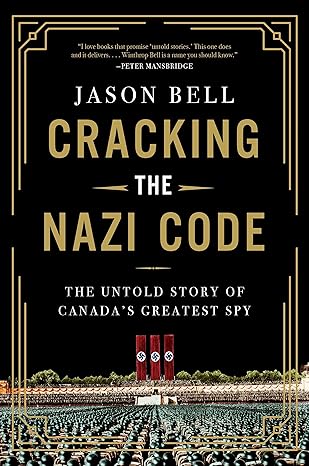 The thrilling true story of Agent A12, the first enemy of the Nazis In public life, Dr. Winthrop Picard Bell was a Harvard philosophy professor and wealthy businessman. As MI6 Secret Agent A12, he evaded gunfire and shook pursuers to break open the emerging Nazi conspiracy in electrifying 1919 Berlin. His reports, the first warning of the Nazi plot for WWII, went directly to the man known as C, the mysterious founder of MI6, and to prime ministers. But a powerful fascist politician quietly worked to suppress his alerts. Nevertheless, his intelligence sabotaged the Nazis in ways only now revealed. Bell became a spy once again in the face of WWII. In 1939, he was the first to crack Hitler’s deadliest secret code: the Holocaust. At that time the Führer was a popular politician who said he wanted peace. Could anyone believe Bell’s shocking warning? Fighting an epic intelligence war from Ukraine, Russia, and Poland to France, Germany, Canada and Washington, D.C., A12 was the real-life 007, waging a single-handed fight against madmen bent on destroying the world. Without Bell’s astounding courage, the Nazis might just have won the war.
CRACKING THE NAZI CODE, informed by recently declassified documents, is the first book to illuminate the astounding exploits of Winthrop Bell, Agent A12.
Jason Bell, Ph.D. is a professor of philosophy at the University of New Brunswick, Canada. He has served as Fulbright Professor in Germany (at Göttingen, Winthrop Bell’s alma mater), and has taught at universities in Belgium, the United States, and Canada. He was the first scholar granted exclusive access to Winthrop Pickard Bell’s classified espionage papers.
 When Arthur Woods took command of the NYPD in April of 1914, the institution was still largely corrupt and low-tech. Determined to change that, he couldn’t have anticipated the maelstrom of violence that would test his science-based approach to policing. Within weeks of his tenure, New York City was engulfed in a period of relentless bombings, many of them perpetrated by the anarchists movement led by the radicals Alexander Berkman and Emma Goldman.
 For centuries, women were denied equal access to money and the freedom and power that came with it. They were restricted from owning property or transacting in real estate. Even well into the 20th century, women could not take out their own loans or own bank accounts without their husband’s permission. They could be fired for getting married or pregnant, and if they still had a job, they could be kept from certain roles, restricted from working longer hours, and paid less than men for equal work.
 A leading scholar of artificial intelligence explores the ways in which AI is shaping contemporary culture: how it will change our lives, for better and for worse, and what it means to live in this crucial, watershed moment. The book will be structured around five parts, each centered on a basic ingredient of human creation: Words, Images, Sounds, Motion, and Systems. The chapters contend with how each element is transformed by AI systems, and how the industries that depend upon it are changing, Asking what does this mean for us, as individuals and as a society, Professor Crawford posits that the best way to understand the cultural metamorphosis underway is to start with how AI makes things for us, and what we are making of it. In this way, the book speaks to changes at the foundational level of human creation, as well as addressing a dramatic series of simultaneous industrial shifts.