
The instant New York Times bestseller, When They Call You a Terrorist is now adapted for the YA audience with photos and journal entries. In this meaningful, empowering account of survival, strength, and resilience, Patrisse Khan-Cullors and asha bandele seek to change the culture that declares innocent black life expendable.
WHEN THEY CALL YOU A TERRORIST (Young Adult Edition):
A Story of Black Lives Matter and the Power to Change the World
by Patrisse Khan-Cullors & asha bandele
Wednesday Books/St. Martin’s Press, September 2020 (voir catalogue)
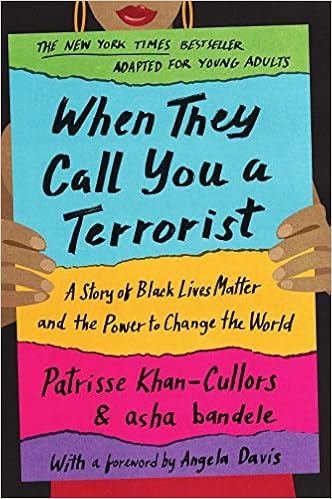 A movement that started with a hashtag—#BlackLivesMatter—on Twitter spread across the nation and then across the world. From one of the co-founders of the Black Lives Matter movement comes a poetic memoir and reflection on humanity. Necessary and timely, Patrisse Cullors’ story asks us to remember that protest in the interest of the most vulnerable comes from love. Leaders of the Black Lives Matter movement have been called terrorists, a threat to America. But in truth, they are loving women whose life experiences have led them to seek justice for those victimized by the powerful. Now, the New York Times bestseller is adapted for the YA audience with new material and reader questions plus photos, journal notes, lyrics, doodles, and more!
Patrisse Khan-Cullors is an artist, organizer, and freedom fighter from Los Angeles, CA. Co-founder of Black Lives Matter, she is also a performance artist, Fulbright scholar, popular public speaker, and an NAACP History Maker.
asha bandele is the award-winning author of The Prisoner’s Wife and several other works. Honored for her work in journalism and activism, asha is a mother, a former senior editor at Essence and a senior director at the Drug Policy Alliance.
 Celebrating, honoring, and using the chakras frees us to express our authenticity and live a life of power, love, joy, creativity, connection and purpose. In today’s yoga culture, the chakras are for much more than healing, which has been the traditional application of this 4000-year-old wisdom. While the idea and attributes of the chakras have become trendy, sexy, cool, and very spiritual, few people today really know how to activate the chakras’ powerful energy for deep transformation. Cristi aims to change that, and her book offers readers a multi-dimensional, practical and inspiring, structured seven-week step-by-step program.
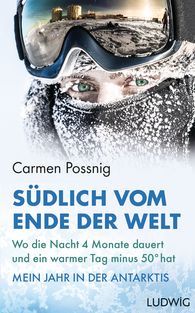 A return trip to the South Pole is an impossible dream for many of us – but the medic Carmen Possnig did just that. On behalf of the European Space Agency, she spent a year in the heart of the Antarctica to find out what it’s like to live in extreme weather conditions, with a distinct lower level of oxygen and in complete isolation from the rest of the world. With twelve other scientists, she spent the winter at the Concordia research station in the eternal ice. There, she not only encountered the breathtaking beauty of the most extreme continent on Earth, but also her own limits: Sharing a tight space with other people for twelve months, in a world that remains dark for months on end and where the temperature drops to -80°C, requires a huge physical and mental effort. Carmen Possnig’s personal and witty travel report, and its wealth of photographs, opens up a window onto an alien world – making us marvel at our planet’s diversity, and at how adaptable human nature can be.
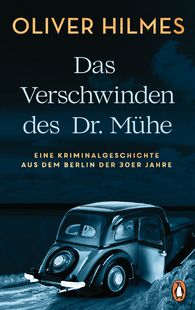 During the final months of the Weimar Republic, a highly regarded doctor disappears. His sports car is found abandoned on the shores of a lake near Berlin. The homicide division investigates and discovers that the respectable medic’s carefully cultivated façade has been hiding a shady double life, whose trail leads from Berlin all the way to Barcelona. Oliver Hilmes has reconstructed this sensational and puzzling case from files discovered in Berlin’s regional archive. Enriched with fictional touches, Dr Mühe’s Disappearance is the gripping and ingenious story of the search for truth, and of the dark side of middle-class life on the eve of dictatorship.
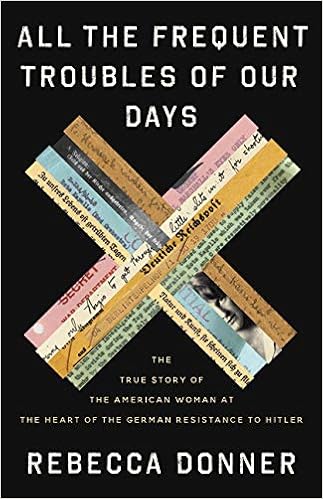 What do you do when you suddenly find yourself confronted with a mortal threat to your society’s fundamental, stabilizing principles? Mildred Harnack chose to stand. Milwaukee-born, she was the leader of the largest anti-Nazi resistance group in Germany, and the only American woman to be put to death on Hitler’s orders. Despite its unmatched vastness, the record of World War II atrocity and nobility will forever remain incomplete. This ever-expanding volume of belligerence and courage is perhaps the most gravely gendered historical document we have; a war perpetrated, suffered and recounted by men. There are periodically polite acknowledgments of the roles played by woman in ‘aiding’ the war effort, but these usually have the hollow ring of tokenism. Mildred Harnack’s short but monumental life shows us just how incomplete that record remains. From 1933-42, with her German husband, Arvid, Mildred led a cell that couriered top secret military intelligence to the Allies, helped dissidents and persecuted minorities escape Germany, and distributed literature that encouraged civil disobedience and exposed Nazi plans. Fusing elements of biography, political thriller, and scholarly detective story, Harnack’s great-great-niece Rebecca Donner brilliantly interweaves family archives, original research, exclusive interviews with survivors, and a trove of declassified intelligence documents into a powerful, enthralling story, reconstructing the moral courage of an enigmatic woman nearly erased by history.