
In this beautifully written, vividly detailed memoir, a young woman chronicles her adventures traveling across the deserts of the American West in an orange van named Bertha and reflects on an unconventional approach to life.
NOWHERE FOR VERY LONG:
The Unexpected Road to an Unconventional Life
by Brianna Madia
HarperOne, April 2022
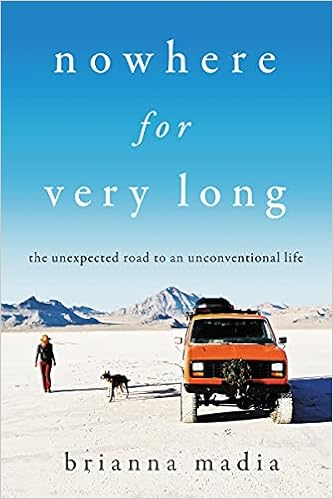 A woman defined by motion, Brianna Madia bought a beat-up bright orange van, filled it with her two dogs Bucket and Dagwood, and headed into the canyons of Utah with her husband. Nowhere for Very Long is her story of exploration—of the world outside and the spirit within.
Brianna knew her road would be the one less traveled from an early age. Rejecting the competitive and capitalistic path set out before her, she chose to seek a different version of happiness, a road scary, uncertain, and entirely her own. But pursuing a life of intention isn’t always what it seems. In fact, at times it was downright boring, exhausting, and even desperate—when the van overheated and she was forced to pull over on a lonely stretch of South Dakota highway; when the weather was bitterly cold and her water jugs froze beneath her as she slept in the parking lot of her office; when she worried about money, her marriage, and the looming question mark of her future. But she was living a life true to herself, come what may, and that made all the difference.
NOWHERE FOR VERY LONG is the chronicle of a woman learning and unlearning, from backroads to breakdowns, married to solo, and finally, from lost to found.
Brianna Madia is a writer, adventurer, and desert-dweller. For the last several years, she and her now three pups Bucket, Dagwood, and Birdie call her big orange van, Bertha, home. An avid climber, canyoneer, mountain biker, kayaker, and explorer, Brianna believes in moving against the grain, embracing her true self, and trying all the things that scare you.
 For nine years, South Carolina officials struggled to identify “the boy in the woods,” whose body had been discovered just south of Myrtle Beach in a fishing village called Murrells Inlet. Meanwhile,1,200 miles away in Kansas City, Missouri, Frank McGonigle’s family searched for him at Grateful Dead concerts and in the face of every long-haired hitchhiker they passed. Consumed by guilt for how they’d treated him, Frank’s eight siblings slowly came to understand that — like Jerry Garcia sang — he’s gone and nothin’s gonna bring him back. Frank McGonigle was finally found — and identified as “the boy in the woods.”
 Americans of good will on both the left and the right are secretly asking themselves the same question: how has the conversation on race in America gone so crazy? We’re told to read books and listen to music by people of color but that wearing certain clothes is “appropriation.” We hear that being white automatically gives you privilege and that being Black makes you a victim. We want to speak up but fear we’ll be seen as unwoke, or worse, labeled a racist. According to John McWhorter, the problem is that a well-meaning but pernicious form of antiracism has become, not a progressive ideology, but a religion—and one that’s illogical, unreachable, and unintentionally neoracist.
 Publié en janvier 2020 chez Grove Atlantic, le livre de David Zucchino intitulé WILMINGTON’S LIE: The Murderous Coup of 1898 and the Rise of White Supremacy vient de remporter le prestigieux prix Pulitzer dans la catégorie « General Nonfiction ».
 Soos is coming of age in a household with a lot of rules. No bikinis, despite the Queensland heat. No boys, unless he’s Muslim. And no life insurance, not even when her father gets cancer. Soos is trying to balance her parents’ strict decrees with having friendships, crushes and the freedom to develop her own values. With each rule Soos comes up against, she is forced to choose between doing what her parents say is right and following her instincts. When her family falls apart, she comes to see her parents as flawed, their morals based on a muddy logic. But she will also learn that they are her strongest defenders.