
The Atlantic staff writer and poet Clint Smith’s revealing, contemporary portrait of America as a slave-owning nation.
HOW THE WORD IS PASSED:
A Reckoning with the History of Slavery Across America
by Clint Smith
Little, Brown, June 2021
 Beginning in his own hometown of New Orleans, Clint Smith leads the reader through an unforgettable tour of monuments and landmarks—those that are honest about the past and those that are not—that offer an intergenerational story of how slavery has been central in shaping our nation’s collective history, and ourselves. It is the story of the Monticello Plantation in Virginia, the estate where Thomas Jefferson wrote letters espousing the urgent need for liberty while enslaving over 400 people on the premises. It is the story of the Whitney Plantation, one of the only former plantations devoted to preserving the experience of the enslaved people whose lives and work sustained it. It is the story of Angola, a former plantation-turned maximum security prison in Louisiana that is filled with Black men who work across the 18,000-acre land for virtually no pay. And it is the story of Blandford Cemetery, the final resting place of tens of thousands of Confederate soldiers. In a deeply researched and transporting exploration of the legacy of slavery and its imprint on centuries of American history, HOW THE WORD IS PASSED illustrates how some of our country’s most essential stories are hidden in plain view—whether in places we might drive by on our way to work, holidays such as Juneteenth, or entire neighborhoods—like downtown Manhattan—on which the brutal history of the trade in enslaved men, women and children has been deeply imprinted.
Informed by scholarship and brought alive by the story of people living today, Clint Smith’s debut work of nonfiction is a landmark work of reflection and insight that offers a new understanding of the hopeful role that memory and history can play in making sense of our country and how it has come to be.
Clint Smith is a staff writer at The Atlantic and the author of the poetry collection Counting Descent. The book won the 2017 Literary Award for Best Poetry Book from the Black Caucus of the American Library Association and was a finalist for an NAACP Image Award. His writing has been published in The New Yorker, The New York Times Magazine, Poetry Magazine, The Paris Review and elsewhere. Born and raised in New Orleans, he received his B.A. in English from Davidson College and his Ph.D. in Education from Harvard University.
 After a near-death experience in Snowdonia, journalist Cecily Wong swore she’d never go to the mountains again. But when she’s offered the career opportunity of a lifetime – to interview world famous mountaineer Charles McVeigh as he completes his record-breaking mission in Nepal – she has no choice but to take it. There’s just one caveat: she has to summit the mountain first. It’s a mammoth task that Cecily fears she cannot handle, especially when disaster strikes before they’ve even left for base camp in the form of an earthquake that seriously injures one of the team, and an anonymous note left pinned to her tent, warning her there’s a murderer on the mountain.
 After the events of
 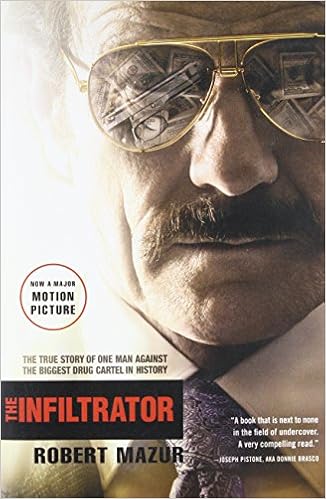 Robert Mazur spent years undercover infiltrating the Medellín Cartel’s criminal hierarchy. The dirty bankers and businessmen he befriended – some of whom still shape power across the globe – knew him as Bob Musella, a wealthy, mob-connected big shot living the good life. Together they partied in $1,000-per-night hotel suites, drank bottles of the world’s finest champagne, drove Rolls-Royce convertibles, and flew in private jets. But under Mazur’s Armani suits and in his Renwick briefcase, recorders whirred silently, capturing the damning evidence of their crimes.