
A radical argument that we are living on the wrong clock—one that tells us time is money—and that there are other ways of experiencing time that offer bold, hopeful possibilities for ourselves and the planet from the New York Times bestselling author of How to Do Nothing.
SAVING TIME:
Discovering A Life Beyond the Clock
by Jenny Odell
Random House, March 2023
(via Frances Goldin Literary)
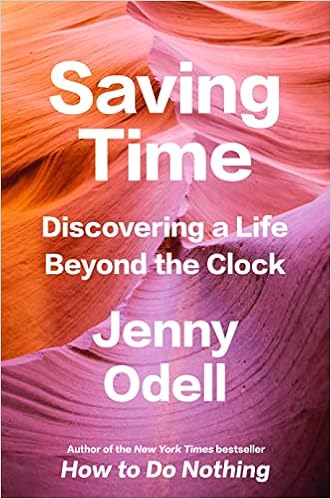
Our daily experience, dominated by the corporate clock that so many of us contort ourselves to fit inside, is destroying us. It wasn’t built for people, it was built for profit. This is a book that tears open the seams of reality as we know it—the way we experience time itself—and rearranges it, reimagining a world not centered around work, the office clock, or the profit motive. Explaining how we got to the point where time became money, Odell offers us new models to live by–inspired by pre-industrial cultures, ecological, and geological time–that make a more humane, more hopeful way of living seem possible.
In this dazzling, subversive, and deeply hopeful reframing of time, Jenny Odell takes us on a journey through other temporal habitats. As planet-bound animals, we live inside shortening and lengthening days, alongside gardens growing, birds migrating, and cliffs eroding. The stretchy quality of waiting and desire, the way the present may suddenly feel marbled with childhood memory, the slow but sure procession of a pregnancy, or the time it takes to heal from injuries–physical or emotional. Odell urges us to become stewards of these different rhythms of life, to imagine a life, identity, and source of meaning outside of the world of work and profit, and to understand that the trajectory of our lives–or the life of the planet–is not a foregone conclusion. In that sense, “saving” time—recovering its fundamentally irreducible and inventive nature—could also mean that time saves us.
JENNY ODELL is the author of How To Do Nothing, which was a NYT bestseller and one of Barack Obama’s favorite books of 2019. Odell’s writing has appeared in outlets including The New York Times, New York Magazine, The Atlantic, The Believer, The Paris Review, and McSweeney’s. Her work as a visual artist has been exhibited locally and internationally. She teaches digital art at Stanford University.
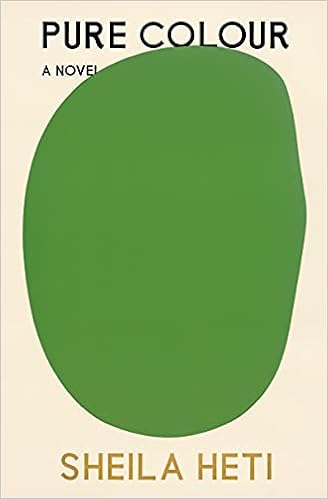 The world is failing to remain a world. It is coming apart. The ice cubes are melting. Species are dying. People, too―of different things. But what if this world is just a first draft, made by some great artist in order to be destroyed? In this first draft of the world, a woman named Mira leaves home to study. There, she meets Annie, whose tremendous power opens Mira’s chest like a portal―to what, she doesn’t know. When Mira is older, her beloved father dies, and his spirit passes into her. Together, they become a leaf on a tree. But photosynthesis gets boring and being alive is a problem that cannot be solved, even by a leaf. Eventually, Mira must remember the human world she’s left behind, including Annie, and choose whether or not to return.
 Gerald, an employee of a New York-based PR firm, is working in a spreadsheet when he finds his consciousness uploaded into the company’s Slack channel. Despite his posts for help, his colleagues assume it’s an elaborate strategy to work from home. Gerald enlists his co-worker Pradeep to care for his body while they figure out how to reintegrate his consciousness. Plunging deeper into the Slack workspace—and becoming a more productive employee by the day—Gerald relies on Slackbot, the messaging service’s AI assistant, to help him navigate his new digital reality. But what happens when the Slackbot discovers a world (and an empty body) outside the Slack app? Meanwhile, Gerald’s co-workers scramble to stem the PR catastrophe that erupts after Bjärk dog food poisons Pomeranians across the country. Will their boss Doug discover that Tripp has been fucking new hire Beverley on Doug’s now-broken desk? Why does Lydia now hear an incessant howling that started on a work-from-home day? Is it possible for love to develop between two men when one is a disembodied consciousness? And what the hell does the :dusty-stick: emoji mean?
 In WHATEVER WORKS, Thalma Lobel, one of the world’s leading experts on human behavior, explores groundbreaking psychological research on job performance, satisfaction, and creativity. Lobel goes beyond obvious considerations like salary, title, and company culture to shed light on the hidden factors-often unrecognized, counterintuitive, or invisible-that have profound effects on how well we can do our jobs and how happy we are at work. Did you know that just doodling in a certain way can increase your creativity? That looking at something green for forty seconds will improve your attention? That crossing your legs similarly to an interviewer could get you the job? That the mere presence of a smartphone on your desk can lessen your performance, even if it’s turned off? That being in a warmer room makes you more likely to want to conform with the group, affecting your decision-making? These are the invisible factors that nudge our behavior on a daily basis, and combined, have a real and significant bearing on our success—or failure—at work. Helpful for anyone from individual employees to managers to leaders of large organizations, WHATEVER WORKS shares valuable insights and practical takeaways to transform your professional life.