
THE EXTREMIST MIND weaves together personal memoir with evolutionary psychology, neuroscience, political economics, and anthropological fieldwork with jihadists, white nationalists, QAnon devotees to explain how people develop and act on extremist beliefs.
THE EXTREMIST MIND:
What It Says About Human Nature and the Modern World
by Dr Nafees Hamid
Bloomsbury UK, 2026
(via Northbank Talent Management)
 We’ve all been exposed to extremist, populist, and conspiratorial narratives and yet most of us roll our eyes at it or laugh it off. What causes some small minority of people to take these narratives seriously? What causes an even smaller percentage of that population to actually act on those narratives? Why do some even give their lives based on those ideas? And, most importantly, what can we do to stop people from committing political violence?
Cognitive scientist Nafees Hamid has travelled the world meeting members of ISIS, Hezbollah, NeoNazis, QAnon, and a variety of other violent and divisive movements. He has interviewed, surveyed, conducted psychology experiments with them and is one of the few people to have scanned their brains. The book details Nafees’s experiences going out into the field to find the subjects: from escaping an ISIS recruiter; to realising his research assistant had gradually been radicalised right under his nose; to a former flatmate who turned to QAnon during the pandemic, challenging Nafees to put into practice everything he had learned in order to de-program his friend.
Dr Nafees Hamid is a Cognitive Scientist of extremism, conspiracy theories, and political violence. In his current role at King’s College London, he co-leads a multi-nation research project which explores the role of trauma and mental health on pathways to peace versus violence in fragile and conflict affected states.
 In this game-changing parenting book, Dr. Escalante outlines her 3-step science-based approach to escaping the ShouldStorm and embracing shouldfree mindful parenting. Going into detail about each step, she clearly explains how to implement this approach in everyday situations where parents may feel overwhelmed and shares real results from parents and children who use the technique:
 Rhetoric once sat at the center of elite education. Alexander the Great, Shakespeare, and Martin Luther King, Jr., used it to build empires, write deathless literature, and inspire democracies. Now it will help you to take leadership over yourself; not through pop psychology or empty inspiration, but with persuasive tools that have been tested for more than three thousand years. In
  ALL ALONE works against the myth that being alone is necessarily equivalent to being lonely or being antisocial, instead it argues for an understanding of solitude as a natural, necessary, and beneficial part of a healthy human life. It is a guidebook on how to approach solitude in a healthy way and how to best strike a balance between solitude and socialization at home, in the workplace, in our romantic relationships, as parents, and at different life stages.
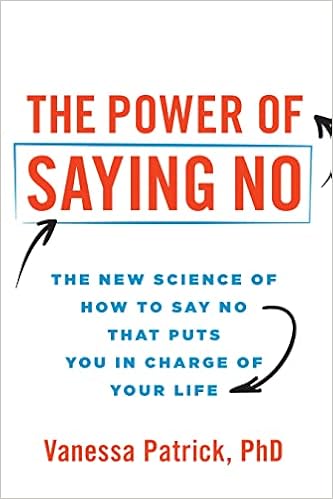 You have probably said « yes » to bosses, partners, family, friends, and even strangers, when you actually want to say « no. » Maybe you wish you could say no more often, but you’re not sure how or if it’s even possible to do so. You’re not alone! We’re taught to say yes as often as we can. After all, if you say no, aren’t you likely to miss out on opportunities and sever important relationships? Isn’t saying no a harmony-buster?