
Why are some people more susceptible to bad ideas and others are more capable of repelling them?
MENTAL IMMUNITY:
Infectious Ideas, Mind Parasites, and the Search for a Better Way to Think
by Andy Norman
HarperWave, May 2021
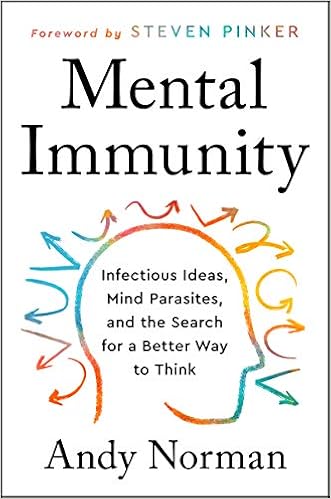 Andy Norman has spent years studying the destructive forces that can flip the minds of sensible people to understand how they take hold. He calls them mind-parasites, ideas that can poison our thinking and leave us more susceptible to wild conspiracies, lead us to reject scientific evidence, and convince us to double down on unfounded beliefs. Just as the body can be weakened by foreign organisms that make us sick, the mind too is vulnerable to infection. But just as antibiotics can be used to attack the biological organisms causing physical illness, we can treat the mind parasites that invade our heads. He shows us how to engage in productive discussion, analyzes the psychological evidence about how to change minds, and reveals how we can safeguard ourselves and protect those around us from mind-parasites like conspiracies and fake news. In MENTAL IMMUNITY Andy Norman calls for the study of cognitive immunology, a way of thinking where individuals and society learn to differentiate facts and reasons from disinformation and false memes. By strengthening our mental immunity, we become open to other ideas and learn how better to communicate about beliefs and policy without dissolving into partisan finger-pointing. Norman offers suggestions to create a value- and respect-based system of dialogue that can help us bolster cultural cognitive immunity as we protect our own minds from succumbing to bad ideas.
Steven Pinker will write the foreword and has already said that this is “a splendid idea for a book: original, controversial, and timely.”
Andy Norman teaches philosophy and directs the Humanism Initiative at Carnegie Mellon University. His work has appeared in Free Inquiry, Essays in the Philosophy of Humanism, and dozens of other journals.
 Being a mother is the most wonderful job in the world – but also the most demanding. Pressures of high expectations, overwhelming responsibilities, and exhaustion are just some of the stress factors that can lead to health problems such as cardiovascular disease and depression. What are the best ways to help mothers?
 In WHATEVER WORKS, Thalma Lobel, one of the world’s leading experts on human behavior, explores groundbreaking psychological research on job performance, satisfaction, and creativity. Lobel goes beyond obvious considerations like salary, title, and company culture to shed light on the hidden factors-often unrecognized, counterintuitive, or invisible-that have profound effects on how well we can do our jobs and how happy we are at work. Did you know that just doodling in a certain way can increase your creativity? That looking at something green for forty seconds will improve your attention? That crossing your legs similarly to an interviewer could get you the job? That the mere presence of a smartphone on your desk can lessen your performance, even if it’s turned off? That being in a warmer room makes you more likely to want to conform with the group, affecting your decision-making? These are the invisible factors that nudge our behavior on a daily basis, and combined, have a real and significant bearing on our success—or failure—at work. Helpful for anyone from individual employees to managers to leaders of large organizations, WHATEVER WORKS shares valuable insights and practical takeaways to transform your professional life.
 Stephanie Foo was an accomplished journalist, a producer at