
Do you ever look up to the stars and wonder about what is out there? An accessible science narrative for readers of Astrophysics for People in a Hurry, this book allows readers to eavesdrop on a conversation between two Award-winning physicists and delve into a multidisciplinary discussion of our understanding of the universe.
WHERE DID THE UNIVERSE COME FROM?
and Other Cosmic Questions: Our Universe, from the Quantum to the Cosmos
by Chris Ferrie & Geraint F. Lewis
Sourcebooks, September 2021
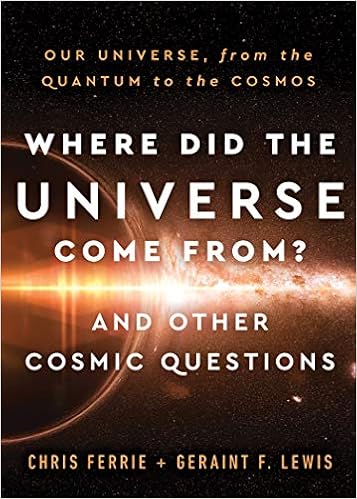 Over the last few centuries, humans have successfully unraveled much of the language of the universe, exploring and defining formerly mysterious phenomena such as electricity, magnetism, and matter through the beauty of mathematics. But some secrets remain beyond our realm of understanding—and seemingly beyond the very laws and theories we have relied on to make sense of the universe we inhabit. It is clear that the quantum, the world of atoms and electrons, is entwined with the cosmos, a universe of trillions of stars and galaxies…but exactly how these two extremes of human understanding interact remains a mystery. WHERE DID THE UNIVERSE COME FROM? and Other Cosmic Questions allows readers to eavesdrop on a conversation between award-winning physicists Chris Ferrie and Geraint F. Lewis as they examine the universe through the two unifying and yet often contradictory lenses of classical physics and quantum mechanics, tackling questions such as: Where did the universe come from? Why do dying stars rip themselves apart? Do black holes last forever? What is left for humans to discover?
A brief but fascinating exploration of the vastness of the universe, this book will have armchair physicists turning the pages until their biggest and smallest questions about the cosmos have been answered.
Chris Ferrie is an award-winning physicist and Senior Lecturer for Quantum Software and Information at the University of Technology Sydney. He has a BMath in Mathematical Physics and a PhD in Applied Mathematics. He lives in Australia with his wife and children.
Geraint F. Lewis is an award-winning astrophysicist and Professor of Astrophysics at the Sydney Institute for Astronomy.
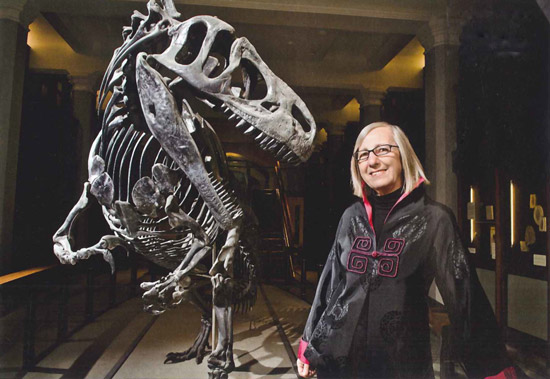 World-renowned geologist and paleontologist Gerta Keller is at the center of what has been called the nastiest feud in science, a contentious debate popularly known as “The Dinosaur Wars” over what triggered the fifth mass extinction at the end of the Cretaceous Era sixty-six million years ago. Dinosaurs have enthralled us for generations, and the question of what caused their demise is more relevant than ever, as humankind confronts the paroxysms of an imperiled planet and the possibility that we may become the dinosaurs of the sixth extinction.
 There is the initial pain of loss, and then there is the grieving. We have long assigned grief to the realm of nebulous emotions, but we now know that the brain creates those emotions in response to many outside factors. Neuroscientist Mary-Frances O’Connor has been studying the effects of grief on the brain and body for more than twenty years, and the clues she has found as to how we cope with loss turn out to be rooted in how we fall in love. In THE GRIEVING BRAIN, she explores this new territory and explains what happens inside the brain when we become attached to another and then lose that loved one—and why it can be so difficult to imagine a future without them. (Hint: Sometimes the brain leads us to believe the death is just not true.)
 WATER ALWAYS WINS makes clear that we need to fundamentally rethink our relationship with water. We must embrace the reality that we are an integral part of nature and need learn to live in harmony with these forces that we cannot conquer. This requires humility, not arrogance; collaboration, not aggressive control and setting a goal, which is to determine what water wants and figure out a how to make way for it, while protecting and securing our lives. The overarching theme is that such a mindset is essential in all our dealings with every aspect of nature, if we want our planet to survive. As Erica Gies so beautifully states, water is life, it “flexes with the rhythms of the earth, expanding and retreating in an eternal dance upon the land.”
 The smartphone. How could a small device have become so life-defining so quickly? Can we change this situation without having to do without too many things? Christoph Koch says, yes, we can. For many years he has been dealing with the topics of internet abstinence and online addiction. With scientifically supported findings, he explains what is behind all this. Why are apps so addicting? What is happening in the brain? Why is almost no one resistant to it? Which business models are based on this? And what do experts say? Koch’s 30-day challenge shows why it is worth reducing online consumption and how one can benefit both physically and mentally through a more aware interaction with digital media. Motivating, entertaining, easy to implement – a guide for creating a digital balance.