
Science journalist Rebecca Boyle explores the cultural and scientific history of the Moon and discovers that far from being a lifeless ornament of the sky, the Moon holds the answers to some of our most fundamental questions—from the origins of the Earth and the genesis of life to the nature of time itself.
OUR MOON:
Uncovering the Secrets It Holds to Our Past and Our Future
by Rebecca Boyle
Random House, January 2024
(via DeFiore and Co.)
 The Moon is our constant companion. It has been watching over us since before there was an “us.” From our earliest beginnings, we have worshipped the moon, used it to mark our days, depended on its predictability to grow our crops and follow migrating herds, and looked to it for artistic and spiritual inspiration. The Moon has played many roles in our lives, and now it is ready to tell us all it knows.
In OUR MOON, award-winning science journalist Rebecca Boyle traces our relationship with the Moon over the centuries and explores the latest scientific findings into what the Moon can now tell us about Earth’s origins and its future. As we prepare to return to the Moon, it is more important than ever to take a closer look at this still mysterious neighbor of ours.
No other book has delved into the cultural and scientific history of the Moon. A subject with truly global appeal, OUR MOON is for readers who enjoy single-subject works such as Yuval Noah Harari’s Sapiens and David George Haskell’s The Songs of Trees.
Rebecca Boyle is a contributing writer for The Atlantic, a frequent contributor at FiveThirtyEight, and a freelance journalist whose work has been published in the New York Times, Wired, Aeon, Quanta, Popular Science, The New Yorker, and Scientific American. Boyle was a 2011 Ocean Science Journalism fellow at the Woods Hole Oceanographic Institution in Woods Hole, Massachusetts, and a 2013 journalism fellow at the National Center for Atmospheric Research in Boulder, Colorado. This is her first book.
 Artificial intelligence is bringing a new digital order—it is changing war, surveillance, and disinformation, with profound effects on human freedom, global security, and power dynamics. THE BLACK BOX takes us inside the immensely competitive global struggle to lead in the four key elements of AI advantage: data, computing power, talent, and institutions. A world expert in AI-enabled weapons, Paul Scharre examines the strengths and weaknesses of today’s major superpowers, including China, the United States, Europe, and the Big Tech corporations that control the global supply of data and compute.
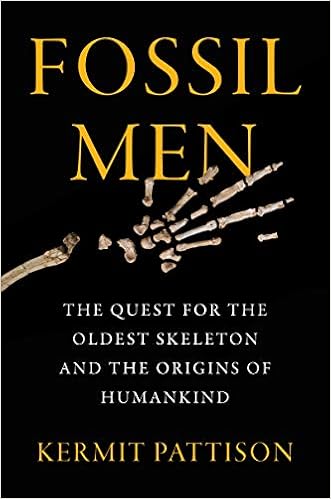 In 1994, a team led by fossil-hunting legend Tim White—”the Steve Jobs of paleoanthropology”—uncovered the bones of a human ancestor in Ethiopia’s Afar region. Radiometric dating of nearby rocks indicated the skeleton, classified as Ardipithecus ramidus, was 4.4 million years old, more than a million years older than “Lucy,” then the oldest known human ancestor. The findings challenged many assumptions about human evolution—how we started walking upright, how we evolved our nimble hands, and, most significantly, whether we were descended from an ancestor that resembled today’s chimpanzee—and repudiated a half-century of paleoanthropological orthodoxy. FOSSIL MEN is the first full-length exploration of Ardi, the fossil men who found her, and her impact on what we know about the origins of the human species. It is a scientific detective story played out in anatomy and the natural history of the human body. Kermit Pattison brings into focus a cast of eccentric, obsessive scientists, including one of the world’s greatest fossil hunters, Tim White—an exacting and unforgiving fossil hunter whose virtuoso skills in the field were matched only by his propensity for making enemies; Gen Suwa, a Japanese savant who sometimes didn’t bother going home at night to devote more hours to science
 On the 20th September 2019 began the largest polar expedition of all time: The research vessel RV Polarstern set off from the port of Tromsø, Norway, to be frozen to the ice of the North Pole. Scientists from 20 countries have boarded to research the consequences of climate change for one whole year. Markus Rex, the head of this research expedition called MOSAiC, recounts in his book the story of this unique endeavour. He tells of everyday life in the extreme environment of the Arctic, of the challenges in terms of logistics and planning, and of the scientific findings that the researchers were able to gather. EINGEFROREN AM NORDPOL is not only the story of the largest research adventure ever but at the same time a vivid insight into the dramatic consequences of climate change.
 A criminalistic search for clues of the origins of humanity