
Fans of Morgan Matson and Sarah Dessen will fall in love with this contemporary coming of age story set at a picturesque Virginia boarding school.
ANY PLACE BUT HERE
by Sarah Van Name
Sourcebooks, May 2021
(via Sterling Lord Literistic)
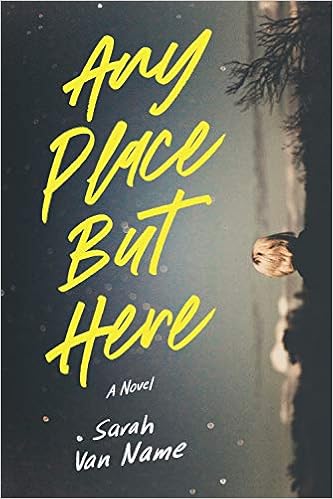 That’s what Jess was to me. I was the ground; she was the rain. I wasn’t anything until she woke me up. Seventeen-year-old June is completely wrapped up in her best friend Jess. The two are inseparable and June feels so lucky that they found each other. Even if everyone else around her thinks Jess is a bad influence. Even if June is starting to question if she likes Jess as more than just a friend. But after June is expelled from school at the end of her first semester of junior year, she’s forced to move to Virginia, to live with her grandmother and attend an all-girls boarding school. She’ll be miles away from her home, from her family, and from Jess. June is miserable at first and counts down the days until she can come back home for the summer. But when she befriends two new girls and meets a boy named Sam, who she is instantly drawn to, life in Virginia starts to feel more real. Except Jess is always on her mind, and she can’t deny her feelings anymore, even as Jess starts to pull away from her. June can’t let Jess go―but she needs to figure out how to move forward, and how to find the place she really belongs.
Sarah Van Name grew up in North Carolina and attended Duke University twice, once for a teenage creative writing camp and once as an undergraduate. She lives and works in Durham with her husband, Ben, and her dog, Toast. She is the author of The Goodbye Summer.
 THE SIGN FOR HOME tells the story of Arlo Dilly, a DeafBlind 23-year-old man raised by conservative family members who limit his use of technology. While taking a basic English composition class, Arlo is assigned a new sign language interpreter named Cyril Brewster who is recovering from a romantic breakup and is looking for a new challenge in his career. When Cyril begins to interpret Arlo’s classes he soon realizes that Arlo’s understanding of language, love, and life have been limited, governed, and often censored by iron-fisted guardians. Showing Arlo more of the world and the independence he could have puts Cyril in conflict with Arlo’s family. Against this external conflict of language mediation, we travel inside Arlo’s mind and inside his perceptions of the most important moments of his life, including his own linguistic awakenings, and a heartbreaking memory of first love and first friendship derailed by unspeakable tragedy. When the buried memories are eventually unlocked by a class writing assignment, Arlo convinces Cyril to abandon his own professional ethics to facilitate a forbidden meeting with his old school friends and first love. The narration of The Sign For Home alternates between Arlo’s voice (with its distinctive Deaf syntax) and Cyril’s fast and funny point of view, with dialogue rendered in both standard English and an approximation of American Sign Language structure. The resulting novel is not only unique, but fast-paced, delectable, emotional, and powerful.
 THE PARTY YEAR is a an ekphrastic, illuminating tour de force, inspired in part by Cunningham’s own time working on the 2008 presidential campaign of Barack Obama. In these pages, fundraising staffer David Hammond travels around the country for donor events, landing everywhere from a trailer in New Hampshire to a Beverly Hills mansion. Hammond is a keen and thoughtful observer, whose reflections on memory and history are interwoven throughout in a flowing counterpoint between past and present, the personal and the larger-than-life. Through intimate, candescent prose, THE PARTY YEAR contemplates the stories and arts that define and bring beauty to our lives.
 An unnamed woman checks into a guesthouse in a mysterious district known only as the Subdivision. The guesthouse’s owners, Clara and the Judge, are welcoming and helpful, if oddly preoccupied by the perpetually baffling jigsaw puzzle in the living room. With little more than a hand-drawn map and vague memories of her troubled past, the narrator ventures out in search of a job, an apartment, and a fresh start in life. Accompanied by an unusually assertive digital assistant named Cylvia, the narrator is drawn deeper into an increasingly strange, surreal, and threatening world, which reveals itself to her through a series of darkly comic encounters reminiscent of Gulliver’s Travels. A lovelorn truck driver…a mysterious child…a watchful crow. A cryptic birthday party. A baffling physics experiment in a defunct office tower where some calamity once happened. Through it all, the narrator is tempted and manipulated by the bakemono, a shape-shifting demon who poses a distinctly terrifying danger. Harrowing, meticulous, and deranged, SUBDIVISION is a brilliant maze of a novel from the writer Kelly Link has called “a master of the dark arts.” With the narrative intensity and mordant humor familiar to readers of
 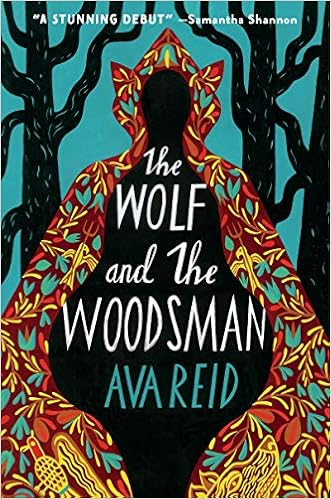 In her forest-veiled pagan village, Évike is the only woman without power, making her an outcast clearly abandoned by the gods. The villagers blame her corrupted bloodline—her father was a Yehuli man, one of the much-loathed servants of the fanatical king. When soldiers arrive from the Holy Order of Woodsmen to claim a pagan girl for the king’s blood sacrifice, Évike is betrayed by her fellow villagers and surrendered. But when monsters attack the Woodsmen and their captive en route, slaughtering everyone but Évike and the cold, one-eyed captain, they have no choice but to rely on each other. Except he’s no ordinary Woodsman—he’s the disgraced prince, Gáspár Bárány, whose father needs pagan magic to consolidate his power. Gáspár fears that his cruelly zealous brother plans to seize the throne and instigate a violent reign that would damn the pagans and the Yehuli alike. As the son of a reviled foreign queen, Gáspár understands what it’s like to be an outcast, and he and Évike make a tenuous pact to stop his brother. As their mission takes them from the bitter northern tundra to the smog-choked capital, their mutual loathing slowly turns to affection, bound by a shared history of alienation and oppression. However, trust can easily turn to betrayal, and as Évike reconnects with her estranged father and discovers her own hidden magic, she and Gáspár need to decide whose side they’re on, and what they’re willing to give up for a nation that never cared for them at all.