
The unforgettable story of a fiercely resilient young man grappling with a physical disability, and his efforts to solve a mystery unfolding right outside his door.
HOW LUCKY
by Will Leitch
HarperCollins, May 2021
 Daniel leads a rich life in the university town of Athens, Georgia. He’s got a couple close friends, a steady paycheck working for a regional airline, and of course, for a few glorious days each Fall, college football tailgates. He considers himself to be a mostly lucky guy—despite the fact that he’s suffered from a debilitating disease since he was a small child, one that has left him unable to speak or to move without a wheelchair. Daniel spends the hours he’s not online communicating with irate air travelers observing his neighborhood from his front porch. One young woman passes by so frequently that spotting her out the window has almost become part of his daily routine, until the day he’s almost sure he sees her being kidnapped. Featuring a great cast of charactrers, HOW LUCKY is as suspenseful as it is moving.
Will Leitch is a contributing editor at New York magazine and writes weekly for the magazine, Intelligencer and Vulture. He also writes regularly for NBC News, The New York Times, The Washington Post, Medium and MLB.com and is the founder of the late sports website Deadspin. He lives in Athens, Georgia with his wife and two sons.
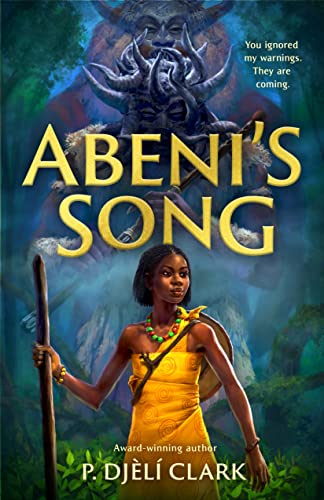 In darkness, a song can lead the way. Beware which one you listen to. On the day of the spirits festival, the old woman who lives in the forest appears in Abeni’s village with a terrible message: “You ignored my warnings. It’s too late to run. They are coming.”
 A quick, straightforward, fast-paced read about Mateo, a boy who not only can fight off disease in a world where antibiotics have lost all of their power, but can heal others. This amazing kid is being hunted by those who want to harness and potentially extinguish his ability. When two detectives find themselves caught in the crossfire of the pursuit, they put their careers and their lives at risk, deciding to deliver Mat to The Resistance—an organization they’ve been trained to view as an enemy to the State but soon start to realize is probably society’s last, best hope.
 Beginning in his own hometown of New Orleans, Clint Smith leads the reader through an unforgettable tour of monuments and landmarks—those that are honest about the past and those that are not—that offer an intergenerational story of how slavery has been central in shaping our nation’s collective history, and ourselves. It is the story of the Monticello Plantation in Virginia, the estate where Thomas Jefferson wrote letters espousing the urgent need for liberty while enslaving over 400 people on the premises. It is the story of the Whitney Plantation, one of the only former plantations devoted to preserving the experience of the enslaved people whose lives and work sustained it. It is the story of Angola, a former plantation-turned maximum security prison in Louisiana that is filled with Black men who work across the 18,000-acre land for virtually no pay. And it is the story of Blandford Cemetery, the final resting place of tens of thousands of Confederate soldiers. In a deeply researched and transporting exploration of the legacy of slavery and its imprint on centuries of American history, HOW THE WORD IS PASSED illustrates how some of our country’s most essential stories are hidden in plain view—whether in places we might drive by on our way to work, holidays such as Juneteenth, or entire neighborhoods—like downtown Manhattan—on which the brutal history of the trade in enslaved men, women and children has been deeply imprinted.
 In its earliest days, WeWork promised the impossible: to make the American work place cool. Adam Neumann, an immigrant determined to make his fortune in the United States, landed on the idea of repurposing surplus New York office space for the burgeoning freelance class. Over the course of ten years, WeWork attracted billions of dollars from some of the most sought-after investors in the world, while spending it to build a global real estate empire that he insisted was much more than that: an organization that aspired to nothing less than « elevating the world’s consciousness. » Moving between New York real estate, Silicon Valley venture capital, and the very specific force field of spirituality and ambition erected by Adam Neumann himself, Billion Dollar Loser lays bare the internal drama inside WeWork. Based on more than two hundred interviews, this book chronicles the breakneck speed at which WeWork’s CEO built and grew his company along with Neumann’s relationship to a world of investors, including Masayoshi Son of Softbank, who fueled its chaotic expansion into everything from apartment buildings to elementary schools. Culminating in a day-by-day account of the five weeks leading up to WeWork’s botched IPO and Neumann’s dramatic ouster, Wiedeman exposes the story of the company’s desperate attempt to secure the funding it needed in the final moments of a decade defined by excess. Billion Dollar Loser is the first book to indelibly capture the highly leveraged, all-blue-sky world of American business in President Trump’s first term, and also offers a sober reckoning with its fallout as a new era begins.