
Sold in a major deal following an 8-publisher auction, ITTY-BITTY KITTY-CORN is an irresistible new picture book about friendship of the deepest kind, and about the importance of being seen and understood by ourselves and others, from the author-illustrator duo behind the bestselling Real Friends!
ITTY-BITTY KITTY-CORN
by Shannon Hale, illustrated by LeUyen Pham
Abrams, March 2021
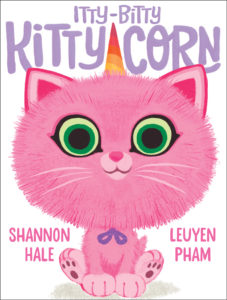 Kitty thinks she might be a unicorn. She feels so perfectly unicorn-y! “Neigh!” says Kitty. But when Unicorn clop clop clops over, sweeping his magnificent tail and neighing a mighty neigh, Kitty feels no bigger than a ball of lint. Can this unlikely pair embrace who they are, and truly see one another?
Shannon Hale is the bestselling author of many books, including Real Friends, the Ever After High series, and Newbery Honor-winner Princess Academy. With her husband Dean Hale she co-wrote Rapunzel’s Revenge, Calamity Jack, the Unbeatable Squirrel Girl series, and The Princess in Black series. They live with their four children near Salt Lake City, Utah.
LeUyen Pham is the bestselling illustrator of Real Friends and The Princess in Black series. She wrote and illustrated Big Sister, Little Sister and The Bear Who Wasn’t There. She has illustrated many other picture books, including The Boy Who Loved Math. She lives and works in Los Angeles with her husband and her two adorable sons.
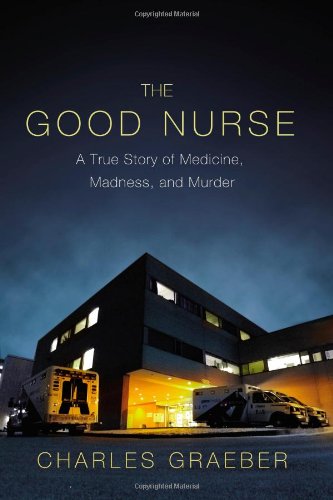 THE GOOD NURSE: A True Story of Medicine, Madness, and Murder, publié chez Twelve en 2013, est un récit poignant par le journaliste Charles Graeber exposant les crimes épouvantables d’un des tueurs en série les plus prolifiques des États-Unis, Charlie Cullen. Époux, père de famille et infirmier expérimenté, sa compulsion secrète l’a impliqué dans la mort d’au moins 300 patients entre 1988 et 2003, répartis dans neuf hôpitaux du New Jersey et de Pennsylvanie.
 Charlie Berg has a weak heart and the sensitive nose of a dog. The only thing his parents taught him as a child was that a couple of artists should never have children. It is the early 1990s, Charlie wants to move out and stop being the family jackass who keeps everything together while mother is at the theatre unsettling the world and father sitting around stoned for weeks in recording studios. The job at the lighthouse is within his grasp – and then everything gets out of hand: While out hunting with Granddad, not only is the stag shot at but Granddad as well. And what about Charlie’s secret big love, Mayra, his video pen pal in Mexico? Doesn’t have anything better to do than marry that crook Ramón …
 Rügen 1924. There it is on the promenade of Binz, white and magnificent – the impressive Grand Hotel belonging to the von Plesow family. A lot has happened here, and things have not always been easy, but Bernadette is proud of her hotel, the best in town. It was here that she brought up her children: the quiet Alexander, who one day will inherit the Grand Hotel; Josephine, the rebellious artist who is still trying to find her place in life; Constantin, always on the go, who already has his own hotel in Berlin, the Astor. Things could hardly be better. Of course, there is the odd quarrel with her daughter, and something seems to be not quite right with the otherwise cheerful maid Marie – but all this is nothing compared to what the unannounced visit of a man could lead to who threatens Bernadette he will disclose her darkest secret …
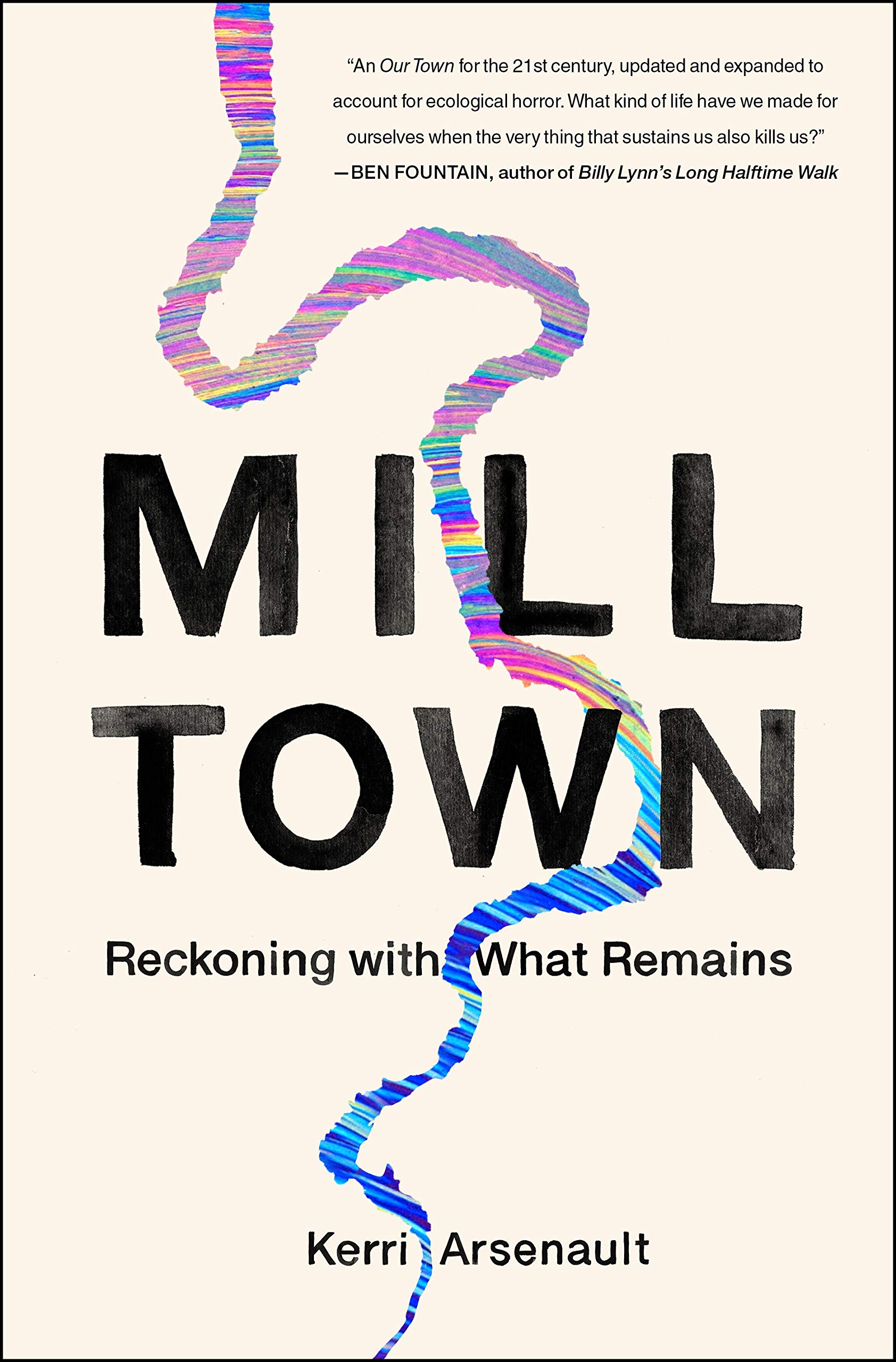 Kerri Arsenault grew up in the rural working class town of Mexico, Maine. For over 100 years the community orbited around a paper mill that employs most townspeople, including three generations of Arsenault’s own family. Years after she moved away, Arsenault realized the price she paid for that seemingly secure childhood. The mill, while providing livelihoods for nearly everyone, also contributed to the destruction of the environment and the decline of the town’s economic, moral, and emotional health in a slow-moving catastrophe, earning the area the nickname “Cancer Valley.” In Mill Town, Arsenault undertakes an excavation of a collective past, sifting through historical archives and scientific reports, talking to family and neighbors, and examining her own childhood to present a portrait of a community that illuminates not only the ruin of her hometown and the collapse of the working-class of America, but also the hazards of both living in and leaving home, and the silences we are all afraid to violate. In exquisite prose, Arsenault explores the corruption of bodies: the human body, bodies of water, and governmental bodies, and what it’s like to come from a place you love but doesn’t always love you back. A galvanizing and powerful debut,