
Governor Andrew Cuomo tells the riveting story of how he took charge in the fight against COVID-19 as New York became the epicenter of the pandemic, offering hard-won lessons in leadership and his vision for the path forward.
AMERICAN CRISIS:
Leadership Lessons from the COVID-19 Pandemic
by Andrew Cuomo
Crown, October 2020
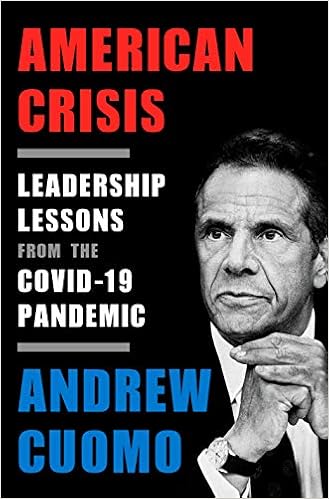 When COVID-19 besieged the United States, New York State emerged as the global “ground zero” for a deadly contagion that threatened the lives and livelihoods of millions. Quickly, Governor Andrew Cuomo provided the leadership to address the threat, becoming the standard-bearer of the organized response the country desperately needed. With infection rates spiking and more people dying every day, the systems and functions necessary to combat the pandemic in New York—and America—did not exist. So Cuomo undertook the impossible. He unified people to rise to the challenge and was relentless in his pursuit of scientific facts and data. He quelled fear while implementing an extraordinary plan for flattening the curve of infection. He and his team worked day and night to protect the people of New York, despite roadblocks presented by a president incapable of leadership and addicted to transactional politics. In his own voice, Andrew Cuomo chronicles the ingenuity and sacrifice required of so many to fight the pandemic, sharing the decision-making that shaped his policy as well as his frank accounting and assessment of his interactions with the federal government, the White House, and other state and local political and health officials. Real leadership, he shows, requires clear communication, compassion for others, and a commitment to truth-telling—no matter how frightening the facts may be. A remarkable portrait of selfless leadership and a gritty story of difficult choices that points the way to a safer future for all of us.
Andrew Cuomo is the 56th Governor of New York, serving since 2011. He is the author of All Things Possible: Setbacks and Success in Politics and Life and Crossroads: The Future of American Politics.
 Six days after giving birth, a polar bear named Aurora got up and left her den at the Columbus Zoo, leaving her tiny, squealing cub to fend for herself. Hours later, Aurora still hadn’t returned. The cub was furless and blind, and with her temperature dropping dangerously, the zookeepers entrusted with her care felt they had no choice: They would have to raise one of the most dangerous predators in the world themselves, by hand. Over the next few weeks, a group of veterinarians and zookeepers would work around the clock to save the cub, whom they called Nora. Humans rarely get as close to a polar bear as Nora’s keepers got with their fuzzy charge. But the two species have long been intertwined. Three decades before Nora’s birth, her father, Nanuq, was orphaned when an Inupiat hunter killed his mother, leaving Nanuq to be sent to a zoo. That hunter, Gene Agnaboogok, now faces some of the same threats as the wild bears near his Alaskan village of Wales, on the westernmost tip of the North American continent. As sea ice diminishes and temperatures creep up year-after-year, Gene and the polar bears—and everyone and everything else living in the far north—are being forced to adapt. Not all of them will succeed. Sweeping and tender, THE LONELIEST POLAR BEAR explores the fraught relationship humans have with the natural world, the exploitative and sinister causes of the environmental mess we find ourselves in, and how the fate of polar bears is not theirs alone.
 Anyone who has ever been told “You should speak up!” during a presentation at the office, a group project at school, or even a conversation among friends can attest to the misunderstanding at the heart of that demand. For those of us—women, people of color, immigrants, outsiders—who find it hard to speak up, the issue is not just about willpower. Many of us have internalized the same messages since birth: that because of the pitch of our voice, the accent we possess, or the slang we use, we will not be taken seriously. Power, we’re told, sounds like the mostly white, straight, wealthy men who wield it.
 It was never supposed to be this close. And of course she was supposed to win. How Hillary Clinton lost the 2016 election to Donald Trump is the tragic story of a sure thing gone off the rails. For every Comey revelation or hindsight acknowledgment about the electorate, no explanation of defeat can begin with anything other than the core problem of Hillary’s campaign–the candidate herself.