
What stories would the walls tell, if they could speak? A house and its inhabitants, from the Nazi era to the present day. For fans of Imre Kertész, Saša Stanišić and Jenny Erpenbeck.
TREPPE AUS PAPIER
(Paper Stairs)
by Henrik Szántó
Blessing Verlag/PRH Germany, August 2025
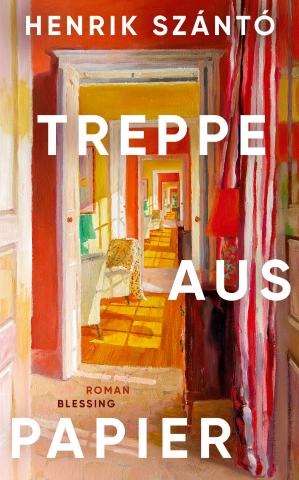 When 15-year-old Nele Bittner and 90-year-old Irma Thon meet in the stairwell of a four-storey period building, their conversation breathes life into what Nele always thought was boring old history.
The narrator of Nele and Irma’s story is the house itself, whose walls, hallways, pipes and nooks and crannies harbour the memories of all those who have lived in it over the past hundred years. Irma has a special connection to the building: she and her Nazi-supporting parents lived here when she was a child. Nele, meanwhile, lives on the top floor, in a flat once occupied by the Sternheim family – and Irma feels responsible for what happened to them.
For this house, everything happens simultaneously: when little Ruth Sternheim skips down the stairs, the house remembers the SA who, years later, will smash the window of the Sternheims’ ground-floor watch shop with their truncheons. While Irma looks back on her life, Nele’s questioning of her own family brings to light things they had hoped to suppress.
A daring, courageous novel about remembrance, responsibility and the shadow cast by history.
Henrik Szántó, born in 1988, is a half-Hungarian, half-Finnish author and presenter living in Hannover. He performs as a spoken word artist on stages across Germany, Austria and Switzerland, and has won several fellowships. He also works as an instructor, running poetry, creative writing, public speaking and performance skills seminars, and stages events showcasing both new and experienced voices. He is particularly interested in multilingualism, remembrance and multiculturalism.
 A secret love story.
 Mae Smith starts her life as a stolen good: her biological mother, Ida, kidnaps her from her adoptive parents, and Mae grows up on the run, constantly changing towns and names, never able to find a home. After her mother’s death, Mae is determined to live a different kind of life. But over the next half century, as she reinvents herself against the backdrop of the Depression and Second World War and pursues stability amid the personal upheavals of marriage and motherhood, she must reckon with the choices she’s made and life’s inexorable turns.
 It’s been four years since rain fell on the Oklahoma panhandle and the closeness between the Stanton twins has dried up as much as the land. Howe Stanton has been practicing running away and longs for the family to quit this land of dust where only troubles grow. Despite the scoliosis that causes Joanna Stanton near-constant pain, she isn’t ready to give up like her brother. But when Daddy leaves the family behind to find work in California, saving the farm from ruin falls on Howe’s unwilling and Joanna’s uneven shoulders.