
Hope Jahren’s Lab Girl meets Elizabeth Kolbert’s The Sixth Extinction in this work of popular science which blends the personal narrative of a trailblazing woman’s life in a male-dominated scientific field with a highstakes inquiry into what really killed the dinosaurs, the greatest scientific detective story of our time.
THE DINOSAUR WARS: MY LIFE AS A WARRIOR SCIENTIST IN THE DINOSAUR WARS
by Gerta Keller
Penguin Press, October 2022
(via Writers House)
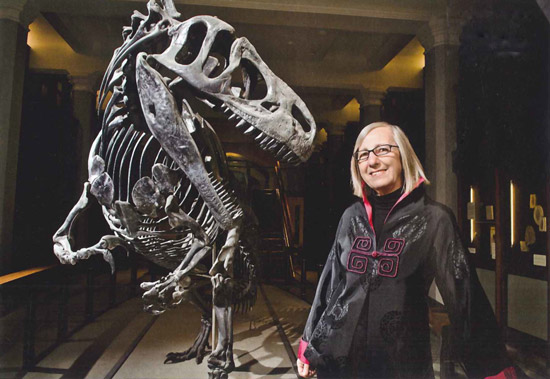 World-renowned geologist and paleontologist Gerta Keller is at the center of what has been called the nastiest feud in science, a contentious debate popularly known as “The Dinosaur Wars” over what triggered the fifth mass extinction at the end of the Cretaceous Era sixty-six million years ago. Dinosaurs have enthralled us for generations, and the question of what caused their demise is more relevant than ever, as humankind confronts the paroxysms of an imperiled planet and the possibility that we may become the dinosaurs of the sixth extinction.
Born into a life of poverty on a small farm in Switzerland as the sixth of a dozen children, Gerta was told her dreams of becoming a doctor were impossible. Defying the odds, Gerta reclaimed her childhood dream of studying science, ultimately completing her graduate studies in geology at Stanford and becoming a professor at Princeton University and a major voice in her field. Along the way, she overcame the hostility and disdain of her male colleagues, who sabotaged her work, took credit for her discoveries, and chided her for not “knowing her place.”
Driven by a relentless passion to discover the truth of Earth’s catastrophic upheavals, Gerta continued her research in a series of incredible adventures across the globe that have caused some to liken her to a female Indiana Jones and which led her to uncover a growing mass of evidence that contradicted the then-widely-accepted asteroid impact theory. Rather, Gerta discovered, the real cause of the dinosaurs’ extinction was Deccan volcanism, a series of cataclysmic volcanic eruptions on the Indian peninsula. Outraged by her daring to challenge them, the toxic, male scientific establishment launched an all-out war against Gerta, doing their utmost to sabotage her work, destroy her reputation, and suppress the publication of her research. But they picked a fight with the wrong woman.
Gerta Keller is a Professor of Paleontology and Geology in the Department of Geosciences at Princeton University, where she has been a tenured faculty member since 1984. She has placed over 260 scientific publications in international journals and is considered a leading authority on catastrophes and mass extinctions, and the biotic and environmental effects of impacts and volcanism. She has co-authored five academic books, is a frequent lecturer, and regularly receives invitations from academic institutions around the world. In recent years, her work has received increased recognition and continues to make waves in the mainstream media, including TV documentaries and news features, radio and podcast interviews, and print and web media, most notably in a widely circulated profile in The Atlantic.
 This was the grim reality that Ann Burgess, then a doctoral graduate with a degree in psychiatric nursing, found when she decided to get involved in the study of rape and sexual assault, choosing a topic that few others saw as worth the trouble. But what she called the complete “absence of understanding” surrounding this urgent issue left her no choice. Fortunately, she connected with a medical sociologist, Lynda Lytle Holmstrom, with whom Ann created the first ever formalized study of rape from the victim’s perspective, and through countless interviews with rape survivors ultimately proved that rape is more about dominance and control than sex. The impact of this early work was groundbreaking. It led to the development of the first rape crisis centers, created new police standards, and resulted in an increase in rape trials with outcomes that favored the victim. It also captured the attention of the FBI Academy, leading Burgess to become one of the first female consultants hired by the agency.
 KILLING THE MOB is the tenth book in Bill O’Reilly’s #1
  Beginning in his own hometown of New Orleans, Clint Smith leads the reader through an unforgettable tour of monuments and landmarks—those that are honest about the past and those that are not—that offer an intergenerational story of how slavery has been central in shaping our nation’s collective history, and ourselves. It is the story of the Monticello Plantation in Virginia, the estate where Thomas Jefferson wrote letters espousing the urgent need for liberty while enslaving over 400 people on the premises. It is the story of the Whitney Plantation, one of the only former plantations devoted to preserving the experience of the enslaved people whose lives and work sustained it. It is the story of Angola, a former plantation-turned maximum security prison in Louisiana that is filled with Black men who work across the 18,000-acre land for virtually no pay. And it is the story of Blandford Cemetery, the final resting place of tens of thousands of Confederate soldiers. In a deeply researched and transporting exploration of the legacy of slavery and its imprint on centuries of American history, HOW THE WORD IS PASSED illustrates how some of our country’s most essential stories are hidden in plain view—whether in places we might drive by on our way to work, holidays such as Juneteenth, or entire neighborhoods—like downtown Manhattan—on which the brutal history of the trade in enslaved men, women and children has been deeply imprinted.
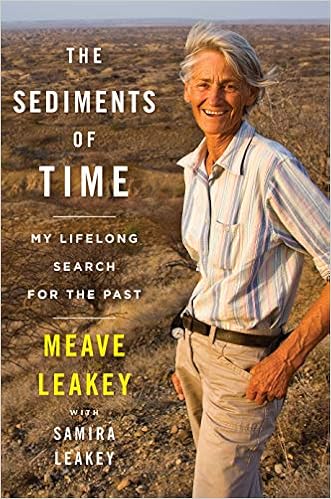 In THE SEDIMENTS OF TIME, preeminent paleoanthropologist Meave Leakey brings us along on her remarkable journey to reveal the diversity of our early pre-human ancestors and how past climate change drove their evolution. She offers a fresh account of our past, as recent breakthroughs have allowed new analysis of her team’s fossil findings and vastly expanded our understanding of our ancestors. Meave’s own personal story is replete with drama, from thrilling discoveries on the shores of Lake Turkana to run-ins with armed herders and every manner of wildlife, to raising her children and supporting her renowned paleoanthropologist husband Richard Leakey’s ambitions amidst social and political strife in Kenya. When Richard needs a kidney, Meave provides him with hers, and when he asks her to assume the reins of their field expeditions after he loses both legs in a plane crash, the result of likely sabotage, Meave steps in. THE SEDIMENTS OF TIME is the summation of a lifetime of Meave Leakey’s efforts; it is a compelling picture of our human origins and climate change, as well as a high-stakes story of ambition, struggle, and hope.