
A major new essay collection from the National Book Award-winning author of Arctic Dreams.
UNTITLED ESSAY COLLECTION
by Barry Lopez
Random House, Fall 2021
 These new and collected essays from the acclaimed naturalist Barry Lopez—his final undertaking—represent the culmination of a lifetime’s thought in service of our relationship with wilderness, and with each other. Here, his collected essays offer a unifying vision; his drive to reconnect the cultural and the natural is unflinching, and major, never-published pieces offer profound commentary on topics that veer from the autobiographical—his abuse as a child—to the evolution of his views on the untamed. His classic prose, like the arctic landscape he elegized, remains as ever: “spare, balanced, extended…” It has been said that Barry Lopez understood what we gain when we accept the enormity of what we don’t know; these essays hinge on that tantalizing concept.
Barry Lopez (1945-2020) was the author of thirteen books of essays, short stories, and nonfiction. He was a recipient of the National Book Award, the Award in Literature from the American Academy of Arts and Letters, a Guggenheim Fellowship, and numerous other literary and cultural honors and awards. His highly acclaimed books include Horizon, Arctic Dreams, Winter Count, and Of Wolves and Men, for which he received the John Burroughs and Christopher medals.
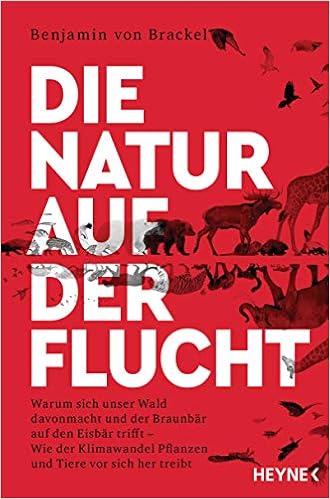 There is something afoot in the world of animals and plants, something which has so far caught too little attention. Wherever they can, animals and plants are moving towards the earth’s poles to flee from rising temperatures and drought in their natural habitats. Tropical zones lose their inhabitants, beavers are settling in Alaska, gigantic shoals of fish disappear just to reappear in front of foreign coastlines. Sea creatures move an average of 72 kilometres a year, land creatures an average of 17 kilometres. In this exciting and vivid book, Benjamin von Brackel describes a phenomenon which demonstrates nature’s impressive adaptability as well as the dramatic consequences of climate change – not the least for humankind, for the migration of species won’t leave us unaffected.
 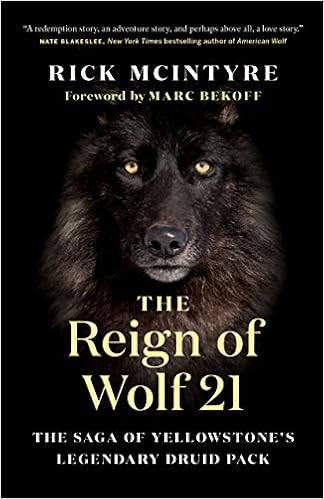 In this compelling follow-up to the national bestseller The Rise of Wolf 8, Rick McIntyre profiles one of Yellowstone’s most revered alpha males, Wolf 21. Leader of the Druid Peak Pack, Wolf 21 was known for his unwavering bravery, his unusual benevolence (unlike other alphas, he never killed defeated rival males), and his fierce commitment to his mate, the formidable Wolf 42. Wolf 21 and Wolf 42 were attracted to each other the moment they met—but Wolf 42’s jealous sister interfered viciously in their relationship. After an explosive insurrection within the pack, the two wolves came together at last as leaders of the Druid Peak Pack, which dominated the park for more than 10 years. McIntyre recounts the pack’s fascinating saga with compassion and a keen eye for detail, drawing on his many years of experience observing Yellowstone wolves in the wild. His outstanding work of science writing offers unparalleled insight into wolf behavior and Yellowstone’s famed wolf reintroduction project. It also offers a love story for the ages.
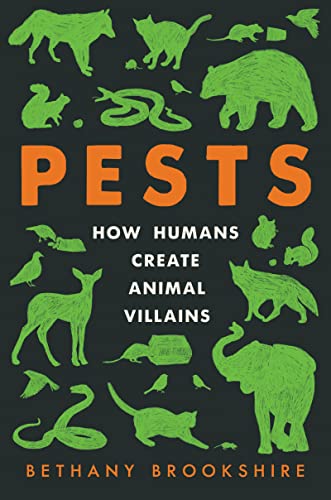 A squirrel in the garden. A rat in the wall. A pigeon on the street. Humans have spent so much of our history drawing a hard line between human spaces and wild places. When animals pop up where we don’t expect or want them, we respond with fear, rage, or simple annoyance. It’s no longer an animal. It’s a pest.
 A return trip to the South Pole is an impossible dream for many of us – but the medic Carmen Possnig did just that. On behalf of the European Space Agency, she spent a year in the heart of the Antarctica to find out what it’s like to live in extreme weather conditions, with a distinct lower level of oxygen and in complete isolation from the rest of the world. With twelve other scientists, she spent the winter at the Concordia research station in the eternal ice. There, she not only encountered the breathtaking beauty of the most extreme continent on Earth, but also her own limits: Sharing a tight space with other people for twelve months, in a world that remains dark for months on end and where the temperature drops to -80°C, requires a huge physical and mental effort. Carmen Possnig’s personal and witty travel report, and its wealth of photographs, opens up a window onto an alien world – making us marvel at our planet’s diversity, and at how adaptable human nature can be.