
The heartbreaking and ultimately hopeful story of an abandoned polar bear cub named Nora and the humans working tirelessly to save her and her species, whose uncertain future in the accelerating climate crisis is closely tied to our own.
THE LONELIEST POLAR BEAR:
A True Story of Survival and Peril on the Edge of a Warming World
by Kale Williams
Crown, March 2021
 Six days after giving birth, a polar bear named Aurora got up and left her den at the Columbus Zoo, leaving her tiny, squealing cub to fend for herself. Hours later, Aurora still hadn’t returned. The cub was furless and blind, and with her temperature dropping dangerously, the zookeepers entrusted with her care felt they had no choice: They would have to raise one of the most dangerous predators in the world themselves, by hand. Over the next few weeks, a group of veterinarians and zookeepers would work around the clock to save the cub, whom they called Nora. Humans rarely get as close to a polar bear as Nora’s keepers got with their fuzzy charge. But the two species have long been intertwined. Three decades before Nora’s birth, her father, Nanuq, was orphaned when an Inupiat hunter killed his mother, leaving Nanuq to be sent to a zoo. That hunter, Gene Agnaboogok, now faces some of the same threats as the wild bears near his Alaskan village of Wales, on the westernmost tip of the North American continent. As sea ice diminishes and temperatures creep up year-after-year, Gene and the polar bears—and everyone and everything else living in the far north—are being forced to adapt. Not all of them will succeed. Sweeping and tender, THE LONELIEST POLAR BEAR explores the fraught relationship humans have with the natural world, the exploitative and sinister causes of the environmental mess we find ourselves in, and how the fate of polar bears is not theirs alone.
Kale Williams is a reporter at The Oregonian/OregonLive, where he covers science and the environment. A native of the Bay Area, he previously reported for the San Francisco Chronicle. He shares a home with his wife, Rebecca; his two dogs, Goose and Beans; his cat, Torta; and his step-cat, Lucas.
 Working through a year in the garden of a large country estate, a gardener explores the path that led him there. His days are spent with the magnolias and roses, moths and beetles and the distant lady who has employed him for the past thirty years. A broken biographical telling of the journey, mythology and poetry of an outcast boy who just wanted to be somebody’s flower, to an old man who has and is everything that he wants. Intimate, moving and full of beauty, Marc’s meditative prose fills the heart with an appreciation for the life we live, making SEED TO DUST the perfect companion for his critically-acclaimed first book, HOW TO CATCH A MOLE.
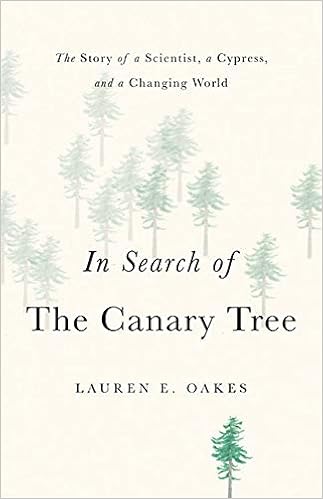 Where mountains meet ocean in Alaska’s Alexander Archipelago, white skeletons of dead yellow cedar trees stand in stark contrast to the verdant landscape of old-growth forests. Researchers spent nearly three decades deciphering the cause of the majestic species’ mysterious death: the culprit, they discovered, was neither pathogen nor pest, but instead climate change. In the wake of this discovery, Lauren Oakes, a young scientist, wondered if what the people in this region were experiencing—whatever ways they were finding to cope with their rapidly changing environment and the loss of this sacred tree—might be a scrying glass into the future.
 There are amazing things going on under water: at night the sea mysteriously sparkles, the tiniest of organisms (plankton) have the greatest power, and the fish are by no means taciturn but instead communicate loudly with one another. Marine biologist Frauke Bagusche has some fascinating tales to tell – stories of the smallest and the largest living creatures in the world. She explains where the smell comes from that tickles our nostrils while we are walking along the beach; what causes the sparkle we see in the water at night; and why the sea steers not only our emotions but also our destiny and that of the entire planet. Her account, in which she explores her own intimate relationship with the sea, is based both on the results of the latest scientific research and her personal experience. Because no matter where we are, we are bound to the blue miracle with every breath we take.