
From young Afghani activist and Amnesty International Global Youth Ambassador Pashtana Durrani, a deeply inspiring memoir about the power of learning and the value of educators in their many forms – from teachers, mentors, and role models, to fathers, mothers, and any one of us with the drive to stand against ignorance.
LAST TO EAT, LAST TO LEARN
My Life in Afghanistan Fighting to Educate Women
by Pashtana Durrani, with Tamara Bralo
Kensington, March 2024
(via The Martell Agency)
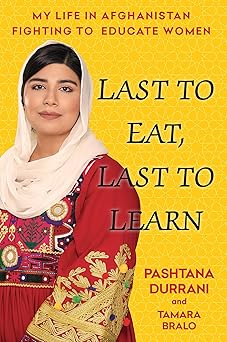 LAST TO EAT, LAST TO LEARN is the remarkable memoir of Pashtana Durrani, a 23-year-old Afghan woman, who has pursued her passion for educating the “disappearing girls” of the remote, contested rural tribal regions, amidst all the turmoil, violence and oppression that has enveloped her country – and her family — over a generation.
Pashtana Durrani was the first recipient of a grant from Malala’s Fund, and the founder of Learn NGO, an organization that was ruthlessly targeted by the Taliban. She conceived and developed a brilliant program for getting educational materials directly into the hands of girls and young women in the form of solar-powered tablets preloaded with lessons for grades K-12.
Pashtana escaped from Afghanistan after the Taliban takeover and will soon be in the U.S., with a two-year residency at Wellesley College to continue her critical work for girls’ education. Malala wrote one of two letters to the U.S. government to petition for Pashatana’s safe evacuation to the U.S. Pashtana is a highly sought-after expert in the on-going international advocacy struggles, a figure of hope and promise for all those determined not to cede ground in the battle for women’s education and autonomy in Afghanistan and beyond.
Tamara Bralo is an award-winning journalist who worked for BBC, CNN, and Al Jazeera English, and spent years covering war zones around the world, including Iraq, Libya, and Syria.
 We’ve all been exposed to extremist, populist, and conspiratorial narratives and yet most of us roll our eyes at it or laugh it off. What causes some small minority of people to take these narratives seriously? What causes an even smaller percentage of that population to actually act on those narratives? Why do some even give their lives based on those ideas? And, most importantly, what can we do to stop people from committing political violence?
 When Arthur Woods took command of the NYPD in April of 1914, the institution was still largely corrupt and low-tech. Determined to change that, he couldn’t have anticipated the maelstrom of violence that would test his science-based approach to policing. Within weeks of his tenure, New York City was engulfed in a period of relentless bombings, many of them perpetrated by the anarchists movement led by the radicals Alexander Berkman and Emma Goldman.
 Inspired by her research for the hit podcast Ultra, Rachel Maddow charts the rise of a wild American strain of authoritarianism that has been alive on the far-right edge of our politics for the better part of a century. Before and even after our troops had begun fighting abroad in World War II, a clandestine network flooded the country with disinformation aimed at sapping the strength of the U.S. war effort and persuading Americans that our natural alliance wasw ith the Axis, not against it. It was a sophisticated and shockingly well-funded campaign to undermine democratic institutions, promote antisemitism, and destroy citizens’ confidence in their elected leaders, with the ultimate goal of overthrowing the U.S. government and installing authoritarian rule.
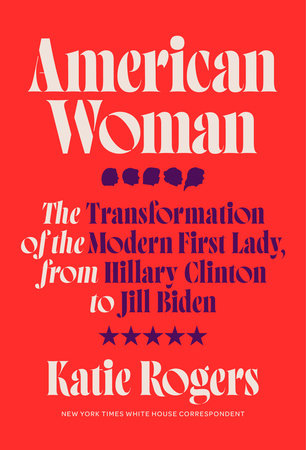 Since the Clinton era, shifts in media, politics, and pop culture have all redefined expectations of First Ladies, even as the boundaries set upon them have often remained anachronistic. With sharp insights and dozens of firsthand interviews with major players in the Biden, Obama, Trump, Bush, and Clinton orbits, including Jill Biden and Hillary Clinton, New York Times White House correspondent Katie Rogers traces the evolution of the role of the twenty-first-century First Lady from a ceremonial figurehead to a powerful political operator, which culminates in the tenure of First Lady Jill Biden.