
How to adapt and thrive in the workplace in an uncertain future filled with change and automation? TOMORROWMIND offers readers—workers, managers, and executives alike—explicit, evidence-based guidance on positive psychology practices to offer a hopeful road map of how to tackle these challenges head on.
TOMORROWMIND:
Flourishing in the Future of Work
by Gabriella Rosen Kellerman & Martin Seligman
Atria, Fall 2022/Spring 2023
In recent years a vast literature, from reports from all the major global political and economic bodies to popular books like Martin Ford’s The Rise of the Robots and Erik Brynjolfsson and Andrew McAfee’s The Second Machine Age, has emerged to document and foretell the unprecedented scale of change facing the global workforce as the Age of Automation dawns. The evidence is overwhelming—and, at first glance, frightening. Forty-two percent of the job skills we use today will be obsolete by 2022. Eighty percent of US workers will have their jobs replaced, or their wages reduced, by automation in the new decade. We can expect, within the next ten years, that we won’t be choosing our careers once in a lifetime, but continually, across a wide range of industries. Our average job tenure will be under two years. Our job skills will expire every 18 months. More and more of our work will be done remotely, alone, or with rotating teams. The scale of the shift dwarfs that of all other eras, including the Industrial Revolution, and it poses a unique set of challenges to human wellbeing. In TOMORROWMIND, Gabriella Kellerman and Martin Seligman ask the question other thinkers on the subject have so far avoided: if, today, we sit on the cusp of the most turbulent changes to work society has ever faced, how will that change us? How will we survive? And more importantly, how can most of us thrive?
Surviving in this new world of work means, first, understanding these challenges, and second, intentionally developing skills to overcome them. TOMORROWMIND will offer readers—workers, managers, and executives alike—explicit, evidence-based guidance on navigating through the worst of what the future holds. Calling on the tenets of positive psychology and prospective psychology, disciplines pioneered by Seligman, and supported by the vast data emerging from BetterUp Labs—the basic science arm of the global virtual coaching company BetterUp, where their collaborators include Adam Grant, Roy Baumeister, Sonja Lyubomirsky, and Rebecca Goldstein—they argue that automation and constant change don’t have to be cause for alarm or despair. On the contrary: the coming disruption presents remarkable opportunities for each of us to push the boundaries of our cognitive and emotional skills. TOMORROWMIND will paint a picture of human thriving, not despite these challenges, but because of them.
Prince Harry has agreed to be the « Chief Impact Officer » for BetterUp, which is intricately connected to TOMORROWMIND. It’s too early to say whether/how Prince Harry will be involved in the promotion but the news of his hiring has greatly increased the profile of BetterUp. Read more about this here.
 Gabriella Rosen Kellerman, MD is the Chief Innovation Officer for the $700M behavior change company BetterUp, and the head of BetterUp Labs, where she leads strategic efforts to develop the next generation of offerings in behavior change technology.
 Martin Seligman, PhD is the Zellerbach Family Professor of Psychology at the University of Pennsylvania, director of the Positive Psychology Center, former president of the American Psychological Association, and a scientific advisory board member of BetterUp Labs. Called the “founder of Positive Psychology,” he is the author of over 30 books for both scholarly and trade audiences, including FLOURISH, AUTHENTIC HAPPINESS, and LEARNED OPTIMISM. His books have been translated into fifty languages and have sold millions of copies worldwide.
 In HOW TRUST WORKS, Dr. Kim will explain the two most powerful determinants of trust (perceived competence and perceived integrity) and why those determinants can be weighted so unevenly when we are deciding whether to trust or forgive someone—or not. We as humans are bad at determining the trustworthiness of other people, and we are even worse at defending our own trustworthiness when it comes under fire. Yet despite this shortcoming, and the fact that we are all keenly aware of how important trust is in all of our personal and professional relationships, surprisingly little substantive research had been done on the topic before Dr. Kim began his inquiries. In fact, the majority of our institutional knowledge at the time seemed to rely almost entirely on case studies and other anecdotes. Dr. Kim was forced to develop his own set of rigorous scientific tools that would help him analyze how people interact with one another in the face of conflict.
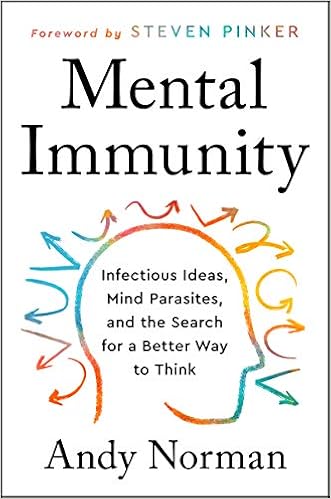 Andy Norman has spent years studying the destructive forces that can flip the minds of sensible people to understand how they take hold. He calls them mind-parasites, ideas that can poison our thinking and leave us more susceptible to wild conspiracies, lead us to reject scientific evidence, and convince us to double down on unfounded beliefs. Just as the body can be weakened by foreign organisms that make us sick, the mind too is vulnerable to infection. But just as antibiotics can be used to attack the biological organisms causing physical illness, we can treat the mind parasites that invade our heads. He shows us how to engage in productive discussion, analyzes the psychological evidence about how to change minds, and reveals how we can safeguard ourselves and protect those around us from mind-parasites like conspiracies and fake news. In MENTAL IMMUNITY Andy Norman calls for the study of cognitive immunology, a way of thinking where individuals and society learn to differentiate facts and reasons from disinformation and false memes. By strengthening our mental immunity, we become open to other ideas and learn how better to communicate about beliefs and policy without dissolving into partisan finger-pointing. Norman offers suggestions to create a value- and respect-based system of dialogue that can help us bolster cultural cognitive immunity as we protect our own minds from succumbing to bad ideas.
 Being a mother is the most wonderful job in the world – but also the most demanding. Pressures of high expectations, overwhelming responsibilities, and exhaustion are just some of the stress factors that can lead to health problems such as cardiovascular disease and depression. What are the best ways to help mothers?
 In WHATEVER WORKS, Thalma Lobel, one of the world’s leading experts on human behavior, explores groundbreaking psychological research on job performance, satisfaction, and creativity. Lobel goes beyond obvious considerations like salary, title, and company culture to shed light on the hidden factors-often unrecognized, counterintuitive, or invisible-that have profound effects on how well we can do our jobs and how happy we are at work. Did you know that just doodling in a certain way can increase your creativity? That looking at something green for forty seconds will improve your attention? That crossing your legs similarly to an interviewer could get you the job? That the mere presence of a smartphone on your desk can lessen your performance, even if it’s turned off? That being in a warmer room makes you more likely to want to conform with the group, affecting your decision-making? These are the invisible factors that nudge our behavior on a daily basis, and combined, have a real and significant bearing on our success—or failure—at work. Helpful for anyone from individual employees to managers to leaders of large organizations, WHATEVER WORKS shares valuable insights and practical takeaways to transform your professional life.