
Nothing is what it seems. No one is who they claim to be. Will the truth come out?
DIE SPUR DES SCHWEIGENS
(The Trace of Silence)
by Amelie Fried
Heyne/Verlagsgruppe Random House Bertelsmann, August 2020 (voir catalogue)
 Journalist Julia struggles to make ends meet as a freelance writer and dreams of the big, investigative story. She receives a tip-off about possible sexual assaults at a renowned research institute. Tired of the me-too debate, she only half-heartedly pursues the suspicion at first. But as soon as the first victim contacts her and Julia meets the attractive prime suspect, her journalistic instinct is awakened. At the institute she encounters a dangerous mixture of abuse of power, silence and cover-ups – and a shocking connection to her brother Robert, who disappeared without a trace twelve years earlier. Suddenly Julia has to ask herself unplea-sant questions: What does Robert have to do with the suicide of a Chinese doctoral student? Why was his body never found? Has she been missing something all these years?
Amelie Fried, born in 1958, presented various TV programs. All her novels are bestsellers and were made into successful TV films. She has received numerous awards for her children’s books, including the German Youth Literature Award.
 Being a mother is the most wonderful job in the world – but also the most demanding. Pressures of high expectations, overwhelming responsibilities, and exhaustion are just some of the stress factors that can lead to health problems such as cardiovascular disease and depression. What are the best ways to help mothers?
 Children are odd. And so are grandparents. Children grow up, get a mortgage, and refuse to touch the cheap booze they used to binge-drink at parties – while their grandparents rediscover a childlike pleasure in conquering the world and pushing the boundaries. Meanwhile, the younger generation prefers to stay at home, and to ‘find’ itself by living between the fridge and the computer. In this new collection of stories, told with much love and humour, family man Wladimir Kaminer reveals the complicated relationship between the generations.
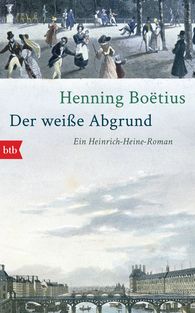 Paris, ca. 1850. Bed-ridden and terminally ill, Heinrich Heine wants to prise one final work from the jaws of death: His memoirs are to be his magnum opus. It’s been a long time since he last attended an illustrious bohemian dinner – instead, he receives occasional visits from German exiles and French artist friends. One day, Elise Krinitz seeks him out. The young woman admires Heine, and hopes to find in him a mentor for her own literary ambitions. He tenderly and ironically calls her ‘Mouche’, and they soon embark on a platonic, but nonetheless passionate affair. Yet when Heine dies on the 17th February 1856, his memoirs are lost forever. Steeped in the fascinating panorama of 1850s Paris, Boëtius’s novel is a unique portrait of the final years of the great German poet Heinrich Heine.
 A return trip to the South Pole is an impossible dream for many of us – but the medic Carmen Possnig did just that. On behalf of the European Space Agency, she spent a year in the heart of the Antarctica to find out what it’s like to live in extreme weather conditions, with a distinct lower level of oxygen and in complete isolation from the rest of the world. With twelve other scientists, she spent the winter at the Concordia research station in the eternal ice. There, she not only encountered the breathtaking beauty of the most extreme continent on Earth, but also her own limits: Sharing a tight space with other people for twelve months, in a world that remains dark for months on end and where the temperature drops to -80°C, requires a huge physical and mental effort. Carmen Possnig’s personal and witty travel report, and its wealth of photographs, opens up a window onto an alien world – making us marvel at our planet’s diversity, and at how adaptable human nature can be.