
Why do people not want to be happy? And how can it be that only a machine can find the true path to happiness? For all readers of Graeme Simsion’s The Rosie Project and Ian McEwan’s Machines Like Me.
DER ALGORITHMUS DER MENSCHLICHKEIT
(The Algorithm of Humanity)
by Vera Buck
Limes/PRH Germany, March 2021
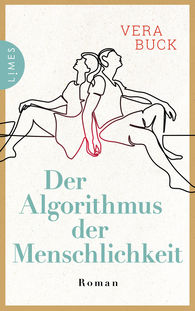 If you meet Mari, you will notice that she is beautiful and almost hauntingly perfect. But also that she fails to get jokes and vies everything rationally. And if you get to know her better, you will notice that Mari needs neither sleep nor food. Because Mari is only almost human. Her artificial intelligence is constantly learning to do one job: to make people happy. When Mari ends up in a Berlin apartment after an unfortunate chain of circumstances with a motley crew of people, including the rebellious blogger Frieda and the lonely student Linus, she realizes that her mission is all but easy. The world follows its own logic, people’s desires are irrational and Mari has to understand that there exists a world beyond provable facts. How is she supposed to make beings happy that have no clue what they want? She comes up with a solution no human would have ever expected… DER ALGORITHMUS DER MENSCHLICHKEIT deals with questions that are becoming incredibly important in the current developments in the technology sector: What makes us human? Why do we need each other? And why do we actually need more of each other, and less of the new technologies that are constantly being developed?
Vera Buck, born in 1986, studied journalism in Hannover and scriptwriting on Hawaii. During this time she wrote texts for radio, television and print media and later short stories for anthologies and literary magazines. After working at universities in France, Spain and Italy, Vera Buck now lives and works in Zürich.
 Journalist Julia struggles to make ends meet as a freelance writer and dreams of the big, investigative story. She receives a tip-off about possible sexual assaults at a renowned research institute. Tired of the me-too debate, she only half-heartedly pursues the suspicion at first. But as soon as the first victim contacts her and Julia meets the attractive prime suspect, her journalistic instinct is awakened. At the institute she encounters a dangerous mixture of abuse of power, silence and cover-ups – and a shocking connection to her brother Robert, who disappeared without a trace twelve years earlier. Suddenly Julia has to ask herself unplea-sant questions: What does Robert have to do with the suicide of a Chinese doctoral student? Why was his body never found? Has she been missing something all these years?
 Being a mother is the most wonderful job in the world – but also the most demanding. Pressures of high expectations, overwhelming responsibilities, and exhaustion are just some of the stress factors that can lead to health problems such as cardiovascular disease and depression. What are the best ways to help mothers?
 Children are odd. And so are grandparents. Children grow up, get a mortgage, and refuse to touch the cheap booze they used to binge-drink at parties – while their grandparents rediscover a childlike pleasure in conquering the world and pushing the boundaries. Meanwhile, the younger generation prefers to stay at home, and to ‘find’ itself by living between the fridge and the computer. In this new collection of stories, told with much love and humour, family man Wladimir Kaminer reveals the complicated relationship between the generations.
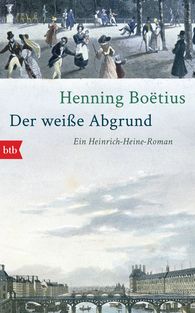 Paris, ca. 1850. Bed-ridden and terminally ill, Heinrich Heine wants to prise one final work from the jaws of death: His memoirs are to be his magnum opus. It’s been a long time since he last attended an illustrious bohemian dinner – instead, he receives occasional visits from German exiles and French artist friends. One day, Elise Krinitz seeks him out. The young woman admires Heine, and hopes to find in him a mentor for her own literary ambitions. He tenderly and ironically calls her ‘Mouche’, and they soon embark on a platonic, but nonetheless passionate affair. Yet when Heine dies on the 17th February 1856, his memoirs are lost forever. Steeped in the fascinating panorama of 1850s Paris, Boëtius’s novel is a unique portrait of the final years of the great German poet Heinrich Heine.