
An astonishing debut novel about family, sexuality, and capitalist systems of control, following three adopted brothers who live above a mosque in Staten Island with their imam father.
BROTHER ALIVE
by Zain Khalid
Grove Atlantic, August 2022
(via Neon Literary)

In 1990, three boys are born, unrelated but intertwined by circumstance: Dayo, Iseul, and Youssef. They are adopted as infants and come to live in a shared bedroom perched atop a mosque in one of Staten Island’s most diverse and precarious neighborhoods, Coolidge. The three boys are a conspicuous trio: Dayo is of Nigerian origin, Iseul, Korean, and Youssef indeterminately Middle Eastern, but they are inseparable, whether scheming or fighting or investigating the traces of their shared history. But Youssef has another sibling he keeps secret from his family, an imaginary familiar who seems hyper-real, a wondrous pet who lives in Youssef’s mind, a shapeshifting creature he calls Brother.
The boys’ adoptive father, Imam Salim, is known for his radical sermons extolling the virtues of opting out of Western ideologies. He is a distant father, never touching his boys physically, but supplementing their education with texts like The Blind Owl and The Foundations of Arithmetic. In the evenings, he likes nothing more than to pour whiskey into his coffee and escape into his study, where he corresponds with compatriots from his time in Saudi Arabia. Like Youssef, he too has secrets, including the cause of his failing health, the reason for his visits to a botanical garden in the middle of the night, and the truth about the boys’ parents he would be ashamed to share.
Imam Salim’s deeds and decisions will take him back to Saudi Arabia, where the boys were born and will be forced to follow. As they settle into an opulent, futuristic world that is designed to account for a new, more sustainable modernity than of the West, they will have to change if they want to survive. They soon realize that they are not the only ones who have returned home—the arrival of Youssef’s Brother will not go unnoticed.
With stylistic brilliance and intellectual acuity, in Brother Alive Zain Khalid brings characters to vivid life with a bold energy that matches the great themes of his novel—family, capital, power, sexuality, and the possibility of reunion for those who are broken.
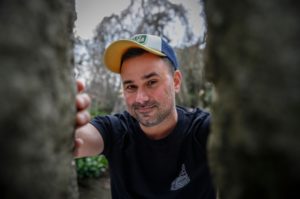
Zain Khalid has been published in The New Yorker, The Believer, The Los Angeles Review of Books, McSweeney’s Quarterly Concern, and elsewhere. He has also written for television. Brother Alive is his first novel. He lives in New York City.
 Todd is playing at the beach with his six-year-old son, Anthony, when he sees a man approach them. It is Jack, the man who made his highschool years a living hell. Radiant, repentant, and overjoyed to have « run into » Todd, Jack suggests a meal (to catch up!) and perhaps a night or two’s stay at Todd’s house (to reconnect!). Todd politely agrees, smile frozen on his face, as a sick feeling begins to grow within him, churning into rot and releasing a repressed darkness. What follows is a tense, fast-paced story of obsession and the grotesque, as disturbing as it is emotionally riveting. A Patricia Highsmith novel for the demented age we’re living through, HAWK MOUNTAIN is a compelling look at how love and hate are indissoluble, intertwined until the last breath.
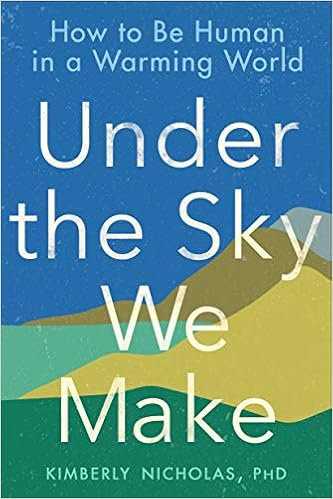 After speaking to the international public for close to fifteen years about sustainability, climate scientist Dr. Nicholas realized that concerned people were getting the wrong message about the climate crisis. Yes, companies and governments are hugely responsible for the mess we’re in. But individuals CAN effect real, significant, and lasting change to solve this problem. Nicholas explores finding purpose in a warming world, combining her scientific expertise and her lived, personal experience in a way that seems fresh and deeply urgent: Agonizing over the climate costs of visiting loved ones overseas, how to find low-carbon love on Tinder, and even exploring her complicated family legacy involving supermarket turkeys. In her astonishing book UNDER THE SKY WE MAKE, Nicholas does for climate science what Michael Pollan did more than a decade ago for the food on our plate: offering a hopeful, clear-eyed, and somehow also hilarious guide to effecting real change, starting in our own lives. Saving ourselves from climate apocalypse will require radical shifts within each of us, to effect real change in our society and culture. But it can be done. It requires, Dr. Nicholas argues, belief in our own agency and value, alongside a deep understanding that no one will ever hand us power—we’re going to have to seize it for ourselves.
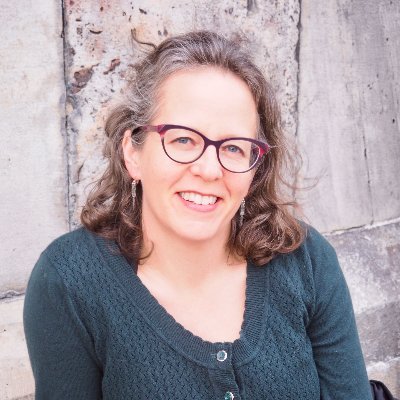 Dr. Kimberly Nicholas is Associate Professor of Sustainability Science at Lund, Sweden’s highest-ranked university. Born and raised on her family’s vineyard in Sonoma, California, she studied the effect of climate change on the California wine industry for her PhD in Environment and Resources at Stanford University. Since then, she has published over 50 articles on climate and sustainability in leading peer-reviewed journals, and her research has been featured in outlets including The New York Times, The Washington Post, The Atlantic, USA Today, Buzzfeed and more. She has also been profiled in Elle and The Guardian, and gives appearances at around 50 lectures each year, such as the recent Climate Change Leadership summit.