
Aimed at philosophers and non-philosophers alike, this is a modern argument about the ambivalence towards childbearing and how to overcome it.
WHAT ARE CHILDREN FOR?
Affirming Life in an Age of Ambivalence
by Anastasia Berg & Rachel Wiseman
St. Martin’s Press, June 2024
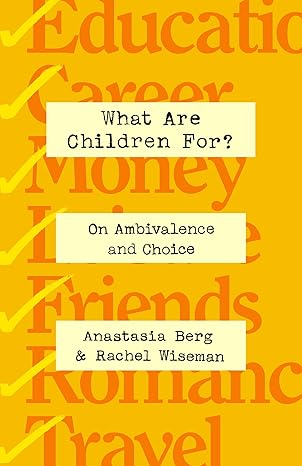
Becoming a parent, once the expected outcome of adulthood, is increasingly viewed as a potential threat to the most basic goals and aspirations of modern life. We seek self-fulfillment; we want to liberate women to find meaning and self-worth outside the home; and we wish to protect the planet from the ravages of climate change. Weighing the pros and cons of having children, the Millennial and Gen Z generations are finding it increasingly hard to judge in its favor. WHAT ARE CHILDREN FOR? seeks to loosen the grip of the shallow narratives that either lament growing childlessness as a mark of cultural decline, or celebrate it as unambiguous evidence of social progress. Berg and Wiseman explore philosophical and cultural examples of this debate, whether from modernist writers like Virginia Woolf, second-wave feminists in the 1970s, or the current trend of dystopian novels and stories. In the tradition of Jenny Odell and Amia Srinivasan, Berg and Wiseman write with clear logic and passionate prose to offer those struggling the guidance necessary to move beyond their uncertainty. They argue that when we make the individual decision whether or not to have children we confront a profound philosophical question, that of the goodness of life itself. How can we justify perpetuating human life given the catastrophic harm and suffering of which we are always at once both victims and perpetrators? WHAT ARE CHILDREN FOR? concludes that we must embrace the fundamental goodness of human life—not only in theory, but in our everyday lives.
Anastasia Berg and Rachel Wiseman first explored these questions in an essay for The Point on choosing to have children, the rare work of philosophical inquiry to have gone viral; Berg recently discussed her own decision to pursue having a family in the context of the novel coronavirus in a widely read op-ed in the New York Times. Frequent collaborators and close friends, Anastasia Berg is currently based in Cambridge and will start as an Assistant Professor of Philosophy at the Hebrew University. She is expecting her first child. Rachel Wiseman lives in Chicago, where she is the managing editor of The Point, an award-winning nonfiction literary magazine.
 From the acclaimed author of
 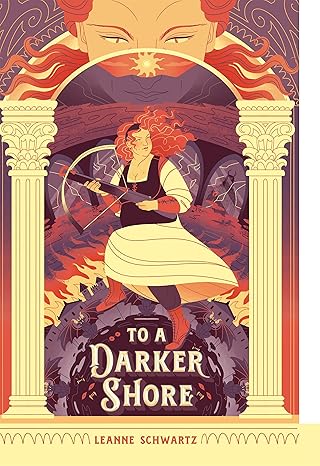 Plain, poor, plus-size, and autistic, Alesta grew up trying to convince her kingdom that she’s too useful to be sacrificed—like so many of their country’s poor—to appease the infernal monster across the poison sea in hell. When Alesta’s attempt to prove herself with inventions goes awry, her best friend and heir to the throne, Kyrian, takes the blame expecting leniency—and ends up tithed in her place. To end the sacrifices forever, Alesta plans to kill the monster that killed her friend. She travels to the depths of hell only to find Kyrian, alive, but monstrously transformed. There’s no escaping hell or their deeper feelings for one another, and the farther they go, the closer they come to uncovering a truth about the tithings that threatens to invoke the wrath of not only monsters but the gods as well.
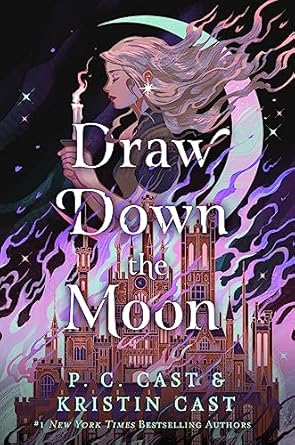 Wren Nightingale isn’t supposed to have any powers. Born of magickal parents but not under a moon sign, she was destined for life as a Mundane—right up until she starts glowing on her eighteenth birthday. In a heartbeat, Wren’s life is turned upside down, and she’s suddenly leaving her home for the mystical Academia de la Luna—a secret magickal school on a hidden island off the Seattle coast. Lee Young has always known about his future at the Academia. He has one goal: pass the trials, impress the Moon Council, and uphold his family’s reputation. But he wasn’t expecting to be attending alongside the girl he’s been secretly in love with for as long as he can remember. As Wren and Lee are thrown into the Academia’s grueling trials, they quickly learn there’s something different—and dangerous—about the school this year. Wren will have to navigate a web of secrets, prophecies—and murder. And Lee will have to decide who to protect—his family’s legacy or the girl he loves.
 Remy Kobata has always wished she was destined to be with her best friend, Cam Yasuda. From growing up neighbors to mixing up magical prank potions together, nothing’s a secret between Remy and Cam—except for how much she is in love with him. Remy is trying to work up the courage to confess her feelings during their senior high school winter break trip to Japan when they stumble upon a secret magical apothecary in the back alleys of Tokyo. Remy and Cam are offered an ancient soulmate elixir, created before all love potions were banned by the magical government. They each have their reasons for wanting to take it, and what could go wrong with finding your soulmate? Except, after they drink up, their trip flips into the worst vacation ever: Cam has forgotten who she is. Cam’s got a feeling that this girl who’s a stranger is important to him—they have thousands of photos together—but he doesn’t have a single memory. If Remy can’t help Cam remember her by midnight on New Year’s Eve, they’ll both be cursed to forget each other. To unravel their past and rewrite the future, Remy and Cam must travel through Tokyo to rediscover Cam’s memories and make new ones—and maybe even fall in love all over again.