
A radical framework for understanding and improving the lives of women, using a data-driven approach to overcoming the structural, economic, and biological factors that force and constrain women’s choices and limit their potential for wellbeing.
FEMONOMICS
Winning the Bread and Baking It Too: A Data Driven Approach to Happiness in Work, Life, and Home
by Corinne Low
Flatiron, Fall 2025
(via Park & Fine Literary and Media)
 Where mostly male behavioral psychologists have previously dominated the categories of happiness and optimization, Corinne, a professor at University of Pennsylvania’s Wharton School, applies economic principles to uniquely female concerns. Teaching readers how to use concepts like personal utility function (how we individually maximize profit and joy) and constrained optimization (making the best choice within external limits) to think about decisions and tradeoffs like the cost of a biological clock, Corinne will arm women with the tools they need to ask for more: from their partners, from their bosses, and from the system itself.
Because Corinne researches the key decisions that shape women’s lives, she finds herself most often answering surprisingly everyday (and existential!) questions from students during office hours, colleagues at conferences, and journalists behind the scenes. Questions like:
- Should I break up with my boyfriend?
- What kind of career gives me the life I want?
- How should I pick a partner?
- What kind of parent do I want to be?
- When should I consider freezing my eggs?
- Why should I fight to get the house in the divorce?
This book is not about optimizing — women are already optimized. It is about moving beyond the work-life binary to help women enjoy a better deal at work, in life, and at home.
Corinne Low is an Associate Professor of business Economics and Public Policy at the Wharton School, specializing in labor and development economics. Her research brings together applied microeconomic theory with lab and field experiments to understand the determinants of who gets how much across gender and age lines. Corinne received her PhD in economics from Columbia University and her undergraduate degree in economics and public policy from Duke University.
 It’s an international tale that takes us from Mozambique to Australia, from Hong Kong to New York, and of course, inside the hushed, marble corridors of Zurich’s banking elite.
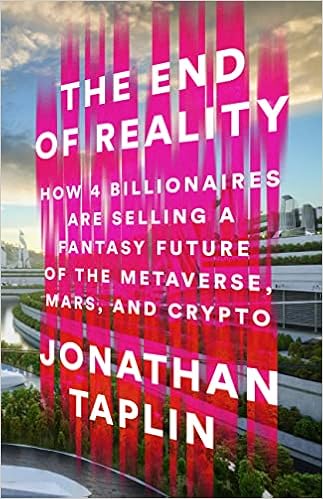 At a time when the crises of income inequality, climate, and democracy are compounding to create epic wealth disparity and the prospect of a second American civil war, four billionaires are hyping schemes that are designed to divert our attention away from issues that really matter. Each scheme—the metaverse, cryptocurrency, space travel, and transhumanism—is an existential threat in moral, political, and economic terms.
 After years on the financial world’s margins, crypto went mainstream in 2021. Giant investment funds were buying it, celebrities like Tom Brady and Justin Bieber endorsed it, and Washington bigwigs debated new regulations. It seemed like everyone knew someone who was bragging about their returns from Bitcoin, Ethereum, Dogecoin and other bizarrely named “digital assets.” FOMO spread: Was crypto the new path to financial freedom? Unspoken was that hardly anyone knew how it worked. To borrow a phrase from crypto parlance, the only thing that mattered was “number go up.”
 Artificial intelligence (AI) has impacted many industries around the world—banking and finance, pharmaceuticals, automotive, medical technology, manufacturing, and retail. But it has only just begun its odyssey toward cheaper, better, and faster predictions that drive strategic business decisions. When prediction is taken to the max, industries transform, and with such transformation comes disruption.