
Told as an unfolding detective story, WATER ALWAYS WINS by award-winning science journalist Erica Gies follows experts who are obsessed with water as they use close observation, historical research, ancient animal and human expertise and cutting-edge science to understand how water really works, why efforts to control it are failing and how to create more resilient water systems in the urgent race to mitigate the catastrophic effects of climate change.
WATER ALWAYS WINS:
Collaborating with Nature for a More Resilient Future
by Erica Gies
University of Chicago Press, 2022
 WATER ALWAYS WINS makes clear that we need to fundamentally rethink our relationship with water. We must embrace the reality that we are an integral part of nature and need learn to live in harmony with these forces that we cannot conquer. This requires humility, not arrogance; collaboration, not aggressive control and setting a goal, which is to determine what water wants and figure out a how to make way for it, while protecting and securing our lives. The overarching theme is that such a mindset is essential in all our dealings with every aspect of nature, if we want our planet to survive. As Erica Gies so beautifully states, water is life, it “flexes with the rhythms of the earth, expanding and retreating in an eternal dance upon the land.”
WATER ALWAYS WINS follows the scientists and engineers who are recovering this lost knowledge and also new understanding of water and then finding ways to let water be water, a kind of un-engineering that reclaims space for water to stall on the land for cleaning, capture, and storage – a “slow water” ethic with many of the same attributes as the slow food movement. WATER ALWAYS WINS takes us along on this great journey, from Peru, where scientists are restoring a 1,500-year-old aqueduct system created by a pre-Incan civilization to Chennai, India, where the technology of ancient Dravidian temple tanks is being introduced to control flooding to San Francisco, where urban planners are mapping the original “ghost” waterways under the city to find improved methods of water management. Animal researchers are studying the ways creatures from beavers (who built a continuous dam twice as long as the Hoover dam) to elephants naturally “engineer” water systems that renew and replenish the land.
This is a riveting and eye-opening “big idea” book that will do for water what The Hidden Life of Trees did for forests or what The Sixth Extinction did for animal genocide.
Erica Gies is the perfect person to write this book. She is an independent journalist who writes about water, climate policy, urban planning, plants and animals for Scientific American, Nature, The New York Times, The Guardian, National Geographic, The Economist, with a proven track record of bringing science alive for the general public. Erica has appeared on NPR’s Science Friday and they are eager to have her on when the book comes out. She holds a master’s degree in literature with a focus in eco-criticism, which brings a wide-angle, narrative lens to her science reporting.
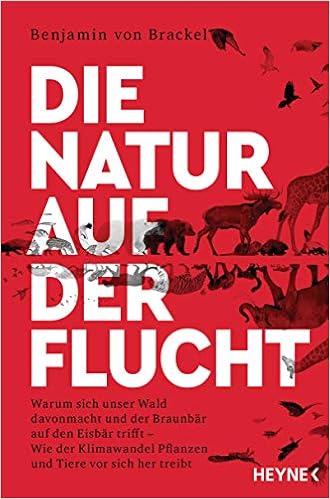 There is something afoot in the world of animals and plants, something which has so far caught too little attention. Wherever they can, animals and plants are moving towards the earth’s poles to flee from rising temperatures and drought in their natural habitats. Tropical zones lose their inhabitants, beavers are settling in Alaska, gigantic shoals of fish disappear just to reappear in front of foreign coastlines. Sea creatures move an average of 72 kilometres a year, land creatures an average of 17 kilometres. In this exciting and vivid book, Benjamin von Brackel describes a phenomenon which demonstrates nature’s impressive adaptability as well as the dramatic consequences of climate change – not the least for humankind, for the migration of species won’t leave us unaffected.
  Most of us do not give much thought to the centerpiece of our bathrooms, but the toilet is an unexpected paradox. On the one hand, it is a modern miracle: a ubiquitous fixture in a vast sanitation system that has helped add decades to human lifespan by reducing disease. On the other hand, the toilet is also a tragic failure: less than half of the world’s population can access a toilet that safely manages bodily waste, including many right here in the United States. And it is inefficient, squandering clean water as well as the nutrients and energy contained in the waste we flush away. While we see radical technological change in almost every other aspect of our lives, we remain stuck in a sanitation status quo—in part because the topic of toilets is taboo. Fortunately, there’s hope—and PIPE DREAMS daringly profiles the growing army of scientists, engineers, philanthropists, entrepreneurs, and activists worldwide who are overcoming their aversions and focusing their formidable skills on making toilets accessible and healthier for all. This potential revolution in sanitation has many benefits, including reducing inequalities, mitigating climate change and water scarcity, improving agriculture, and optimizing health. Author Chelsea Wald takes us on a wild world tour from a compost toilet project in Haiti, to a plant in the Netherlands that harvests used toilet paper from sewage, and shows us a bot that hangs out in manholes to estimate opioid use in a city, among many other fascinating developments. Much more than a glorified trash can, the toilet, Wald maintains, holds the power to help solve many of the world’s problems, if only we can harness it.
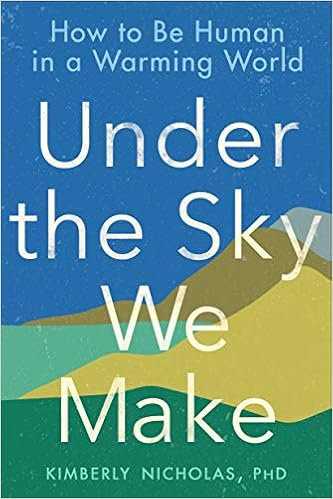 After speaking to the international public for close to fifteen years about sustainability, climate scientist Dr. Nicholas realized that concerned people were getting the wrong message about the climate crisis. Yes, companies and governments are hugely responsible for the mess we’re in. But individuals CAN effect real, significant, and lasting change to solve this problem. Nicholas explores finding purpose in a warming world, combining her scientific expertise and her lived, personal experience in a way that seems fresh and deeply urgent: Agonizing over the climate costs of visiting loved ones overseas, how to find low-carbon love on Tinder, and even exploring her complicated family legacy involving supermarket turkeys. In her astonishing book UNDER THE SKY WE MAKE, Nicholas does for climate science what Michael Pollan did more than a decade ago for the food on our plate: offering a hopeful, clear-eyed, and somehow also hilarious guide to effecting real change, starting in our own lives. Saving ourselves from climate apocalypse will require radical shifts within each of us, to effect real change in our society and culture. But it can be done. It requires, Dr. Nicholas argues, belief in our own agency and value, alongside a deep understanding that no one will ever hand us power—we’re going to have to seize it for ourselves.
 Dr. Kimberly Nicholas is Associate Professor of Sustainability Science at Lund, Sweden’s highest-ranked university. Born and raised on her family’s vineyard in Sonoma, California, she studied the effect of climate change on the California wine industry for her PhD in Environment and Resources at Stanford University. Since then, she has published over 50 articles on climate and sustainability in leading peer-reviewed journals, and her research has been featured in outlets including The New York Times, The Washington Post, The Atlantic, USA Today, Buzzfeed and more. She has also been profiled in Elle and The Guardian, and gives appearances at around 50 lectures each year, such as the recent Climate Change Leadership summit.
 Six days after giving birth, a polar bear named Aurora got up and left her den at the Columbus Zoo, leaving her tiny, squealing cub to fend for herself. Hours later, Aurora still hadn’t returned. The cub was furless and blind, and with her temperature dropping dangerously, the zookeepers entrusted with her care felt they had no choice: They would have to raise one of the most dangerous predators in the world themselves, by hand. Over the next few weeks, a group of veterinarians and zookeepers would work around the clock to save the cub, whom they called Nora. Humans rarely get as close to a polar bear as Nora’s keepers got with their fuzzy charge. But the two species have long been intertwined. Three decades before Nora’s birth, her father, Nanuq, was orphaned when an Inupiat hunter killed his mother, leaving Nanuq to be sent to a zoo. That hunter, Gene Agnaboogok, now faces some of the same threats as the wild bears near his Alaskan village of Wales, on the westernmost tip of the North American continent. As sea ice diminishes and temperatures creep up year-after-year, Gene and the polar bears—and everyone and everything else living in the far north—are being forced to adapt. Not all of them will succeed. Sweeping and tender, THE LONELIEST POLAR BEAR explores the fraught relationship humans have with the natural world, the exploitative and sinister causes of the environmental mess we find ourselves in, and how the fate of polar bears is not theirs alone.