
A gorgeous and moving graphic novel about one family’s struggle to survive in a concentration camp, and the persistence of art-making through the bleakest times.
ODE TO JOY
by Sarah Gavron & Sophie Herxheimer
Pushkin Press, May 2026
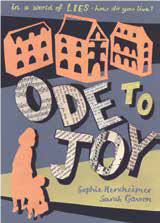 In 1943, Ib Katznelson was deported with the rest of his Jewish family to Terezín, also called Theresienstadt. Terezín was repurposed by the Nazis as a ‘show camp,’ a ghetto for the Jewish cultural elite, designed to deceive the prying Red Cross and conceal the horrifying truth behind Hitler’s death camps.
Ib didn’t speak about his experience for many years, but when he did, it was an incredible tale: in spite of the dreadful daily life of the camp, a rich cultural life proliferated. The incarcerated artists sustained their humanity by secretly continuing to make imaginative work that opposed the propaganda they were forced to produce for the ‘show camp’ by day. And, while many of these prisoners didn’t survive, much of their art does.
ODE TO JOY is a collaboration between Ib’s daughter-in-law, Sarah Gavron, and artist Sophie Herxheimer. Through stunning illustrations and text filled with pathos and peppered with wit, it blends the story of Ib and his parents and fellow prisoners along with that of his modern-day family, learning about the camp and their links to it for the first time.
Sarah Gavron is a British film director. Winner of a BAFTA and BIFA, among other awards, her films include Brick Lane, Suffragette, Village at the End of the World and Rocks.
Sophie Herxheimer is an artist and poet. Her work has been shown at Tate Modern, on a giant mural along the seafront at Margate and at her allotments! She has illustrated six collections of mythology and fairy tales. Her collection Velkom to Inklandt (2017) was a Sunday Times Book of the Year. Her book 60 Lovers to Make and Do (2019) was a TLS Book of the Year.
 After a decade of yearning for parenthood, years marked by miscarriage after miscarriage, Hala Alyan decides to use a surrogate. In this charged time, she turns to the archetype of the waiting woman—the Scheherazade who tells stories to ensure another dawn—to confront her own narratives of motherhood, love, and inheritance. As her baby grows in the body of another woman, in another country, Hala finds her own life unraveling—a husband who wants to leave; the cost of past traumas and addictions threatening to resurface; the city of her youth, Beirut, on the brink of crisis. She turns to family stories and communal myths: of grandmothers mapping their lives through Palestine, Kuwait, Syria, Lebanon; of eradicated villages and invading armies; of places of refuge that proved only temporary; of men that left and women that stayed; of the contradictions of her own Midwestern childhood, and adolescence in various Arab cities. Hala gathers the stories that are her legacy, which makes for emotionally charged, painstaking work, but now the stakes are higher: how to honor ancestors and future generations alike in the midst of displacement? How to impart love for those who are no longer here, for places one can no longer touch?
 In 2018, Noraly Schoenmaker was a thirty-something geologist living in the Netherlands when she learned that her live-in partner had been having a long-term affair. Suddenly without a place to stay, she quit her job, sold her house, and flew to India, planning to spend a year exploring before returning home. But an excursion on a rented motorcycle through the Himalayas changed her life forever—she had found a new obsession. Soon, she decided to purchase a motorcycle and a GoPro, and set off on more unconventional adventures.