
At once an insider account of the historic restoration and a celebration of craft and what the act of making and building reveals about being human in our modern world. For readers of Patrick Hutchison’s Cabin (St. Martin’s Press), Callum Robinson’s Ingrained (Ecco), and Matthew B. Crawford’s Shop Class as Soulcraft (Penguin).
THE CARPENTER AND THE CATHEDRAL:
The Meaning of Craft and the Reconstruction of Notre-Dame de Paris
by Hank Silver
Viking, Spring 2028
(via DeFiore and Company)
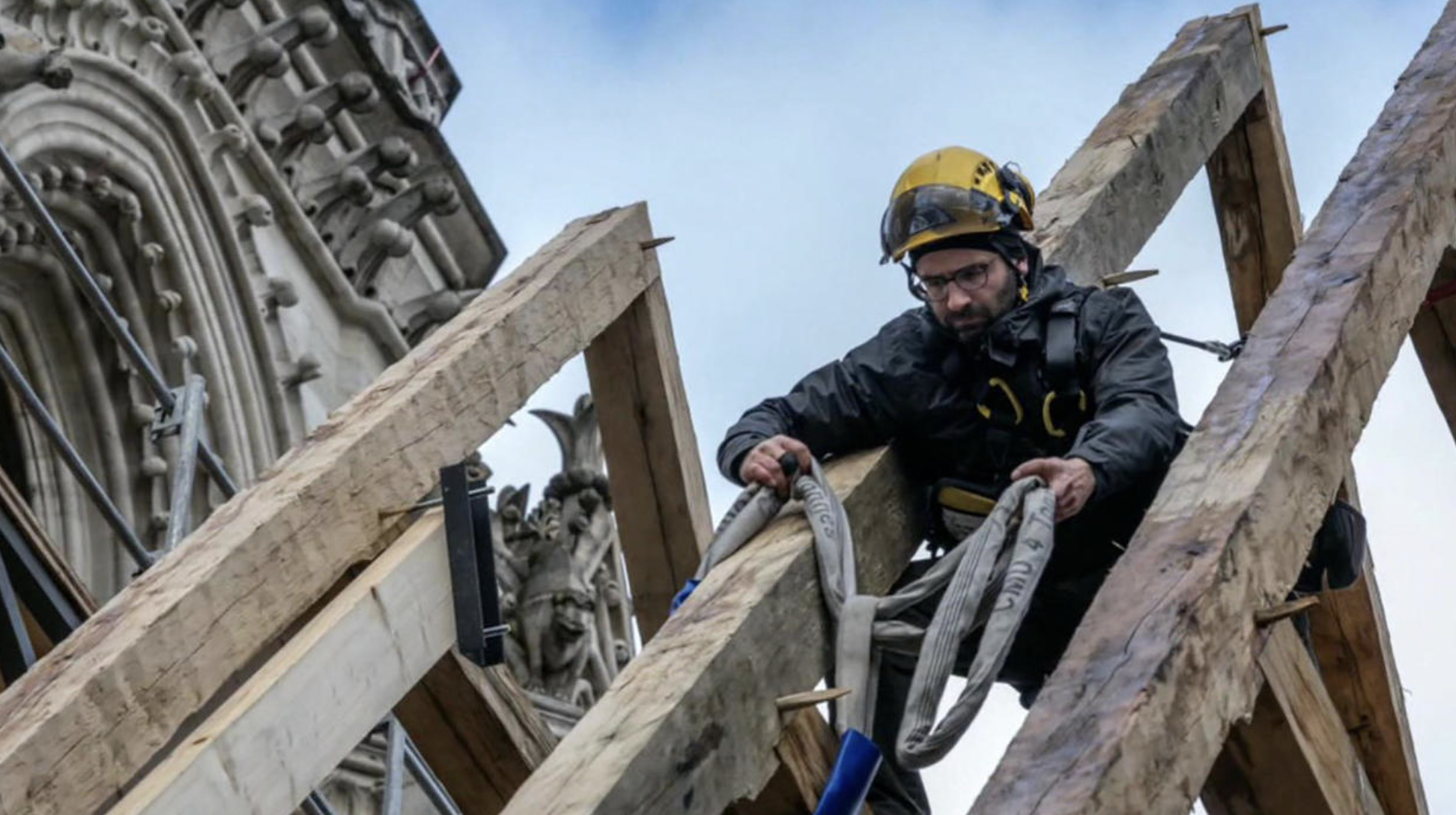
Six hundred logs. When American carpenter Hank Silver arrived at a workshop in Normandy, he was surrounded by heaping piles of oak logs. His small, international team’s task was to hew all them by hand, using reproductions of medieval axes, into more than a thousand individual beams, then lay out and cut fifty-seven roof trusses and framing that would become the nave of the Notre-Dame de Paris. They had just eight months.
When fire engulfed the iconic Notre-Dame Cathedral on April 15, 2019, few believed it could be restored to its former glory using the original materials and methods of the thirteenth century. But thanks to a small group of traditional craftsman, the restoration was indeed possible. THE CARPENTER AND THE CATHEDRAL: The Meaning of Craft and the Reconstruction of Notre-Dame de Paris, is Silver’s behind-the-scenes account of one of the most significant architectural restorations of all time. But it is so much more.
Hank Silver was the only American who worked on site at the cathedral, and his path to Notre-Dame was anything but traditional. Born and raised in an observant Jewish family in New York City, he came to carpentry in college when he happened upon a stash of woodworking books at his grandmother’s house. After graduating, he pursued carpentry and learned traditional timber framing—and what it means to work with one’s hands and with centuries-old tools that have been worn smooth by countless hands before. In captivating prose, he reflects on the connection between the maker and the materials, between craftsmanship and what endures.
For readers of Patrick Hutchison’s Cabin (St. Martin’s Press), Callum Robinson’s Ingrained (Ecco), and Matthew B. Crawford’s Shop Class as Soulcraft (Penguin), THE CARPENTER AND THE CATHEDRAL is at once an insider account of the historic restoration and a celebration of craft and what the act of making and building reveals about being human in our modern world.
 Hank Silver is a master carpenter and the founder of Ironwood Timberworks. He built custom timber frame structures throughout New England for more than 10 years. Since 2018, he has been a member of the volunteer crew Carpenters Without Borders, whose mission is the restoration of world carpentry heritage and the transmission of traditional skills and techniques to future generations of craftspeople. Silver has been featured in two documentaries and was awarded the Institute of Classical Architecture & Art’s 2025 Arthur Ross Award in Artisanship & Craftsmanship. He has been featured in The New York Times, National Geographic, and GQ and on CBS News, NBC’s Weekend Nightly News, and Good Day New York. This is his first book.
 The first time Sonita was put up for sale, she was 10 years old and she thought that she was participating in a dress-up game. She quickly realized that, in her culture, a wedding is a kind of funeral for the bride. Sonita says, “It represents the loss of a future. The loss of a voice.” After the marriage fell through, she was placed on sale again. She was expected to form a family, sleep with a man she never met, and then repeat the terrible cycle with her own children. But Sonita wanted more.
 In the thick of winter 2020, when so many books were buried beneath the catastrophe of the COVID-19 news cycle, one unlikely debut seemed to cut through the noise. Jamie Hood’s How to Be a Good Girl was an inventive and hybrid work of self-making, mingling diary entries, poetry, literary criticism, and love letters to interrogate the archetype of the “good girl,” and the ideas of femininity, passivity, desire, and trauma that come with it. Journeying from the ice age to our modern-day climate crisis, it devoured texts as expansive as Levinas and Plath to the Ronettes and after-school specials, all the while asking: what pound of flesh must a woman pay to be seen as “good.”
 Follow 20 recipes to find calm, improve self-esteem, and form daily habits—in your very own kitchen!—through mindfulness-based cooking therapy.