
From an acclaimed environmental writer, a groundbreaking and provocative new vision for our relationships with—and responsibilities toward—the planet’s wild animals.
WILD SOULS: Freedom and Flourishing in the Non-Human World
by Emma Marris
Bloomsbury, June 2021

Protecting wild animals and preserving the environment are two ideals so seemingly compatible as to be almost inseparable. But in fact, between animal welfare and conservation science there exists a space of underexamined and unresolved tension: wildness itself. When is it right to capture or feed wild animals for the good of their species? How do we balance the rights of introduced species with those already established within an ecosystem? Can hunting be ecological? Are any animals truly wild on a planet that humans have so thoroughly changed? No clear guidelines yet exist to help us resolve such questions.
Transporting readers into the field with scientists tackling these profound challenges, Emma Marris tells the affecting and inspiring stories of animals around the globe-from Peruvian monkeys to Australian bilbies, rare Hawai’ian birds to majestic Oregon wolves. And she offers a companionable tour of the philosophical ideas that may steer our search for sustainability and justice in the non-human world. Revealing just how intertwined animal life and human life really are, WILD SOULS will change the way we think about nature—and our place within it.
Emma Marris is an award-winning journalist based in Oregon. She writes for The Atlantic, The New York Times, National Geographic and Outside Magazine, among many others. Her work has appeared in the “Best America Science Writing 2016” and won an award from the National Association of Science Writers for an essay about wilderness in Orion. She is best known for her previous book, Rambunctious Garden (Bloomsbury, 2011) and subsequent TED Talk urging the importance of letting children experience the outdoors.
 Throughout history, new technologies have disrupted our capacity to make sense of the world, from the printing press to the telegraph, from radio to television. OUTRAGE MACHINE explores the serious recent disruption caused by social media, and how it has triggered an urgent society-wide crisis of trust. Drawing from deep historical context, as well as cutting-edge research, author, designer, and media researcher Tobias Rose-Stockwell shows how social media has bound us to an unprecedented outrage machine, training us to react rather than reflect, and attack rather than debate.
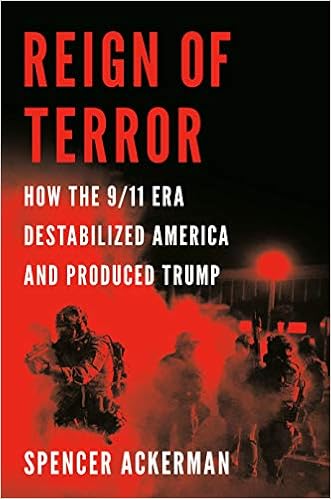 For an entire generation, at home and abroad, the United States has waged an endless conflict known as the War on Terror. In addition to multiple ground wars, it has pioneered drone strikes and industrial-scale digital surveillance, as well as detaining people indefinitely and torturing them. These conflicts have yielded neither peace nor victory, but they have transformed America. What began as the persecution of Muslims and immigrants has become a normalized, paranoid feature of American politics and security, expanding the possibilities for applying similar or worse measures against other targets at home. A politically divided country turned the War on Terror into a cultural and then tribal struggle, first on the ideological fringes and ultimately expanding to conquer the Republican Party, often with the timid acquiescence of the Democratic Party. Today’s nativist resurgence walked through a door opened by the 9/11 era.
 These new and collected essays from the acclaimed naturalist Barry Lopez—his final undertaking—represent the culmination of a lifetime’s thought in service of our relationship with wilderness, and with each other. Here, his collected essays offer a unifying vision; his drive to reconnect the cultural and the natural is unflinching, and major, never-published pieces offer profound commentary on topics that veer from the autobiographical—his abuse as a child—to the evolution of his views on the untamed. His classic prose, like the arctic landscape he elegized, remains as ever: “spare, balanced, extended…” It has been said that Barry Lopez understood what we gain when we accept the enormity of what we don’t know; these essays hinge on that tantalizing concept.
 Raquel Willis is a powerful woman. But growing up as a young boy in the South made being herself almost impossible. In this moving and provocative memoir, Raquel relives the many risks she faced in her struggle to become a fierce advocate for her community—and the powerful woman—that she is today. Today, she is known as a transgender trailblazer, both for work with the Transgender Law Center and speaker at the National Women’s March. She offers intimate reflections on masculinity and blackness, informed by a tumultuous relationship with her father. From a childhood built in opposition to expectations, all the way through her transition at a flagship Southern university, Raquel demonstrates that her story is but one thread in the larger tapestry of Black trans American life; a tapestry that has never truly been chronicled from this millennial, Southern perspective.